ToolMage
Sign in

Best 1 Inspiration AI tools for Education

Popular Inspiration AI tools in Education include Stories by AI, helping you work more efficiently.

Stories by AI
Free

Stories by AI

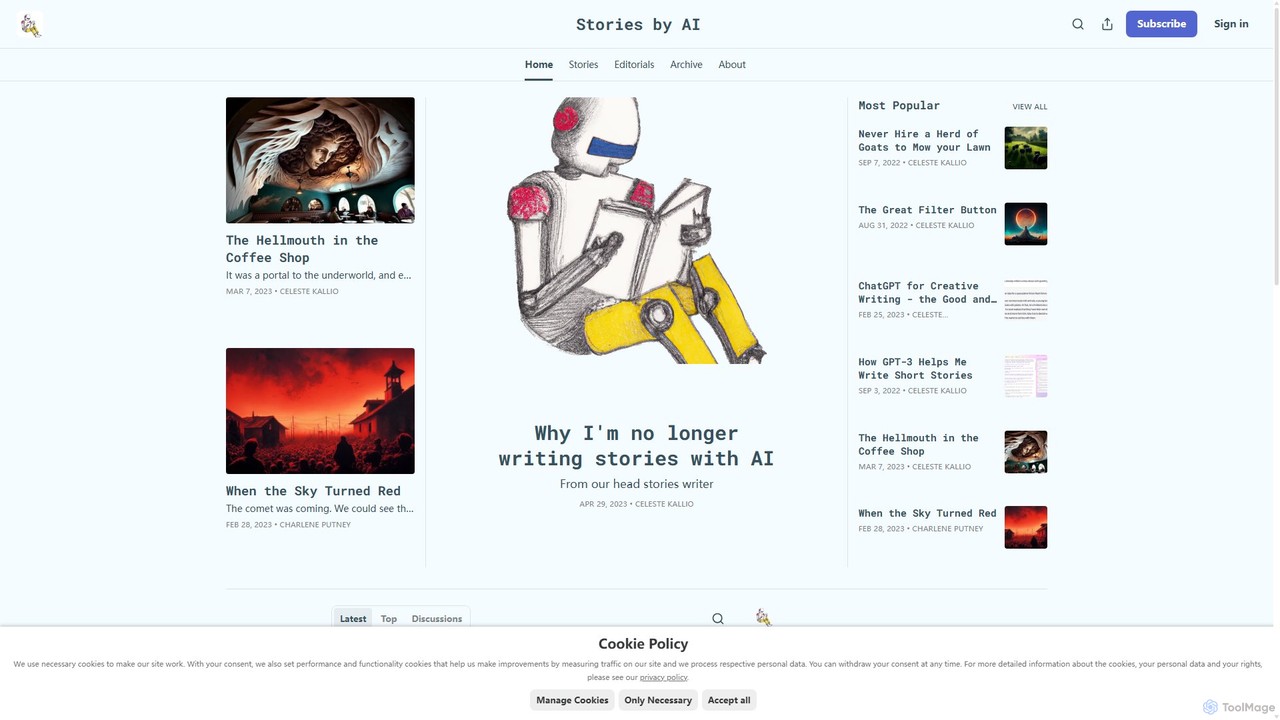
Stories by AI is a pioneering publication and creative project showcasing short stories, illustrations, and narrations co-created with artificial intelligence. It serves as an archive and inspirational resource for writers, artists, and AI enthusiasts, exploring the intersection of human creativity and generative AI tools.

Storytelling
Visits 9KFavorites 122Likes 133

About Inspiration

AI Inspiration tools are a specialized category of educational software designed to generate novel ideas, creative prompts, and conceptual starting points. They leverage large language models and generative algorithms to analyze user inputs, such as keywords or themes, and produce a wide range of related concepts, questions, and analogies. These tools are valuable for overcoming creative blocks in academic and artistic projects, helping students, educators, and researchers explore topics from new perspectives. They function as a digital muse, transforming a blank page into a canvas of possibilities.

Core Features

  • Concept Generation: Produces unique ideas, topics, and theses based on simple text prompts.
  • Creative Prompting: Delivers specific questions, scenarios, or "what if" statements to spark imagination.
  • Mind Map Expansion: Suggests related sub-topics and connections to build out a central idea.
  • Analogy and Metaphor Creation: Generates novel comparisons to explain complex subjects in an intuitive way.
  • Style Emulation: Provides ideas framed in different writing styles, from academic to narrative.

Use Cases

These tools are widely used in academic settings. Students use them for brainstorming essay topics and research questions, while educators leverage them to design engaging lesson plans and creative assignments. Researchers also find them useful for formulating new hypotheses or exploring interdisciplinary connections.

How to Choose

When selecting an AI Inspiration tool, consider the type of output it generates (e.g., text, mind maps, images). Evaluate the level of control you have over the generation process, such as adjusting creativity levels. Also, check for integration with other writing or research tools and consider the pricing model, especially if you need collaborative features.

Inspiration use cases

1

Brainstorming University Essay Topics

A university student is tasked with writing a 5,000-word paper on 'The impact of the printing press.' Feeling stuck, they input the core theme into an AI Inspiration tool. The tool generates a list of unique angles, such as 'The printing press's role in standardizing languages,' 'Economic effects on manuscript scribes,' and 'A counter-factual analysis: a world without movable type.' This provides multiple, specific research paths, helping the student select a compelling and original thesis, saving hours of preliminary research and indecision.

2

Developing Creative Lesson Plans

A high school physics teacher wants to make the topic of 'thermodynamics' more engaging. They use an AI Inspiration tool, asking for creative analogies. The AI suggests comparing the laws of thermodynamics to managing a busy kitchen, social energy in a friend group, or even the plot of a fantasy novel. These novel metaphors provide the foundation for a more relatable and memorable lesson, increasing student participation and understanding of abstract concepts.

3

Generating Research Hypotheses

A PhD candidate in sociology is exploring the link between social media and community engagement. Using an AI Inspiration tool, they input keywords like 'digital communities,' 'political polarization,' and 'local activism.' The tool generates several 'what if' questions and potential correlations, such as 'Does the gamification of local news apps increase real-world civic participation?' This helps the researcher formulate a testable hypothesis that is both specific and innovative, forming the core of their dissertation proposal.

4

Creating Unique Art Project Concepts

An art student needs a concept for their final project on the theme of 'memory.' They use a multimodal AI Inspiration tool, inputting the word and a picture of an old family photograph. The AI generates textual and visual prompts, like 'a sculpture made of dissolving materials,' 'a digital animation where pixels decay over time,' or 'a series of paintings based on AI-generated 'false memories'.' This sparks a unique direction that combines traditional and digital media, moving beyond conventional interpretations.

5

Overcoming Writer's Block in Fiction

A creative writing student is stuck in the middle of a short story. They describe their character and the last scene to an AI Inspiration tool and ask for plot twists. The tool suggests several possibilities: 'The character discovers their trusted mentor is the antagonist,' 'A seemingly insignificant object from Chapter 1 becomes the key to solving the conflict,' or 'The setting itself is revealed to be an illusion.' These prompts help the writer break through their block and add a new layer of complexity to their narrative.

6

Formulating Nuanced Debate Topics

A debate club coach needs fresh topics for an upcoming tournament. Instead of using standard prompts, they ask an AI Inspiration tool to generate topics that require ethical and philosophical reasoning. The tool produces prompts like: 'Should AI be granted creative rights for the art it generates?' or 'In an era of perfect genetic prediction, should individuals have the right *not* to know their future health risks?' These sophisticated topics challenge students to think critically and move beyond simple pro/con arguments.

Inspiration FAQ

What are AI Inspiration tools?

AI Inspiration tools are applications designed to help users generate new ideas and overcome creative blocks, particularly in educational and creative contexts. Unlike search engines that retrieve existing information, these tools use generative AI to create novel concepts, prompts, questions, and connections based on user input. They are ideal for brainstorming topics for essays, research projects, lesson plans, or artistic works.

How do I choose the right AI Inspiration tool for my studies?

To choose the right tool, consider four main factors:

  • Output Format: Do you need text-based ideas, visual mind maps, or conceptual images?
  • Customization: Can you adjust parameters like creativity, tone, or style to refine the suggestions?
  • Field Specificity: Some tools are general, while others might be tailored for specific fields like creative writing, scientific research, or visual arts.
  • Integration: Does it connect with your existing workflow, such as exporting to a word processor or note-taking app?
What's the difference between an AI Inspiration tool and a standard search engine?

The key difference lies in their purpose: creation versus retrieval. A search engine finds and presents existing information from the web based on your query. An AI Inspiration tool, however, synthesizes information and generates entirely new ideas, connections, or perspectives that may not exist anywhere else. A search engine answers 'What is known?', while an inspiration tool helps answer 'What could be imagined?'.

Who can benefit from using AI Inspiration tools in education?

A wide range of users in the educational ecosystem can benefit. Students use them to find unique essay topics and understand complex subjects through new analogies. Teachers and professors use them to create engaging lesson plans and assignments. Researchers can formulate novel hypotheses, and creative professionals in training (like writers and artists) use them to break through creative blocks and explore new conceptual territories.

Can AI Inspiration tools help with non-textual ideas, like for art or music?

Yes, many modern AI Inspiration tools are multimodal. They can generate visual concepts, color palettes, and stylistic suggestions for artists and designers based on textual descriptions. For musicians, some tools can suggest chord progressions, melodic fragments, or rhythmic patterns. The key is to find a tool specifically designed for the creative domain you are working in, as their underlying models are trained on different types of data.