Education Best in category 1 results Investing AI Tool

Popular AI tools in the Investing field of Education include memecoinseason, etc., helping you quickly improve efficiency.

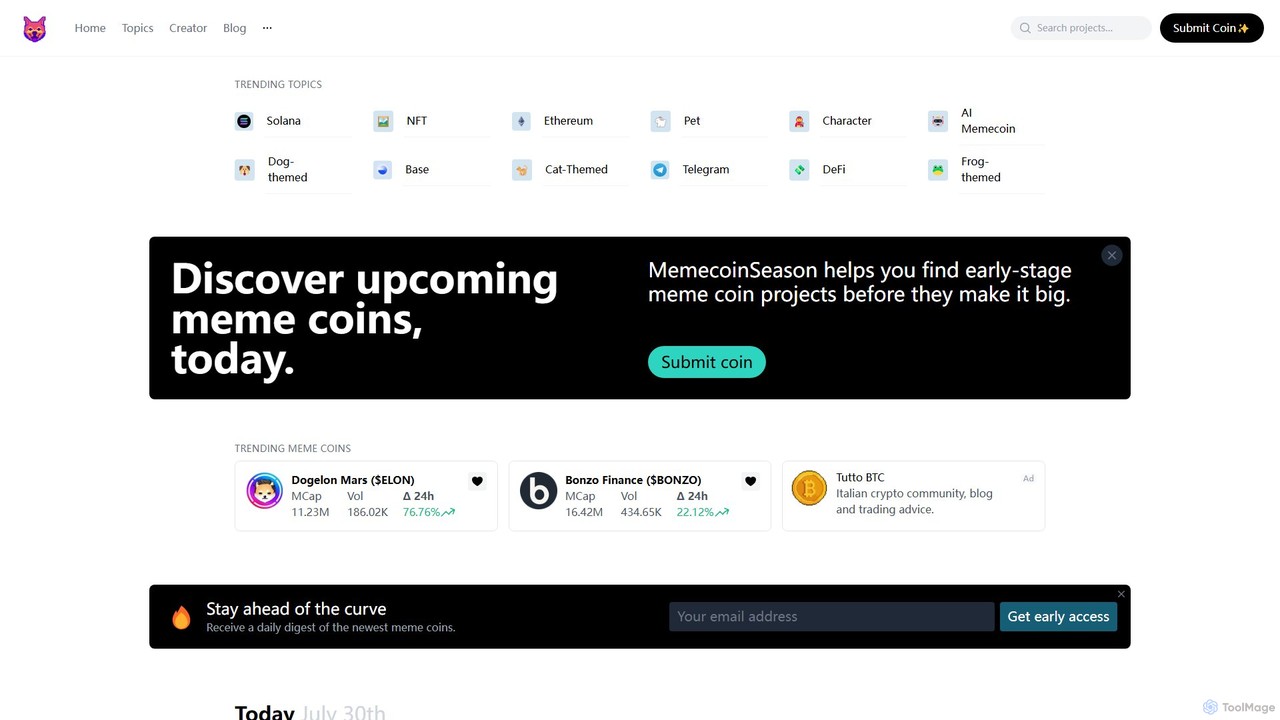
memecoinseason

memecoinseason

A discovery platform for early-stage meme coins and presales. Memecoinseason helps crypto enthusiasts and investors find promising microcap …

2.9K

About Investing

AI Investing tools are a class of educational software that use artificial intelligence to help users learn, analyze, and simulate investment strategies. These tools leverage machine learning models to process vast amounts of market data, identify patterns, and forecast potential outcomes in a risk-free environment. They are designed to empower both novice and experienced individuals to test financial hypotheses, understand market dynamics, and refine their decision-making skills. Unlike automated trading bots, their primary focus is on education and analytical support rather than direct capital execution.

Core Features

  • Market Simulation & Backtesting: Test investment strategies against historical data to evaluate performance and risk.
  • Data-Driven Analysis: Aggregate and interpret news, financial reports, and market sentiment to provide actionable insights.
  • Portfolio Optimization: Recommend asset allocations based on user-defined goals, risk tolerance, and time horizons.
  • Predictive Modeling: Use AI to forecast potential market trends and asset price movements based on various data points.
  • Risk Assessment: Identify and quantify potential risks within a portfolio, modeling scenarios like market downturns.

Use Cases

These tools are widely used by finance students for practical learning, individual retail investors for developing strategies without real-world risk, and financial analysts for testing complex models. They serve as a powerful educational bridge, connecting theoretical financial knowledge with practical application in simulated market conditions.

How to Choose

When selecting an AI Investing tool, consider the quality and breadth of its data sources (e.g., real-time vs. delayed data), the range of assets available for analysis (stocks, crypto, forex), the sophistication of its simulation engine, and the depth of its educational resources. Also, evaluate the user interface to ensure it matches your level of expertise.

InvestingUse Cases

1

Simulating a First Stock Portfolio for Beginners

A finance student uses an AI investing tool to build their first virtual portfolio. They input a starting capital of $10,000 and select several well-known tech stocks. The AI provides instant feedback on the portfolio's diversification score, highlighting concentration risk. It then simulates the portfolio's performance over the past five years, showing how it would have fared during different market conditions and providing educational pop-ups explaining key events, helping the student learn practical portfolio management principles.

2

Backtesting a Trading Strategy with Historical Data

An experienced retail investor develops a new trading strategy based on moving average crossovers. Before risking real money, they use an AI tool to backtest it. They define the exact entry and exit rules within the tool's interface and run the simulation against 10 years of historical data for the S&P 500. The AI generates a detailed report showing total return, maximum drawdown, and a Sharpe ratio, allowing the investor to objectively assess the strategy's viability and make data-driven adjustments.

3

AI-Powered Stock Screening and Fundamental Analysis

A financial analyst is tasked with finding undervalued small-cap stocks. Instead of manually sifting through hundreds of financial statements, they use an AI tool. They set up a screen with criteria like P/E ratio below 15, revenue growth above 20%, and positive cash flow. The AI scans the market in seconds and returns a list of 20 companies. For each company, the tool also provides an AI-generated summary of its latest earnings report and a sentiment analysis score based on recent news, accelerating the research process significantly.

4

Understanding Market Sentiment for Event-Driven Investing

An investor specializing in event-driven strategies uses an AI tool to monitor sentiment around a pharmaceutical company awaiting FDA approval for a new drug. The tool aggregates and analyzes thousands of news articles, social media posts, and medical forum discussions in real-time. It presents a sentiment trend chart, which shows a significant positive shift in expert opinions. This data-driven insight gives the investor higher conviction to take a position before the official announcement, complementing their traditional research.

5

Optimizing a Retirement Portfolio for Risk Tolerance

An individual nearing retirement uses an AI investing tool to review their 401(k) allocation. They complete a questionnaire within the tool to define their risk tolerance as 'conservative'. The AI analyzes their current holdings and determines they are over-exposed to volatile tech stocks. It then suggests a rebalanced portfolio with a higher allocation to bonds and dividend-paying blue-chip stocks, providing a side-by-side comparison of projected returns and potential drawdowns for both the current and suggested portfolios, empowering an informed decision.

6

Learning Advanced Financial Concepts Interactively

A user new to derivatives wants to understand options trading. They use an AI tool's educational module. The module first provides a simple explanation of call and put options. Then, it launches an interactive simulator where the user can buy and sell virtual options on a real stock like AAPL. The tool visualizes the profit/loss potential of their positions in real-time as the underlying stock price changes, providing a hands-on, intuitive way to grasp complex concepts like time decay and implied volatility.

InvestingFrequently Asked Questions