LEADx
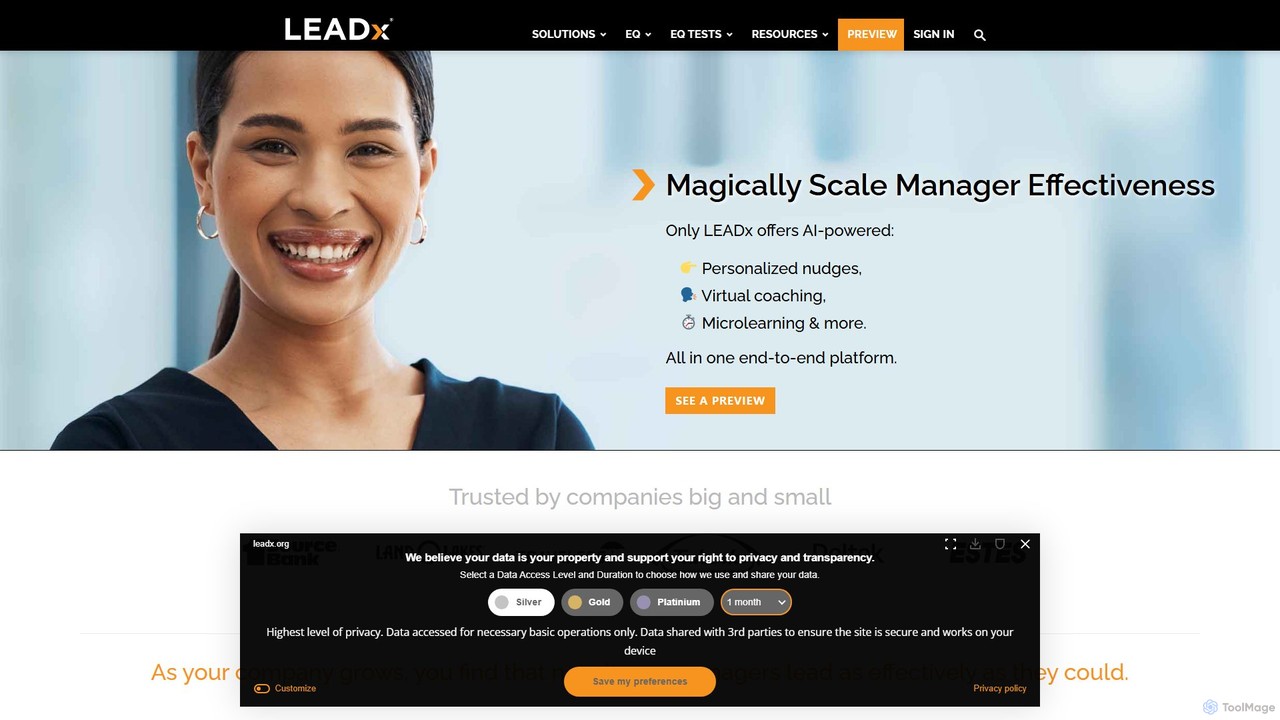
LEADx is an AI-powered leadership development platform designed to scale personalized coaching for managers. Featuring an AI coach …
LEADx is an AI-powered leadership development platform designed to scale personalized coaching for managers. Featuring an AI coach named Amanda, it helps new and experienced leaders master essential skills, improve emotional intelligence (EQ), and drive team engagement and performance.
About Leadership
AI Leadership tools are a specialized category of educational software designed to cultivate and assess management and executive skills. These platforms leverage AI-driven simulations, personalized feedback systems, and data analytics to create immersive learning experiences. They enable current and aspiring leaders to practice complex decision-making, communication, and strategic planning in a risk-free, controlled environment. By analyzing user performance, these tools provide objective insights into strengths and weaknesses, accelerating professional growth.
Core Features
- Scenario Simulation: Engage in realistic, AI-powered business scenarios to practice decision-making under pressure.
- Personalized Feedback: Receive instant, data-driven analysis of your communication style, choices, and leadership patterns.
- Skill Gap Analysis: Identify and track specific leadership competencies, such as strategic thinking or conflict resolution, based on performance data.
- Behavioral Analytics: Gain insights into your inherent leadership style and its impact on team dynamics and outcomes.
Use Cases
These tools are widely used in corporate learning and development (L&D) departments for manager training, by business schools to supplement MBA curricula, and by executive coaches to provide data-backed guidance. They are particularly effective for onboarding new managers, developing high-potential employees, and refining the strategic acumen of senior leadership.
How to Choose
When selecting an AI Leadership tool, consider the relevance and depth of its simulation library to your industry. Evaluate the quality and actionability of the AI-generated feedback. Check for integration capabilities with your existing Learning Management System (LMS) and assess its scalability for individual or enterprise-wide deployment. Finally, review the data privacy and security policies.
LeadershipUse Cases
Onboarding and Training New Managers
An HR department uses an AI leadership platform to onboard newly promoted managers. Instead of relying solely on theoretical workshops, new managers engage in simulations that mimic common challenges, such as resolving team conflicts, managing budgets, and giving difficult feedback. The AI provides immediate, private feedback on their approach, highlighting effective strategies and areas for improvement. This accelerates their transition into the new role and builds confidence by allowing them to practice in a safe environment before facing real-world situations.
Developing Executive Strategic Thinking
A senior executive team uses an advanced AI simulation to prepare for a major market expansion. The tool models complex market dynamics, competitor reactions, and internal resource constraints. Executives can test various strategic approaches and see the projected long-term outcomes based on AI analysis. This process helps them identify potential risks, refine their strategy, and align the team around a data-informed plan, significantly improving the quality of high-stakes decision-making.
Enhancing Business School Curricula
A university's MBA program integrates an AI leadership tool into its core strategy course. Students form teams to run virtual companies, competing against each other and AI-controlled entities. They make decisions on pricing, marketing, and R&D, with the AI simulating the market's response. This hands-on experience bridges the gap between academic theory and practical application, providing students with a dynamic understanding of how leadership decisions impact business performance.
Personalized Coaching for Team Leads
A mid-level team lead works with an AI-powered coaching tool to improve their interpersonal skills. The platform offers simulated one-on-one conversations with virtual team members exhibiting different personalities and performance issues. The team lead practices their communication, motivation, and delegation techniques. The AI analyzes their word choice, tone, and response timing, offering specific suggestions to foster a more positive and productive team environment.
Identifying High-Potential Employees
A large corporation uses an AI leadership assessment tool for its succession planning process. High-potential employees are invited to complete a series of challenging leadership simulations. The platform objectively measures and benchmarks their performance across key competencies like problem-solving, emotional intelligence, and adaptability. This data provides the talent management team with unbiased insights, helping them identify the most promising future leaders for targeted development programs.
Self-Paced Skill Development for Aspiring Leaders
An individual professional aiming for a management role uses a mobile AI leadership app for personal growth. After an initial assessment identifies their skill gaps, the app creates a personalized learning journey with daily micro-lessons, short simulations, and quizzes. They can practice skills like negotiation or public speaking on their own schedule, receiving instant feedback and tracking their progress over time, making leadership development accessible and continuous.