Education Best in category 1 results Math Helper AI Tool

Popular AI tools in the Math Helper field of Education include Bytelearn, etc., helping you quickly improve efficiency.

Bytelearn

Bytelearn

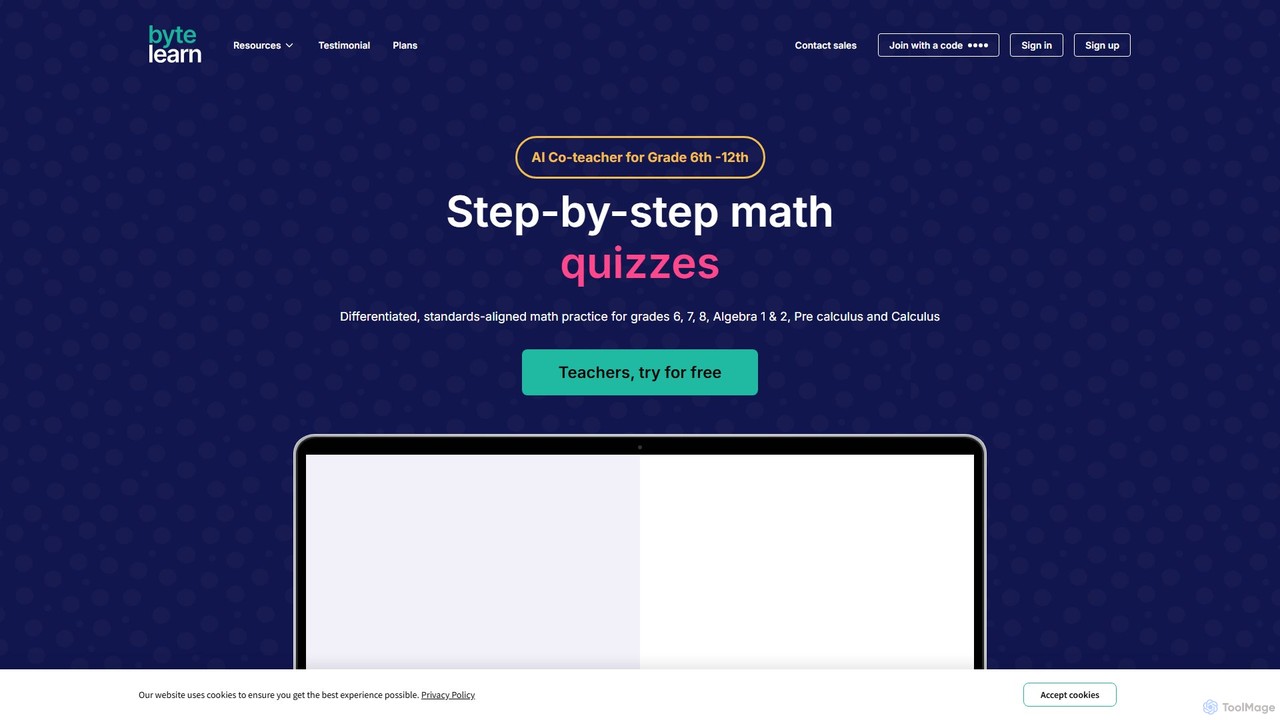
Bytelearn is an AI-powered math tutor and teaching assistant designed for middle and high school students (Grades 6-Algebra …

2.7K

About Math Helper

Math Helper tools are specialized applications that use artificial intelligence to solve a wide range of mathematical problems. Leveraging technologies like Optical Character Recognition (OCR) to interpret equations from images and Natural Language Processing (NLP) for word problems, these tools provide not just final answers but detailed, step-by-step explanations. They function as interactive tutors, helping users understand complex concepts, visualize functions, and build problem-solving skills. This makes them a valuable resource within the broader Education category for students, teachers, and professionals.

Core Features

  • Step-by-Step Solutions: Breaks down complex problems into easy-to-understand stages, showing the logic behind the answer.
  • Photo Problem Recognition: Allows users to snap a picture of a handwritten or printed problem to get an instant solution.
  • Interactive Graphing: Visualizes equations and functions in 2D or 3D, allowing for dynamic exploration of mathematical concepts.
  • Word Problem Solver: Analyzes and solves text-based problems by converting them into mathematical expressions.
  • Scientific Calculator: Includes advanced functions for calculus, algebra, trigonometry, and other higher-level mathematics.

Use Cases

These tools are widely used by students from middle school to university for homework assistance and exam preparation. Educators utilize them to create lesson plans, demonstrate problem-solving methods, and provide supplementary learning aids. Parents also find them helpful for supporting their children's studies, while professionals in STEM fields use them for quick calculation verification.

How to Choose

When selecting a Math Helper, consider the breadth of subjects it covers, from basic arithmetic to advanced calculus. Evaluate its input methods—photo, handwriting, or keyboard—for convenience. The quality and clarity of the step-by-step explanations are critical for learning. Finally, assess its platform availability (mobile app vs. web) and whether it offers additional features like practice problems or concept libraries.

Math HelperUse Cases

1

Solving Complex Homework Problems

A high school student preparing for a calculus exam is stuck on a difficult integration problem. Instead of spending hours frustrated, they use a Math Helper app. They take a photo of the problem in their textbook. The AI instantly recognizes the equation and provides not only the final answer but also a complete, step-by-step derivation. The student can review each step, understand the application of integration rules, and even view a graph of the function to better grasp the concept, turning a point of confusion into a valuable learning opportunity.

2

Visualizing Functions for Deeper Understanding

A university engineering student is studying signal processing and needs to understand the behavior of a complex trigonometric function. By inputting the equation into a Math Helper with interactive graphing capabilities, they can instantly generate a 2D plot. They can then adjust parameters, zoom in on specific intervals, and see how changes affect the waveform in real-time. This dynamic visualization provides an intuitive understanding that static textbook diagrams cannot offer, solidifying their comprehension of the underlying mathematical principles.

3

Quick Calculation Verification for Professionals

An engineer is working on a structural analysis that involves a series of complex differential equations. To ensure accuracy and prevent costly errors, they use an AI Math Helper to double-check their manual calculations. They can quickly input the equations and compare the AI-generated result with their own. This process serves as a rapid and reliable verification method, saving significant time compared to re-deriving the solution by hand or consulting a colleague, thereby increasing confidence and efficiency in their workflow.

4

Assisting Parents with Children's Homework

A parent is helping their middle school child with an algebra word problem but is unsure of the correct method to set up the equations. Using a Math Helper, they can type in the word problem. The tool's NLP capabilities interpret the text and translate it into a system of equations, then solve it step-by-step. This not only helps the child find the answer but, more importantly, empowers the parent to confidently guide their child through the problem-solving process, reinforcing learning for both.

5

Generating Practice Problems for Exam Prep

A college student is preparing for their final exams in linear algebra. To test their knowledge, they use an AI Math Helper that can generate practice problems. They can specify the topic, such as 'matrix inversion' or 'eigenvalue calculations', and the desired difficulty level. The tool then creates a unique set of questions with detailed solutions. This allows for targeted, self-paced practice, helping the student identify areas of weakness and build confidence before the actual exam, going beyond what a static question bank can offer.

6

Creating Dynamic Teaching Materials

A math teacher wants to create an engaging presentation on parabolic equations. Using a Math Helper, they can input a base equation and then use an interactive graph to demonstrate concepts visually. In class, they can modify coefficients in real-time to show students how the parabola shifts, widens, or narrows. They can also use the tool to instantly solve example problems suggested by students. This transforms a static lesson into an interactive and dynamic session, making abstract concepts more tangible and easier for students to understand.

Math HelperFrequently Asked Questions