
Vrain
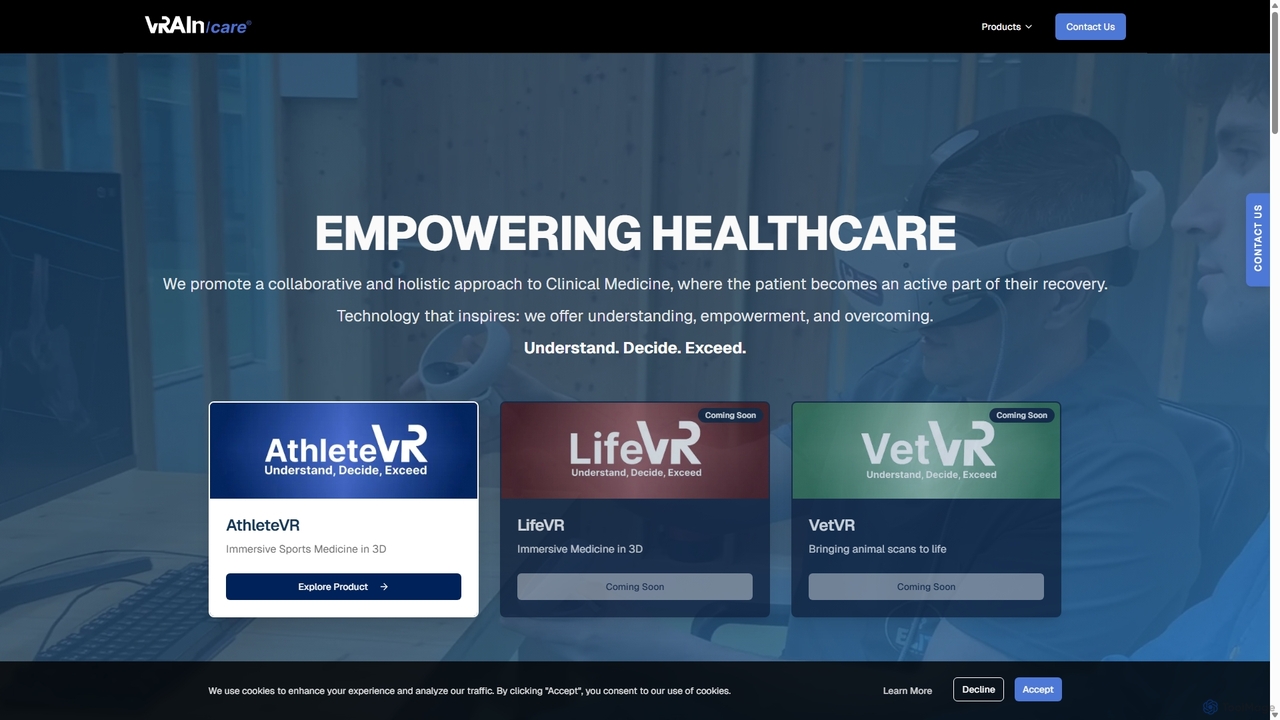
Vrain is an AI-powered bioimaging platform that uses VR, AR, and XR to transform 2D medical scans into …
Vrain is an AI-powered bioimaging platform that uses VR, AR, and XR to transform 2D medical scans into immersive 3D models. It enhances diagnosis, surgical planning, and medical training for professionals in oncology, neurology, and cardiology, aiming to improve patient outcomes through faster, more accurate insights.
About Medical Training
AI Medical Training tools are specialized platforms that use artificial intelligence to create realistic, interactive learning experiences for healthcare professionals. These tools leverage technologies like virtual reality (VR), advanced simulation algorithms, and natural language processing to replicate complex clinical scenarios. They provide a safe, controlled environment for students and practitioners to develop surgical skills, diagnostic reasoning, and patient communication abilities without risking patient safety. This approach allows for standardized assessment and personalized feedback, accelerating the learning curve in the demanding field of medicine.
Core Features
- Surgical Simulation: Offers highly realistic VR/AR environments for practicing complex surgical procedures with haptic feedback.
- Diagnostic Training: Presents AI-generated virtual patient cases with dynamic symptoms for clinical reasoning practice.
- Patient Communication Practice: Utilizes NLP-powered avatars to simulate patient interactions and assess communication skills.
- Personalized Learning Paths: Adapts curriculum and difficulty based on individual performance and identified knowledge gaps.
- Interactive Anatomy Visualization: Provides immersive 3D models of human anatomy for detailed exploration and learning.
Use Cases
These tools are primarily used in medical schools, university hospitals, nursing colleges, and specialized surgical training centers. They support the entire educational journey, from first-year anatomy students exploring virtual cadavers to experienced surgeons mastering new robotic-assisted techniques. They are also invaluable for continuing medical education (CME) and team-based emergency response drills.
How to Choose
When selecting an AI Medical Training tool, consider the clinical validity and realism of the simulations. Evaluate its coverage of specific medical specialties and procedures relevant to your needs. Assess its capabilities for providing objective performance metrics and personalized feedback. Finally, ensure the platform complies with data privacy regulations like HIPAA and can integrate with existing learning management systems (LMS).
Medical TrainingUse Cases
Virtual Reality Surgical Skill Practice
A surgical resident preparing for a complex laparoscopic cholecystectomy uses an AI-powered VR simulator. The platform provides a highly realistic anatomical model and haptic feedback, mimicking the feel of real tissue and instruments. The resident can practice the procedure dozens of times, encountering AI-generated complications like unexpected bleeding. After each session, the AI provides a detailed performance report, highlighting metrics such as instrument precision, procedure time, and economy of motion, allowing for targeted improvement without any risk to a live patient.
AI-Powered Clinical Diagnosis Training
A medical student uses an AI platform to hone their diagnostic skills. The tool presents a virtual patient with a complex set of symptoms, medical history, and lab results. The student interacts with the AI, asking questions and ordering virtual tests to form a differential diagnosis. The AI system, trained on thousands of real cases, provides real-time feedback on the student's line of questioning and clinical reasoning, suggesting alternative paths or highlighting missed clues. This allows students to gain experience with rare diseases and complex presentations in a low-stakes environment.
Standardized Patient Communication Assessment
A nursing school implements an AI tool to assess students' communication skills. Students interact with AI-powered avatars portraying patients with various emotional states, such as anxiety, anger, or confusion. The AI analyzes the student's verbal and non-verbal cues (via webcam), scoring them on empathy, clarity of explanation, and active listening. This provides a standardized, objective method for evaluating crucial soft skills, which is often difficult to achieve with human role-players, and allows for repeatable practice sessions for all students.
Interactive 3D Anatomy Exploration
First-year medical students use an AI-enhanced platform instead of traditional textbooks for anatomy. They can explore a high-fidelity 3D model of the human body on a tablet or in VR. Using voice commands, they can isolate specific organ systems, view blood flow in real-time, or simulate the effect of a particular muscle contraction. The AI component can generate quizzes on-the-fly, highlighting areas where the student is weak and suggesting relevant modules for review, creating a dynamic and personalized learning experience that far surpasses static diagrams.
Team-Based Emergency Response Simulation
An emergency room team, including doctors, nurses, and technicians, participates in a simulated mass casualty event within a virtual hospital. An AI system acts as the simulation director, dynamically introducing new patients with varying injuries and adjusting their vital signs based on the team's interventions. The AI tracks team communication, resource allocation, and adherence to triage protocols (like START). After the simulation, the AI provides a comprehensive debrief, analyzing team dynamics and identifying bottlenecks in their workflow, which helps improve real-world emergency preparedness.
Personalized Pharmacology Review
A pharmacy student struggling with drug interactions uses an AI-powered adaptive learning tool. The system first assesses the student's knowledge with a diagnostic test. Based on the results, the AI creates a personalized study plan, focusing on areas of weakness, such as cytochrome P450 enzyme inhibitors. It delivers content through micro-learning modules, interactive case studies, and spaced-repetition quizzes. The AI continuously monitors progress and adjusts the difficulty and content to ensure mastery, making study time more efficient and effective.