Drumless
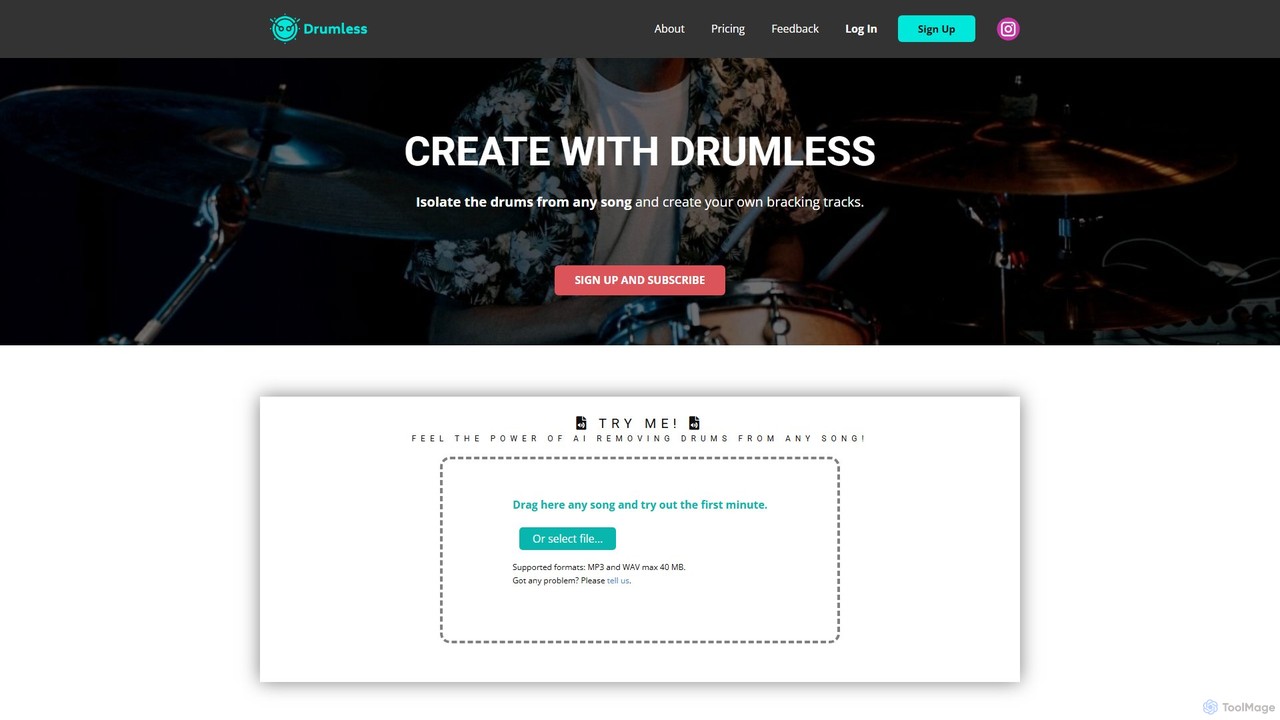
Drumless is an AI-powered tool designed for drummers and musicians to remove drums from any song. It instantly …
Drumless is an AI-powered tool designed for drummers and musicians to remove drums from any song. It instantly creates high-quality, drum-free backing tracks, perfect for practice, performance, and content creation. Simply upload an audio file, and the AI will isolate the drum track, allowing you to play along with your favorite artists.
About Music Education
Music Education AI tools are a specialized category of artificial intelligence applications designed to enhance learning, practice, and creation in music. These tools leverage AI algorithms for personalized instruction, real-time feedback, and creative assistance, making music accessible and engaging for learners of all levels. They transform traditional music pedagogy by offering interactive and adaptive experiences, from instrument practice to theoretical understanding, fostering skill development and artistic expression.
Core Features
- Personalized Learning Paths: AI adapts curriculum and exercises to individual student progress, learning styles, and specific musical goals.
- Real-time Performance Feedback: Analyzes pitch, rhythm, dynamics, and articulation during practice, providing instant, precise corrective guidance.
- Compositional Assistance: Helps users generate melodies, harmonies, chord progressions, or entire pieces based on chosen styles and parameters.
- Interactive Theory & Ear Training: Offers gamified and adaptive modules for understanding music theory concepts and improving auditory skills.
- Sight-Reading & Rhythm Drills: Provides AI-driven exercises to enhance the ability to read musical notation and maintain accurate rhythm.
Use Cases
These tools are invaluable for individual music students seeking self-paced learning, professional musicians refining their skills, and educators looking to augment their teaching methods. They can be used in private lessons, school music programs, or by hobbyists exploring new instruments or genres, offering a flexible and supportive learning environment.
How to Choose
When selecting a Music Education AI tool, consider the specific learning objectives (e.g., instrument practice, theory, composition), the level of personalization offered, and the quality of its feedback mechanisms. Evaluate its compatibility with your existing instruments or software, user interface intuitiveness, and the breadth of its content library. Look for tools that provide clear progress tracking and a supportive learning environment tailored to musical development.

Music EducationUse Cases
Personalized Instrument Practice
A beginner guitarist uses an AI app that listens to their playing, identifies incorrect finger placement or timing, and suggests targeted exercises to improve technique. This allows for self-paced learning with immediate, objective feedback, accelerating skill acquisition without constant supervision from a human instructor.
Advanced Music Theory Comprehension
A college music student utilizes an AI platform to explore complex harmonic progressions, receiving interactive explanations and generating examples to solidify understanding. The AI can adapt the complexity of the material and provide visual aids, helping students grasp abstract concepts more effectively than traditional textbooks.
Creative Composition & Arrangement
An aspiring songwriter employs an AI tool to generate melodic ideas or chord progressions based on a chosen style, then refines and arranges them into a complete song. This accelerates the creative process by providing a starting point or exploring variations that might not be immediately apparent to the human composer.
Efficient Ear Training & Rhythm Drills
A musician preparing for an audition uses an AI application for daily ear training exercises, identifying intervals, chords, and rhythmic patterns with adaptive difficulty levels. The AI's ability to generate endless variations and track progress makes it an ideal tool for consistent and effective skill development.
Adaptive Vocal Coaching
A singer practices scales and songs with an AI vocal coach that analyzes pitch accuracy, breath control, and tone, offering visual feedback and personalized warm-up routines. This provides objective, non-judgmental assessment and guidance, helping vocalists improve their technique and confidence outside of formal lessons.
Music Educator's Assistant
A music teacher integrates AI tools into their classroom to provide individualized homework assignments, track student progress across various skills, and generate custom quizzes. This streamlines administrative tasks and allows the teacher to focus more on personalized instruction and creative engagement with students, enhancing overall learning outcomes.