
ToolMage
Sign in

Best 1 Paraphraser AI tools for Education

Popular Paraphraser AI tools in Education include Reword Generator, helping you work more efficiently.

Reword Generator
Free

Reword Generator

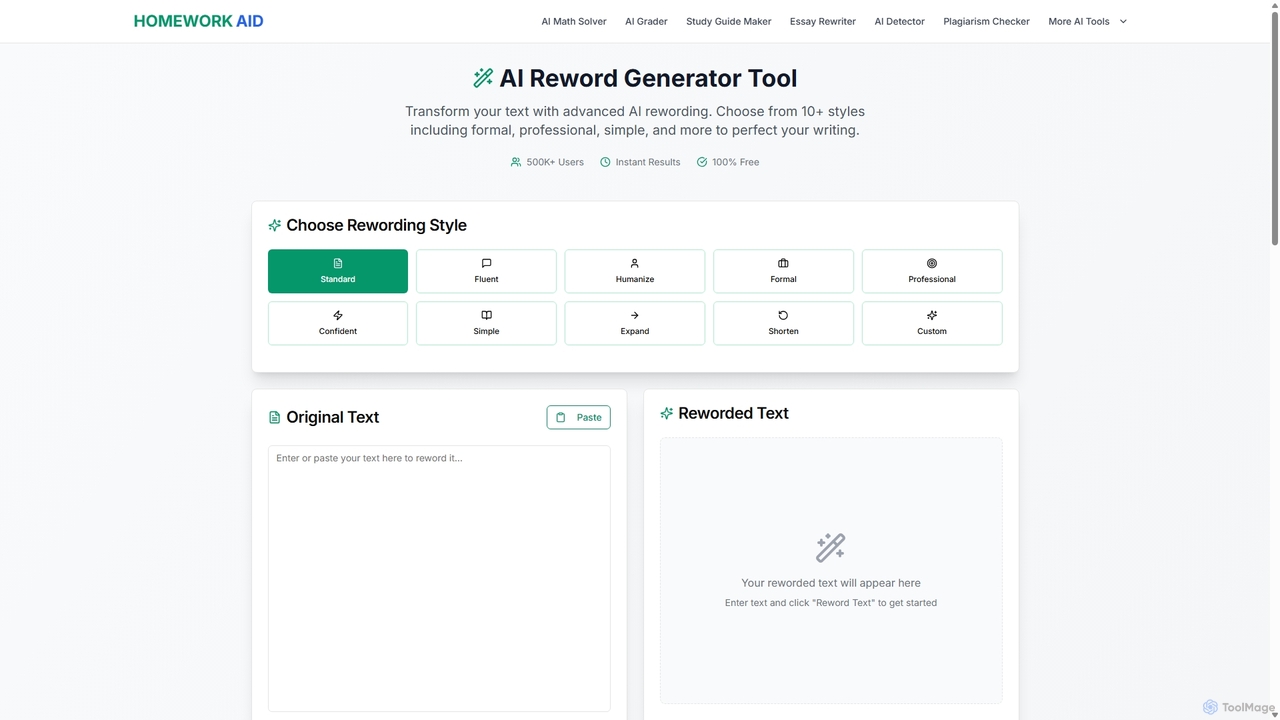
Reword Generator is a free, AI-powered tool designed to transform your writing. It offers over 10 distinct styles—from formal to casual—to help you rephrase sentences, improve clarity, and enhance your tone. Ideal for students, writers, and professionals, it provides instant, high-quality results without any registration or limits, ensuring your original meaning is always preserved.

Paraphraser
Visits 8KFavorites 130Likes 142

About Paraphraser

Paraphraser tools are AI-powered applications designed to rewrite existing text while preserving its original meaning. These tools leverage advanced natural language processing (NLP) algorithms to analyze content, identify key concepts, and generate alternative phrasings. They are invaluable for enhancing clarity, adapting tone, avoiding unintentional plagiarism, and diversifying vocabulary across various writing contexts, particularly within academic and professional communication.

Core Features

  • Semantic Preservation: Rewrites text to ensure the core message and original meaning remain intact.
  • Tone Adjustment: Modifies the text's style to be more formal, informal, creative, or concise as needed.
  • Synonym Replacement: Automatically suggests and replaces words with appropriate synonyms to enrich vocabulary.
  • Grammar and Structure Rephrasing: Restructures sentences and paragraphs to improve readability and vary expression.
  • Multilingual Support: Offers paraphrasing capabilities for texts in multiple languages, aiding global communication.

Use Cases

Paraphrasers are widely used in content creation, academic research, and professional communication. They help students rephrase sources for essays, marketers adapt content for different platforms, and business professionals refine reports for clarity and impact.

How to Choose

When selecting an AI paraphraser, consider its accuracy in preserving meaning, the range of tone adjustment options, supported languages, integration capabilities with other writing tools, and the overall ease of use and interface design.

Paraphraser use cases

1

Enhancing Academic Papers and Essays

Students and researchers utilize AI paraphrasers to rephrase source material for their academic writing, ensuring originality and avoiding accidental plagiarism. This helps them integrate information smoothly while maintaining their unique voice and adhering to academic integrity standards, saving significant time in the drafting process.

2

Repurposing Marketing Content

Marketing professionals use paraphrasers to adapt existing blog posts, articles, or product descriptions into fresh content for different channels like social media, email newsletters, or ad copy. This allows for efficient content repurposing, reaching wider audiences with varied messaging without starting from scratch.

3

Refining Professional Communications

Business professionals leverage paraphrasers to improve the clarity, conciseness, and tone of emails, reports, and presentations. Whether making a formal document more accessible or a casual message more professional, these tools ensure messages are impactful and well-received, enhancing overall communication effectiveness.

4

Adapting Multilingual Content for Local Nuances

Global teams and translators employ paraphrasers to refine translated texts, making them sound more natural and culturally appropriate for target audiences. This goes beyond direct translation, ensuring the rephrased content resonates locally and maintains its intended impact and tone.

5

Generating Creative Writing Variations

Writers and content creators use paraphrasers to explore different ways of expressing ideas, sentences, or paragraphs. This helps overcome writer's block, adds stylistic variety to narratives, and allows for experimentation with different linguistic approaches to find the most compelling phrasing.

6

Supporting Language Learning and Practice

Language learners benefit from paraphrasers by rephrasing sentences or paragraphs to understand alternative expressions and expand their vocabulary. It provides immediate feedback on how ideas can be conveyed differently, aiding in comprehension and improving fluency in a new language.

Paraphraser FAQ

What is an AI Paraphraser?

An AI paraphraser is a tool that uses artificial intelligence to rewrite text, changing its wording while keeping the original meaning intact. It helps users rephrase sentences, paragraphs, or entire documents to improve clarity, adapt tone, or avoid repetition. These tools are particularly useful for academic writing, content creation, and professional communication.

How do I choose the best AI paraphraser?

To choose the best AI paraphraser, consider its accuracy in preserving meaning, the variety of tone and style options it offers (e.g., formal, creative, concise), the range of languages it supports, and its integration capabilities with other writing platforms. User interface and pricing models are also important factors to evaluate for a seamless experience.

What's the difference between paraphrasing and summarizing?

Paraphrasing involves rewriting a text in different words while maintaining its original length and detailed meaning. Summarizing, on the other hand, condenses a text into a shorter version, focusing only on the main ideas and omitting details. Both aim to convey information from a source but differ significantly in scope and length.

Can AI paraphrasers help avoid plagiarism?

Yes, AI paraphrasers can assist in avoiding unintentional plagiarism by helping users rephrase source material into their own words. However, it's crucial to always review the output and cite original sources properly. Relying solely on a tool without critical human oversight can still lead to issues, as the tool might not always capture the nuance required for academic integrity.

Who can benefit from using a paraphraser?

A wide range of users can benefit from paraphrasers, including students for academic writing, content creators for generating diverse content, marketers for repurposing material, business professionals for refining communications, and language learners for improving their vocabulary and understanding of different expressions. Essentially, anyone who writes regularly can find value in these tools.