AskBooks
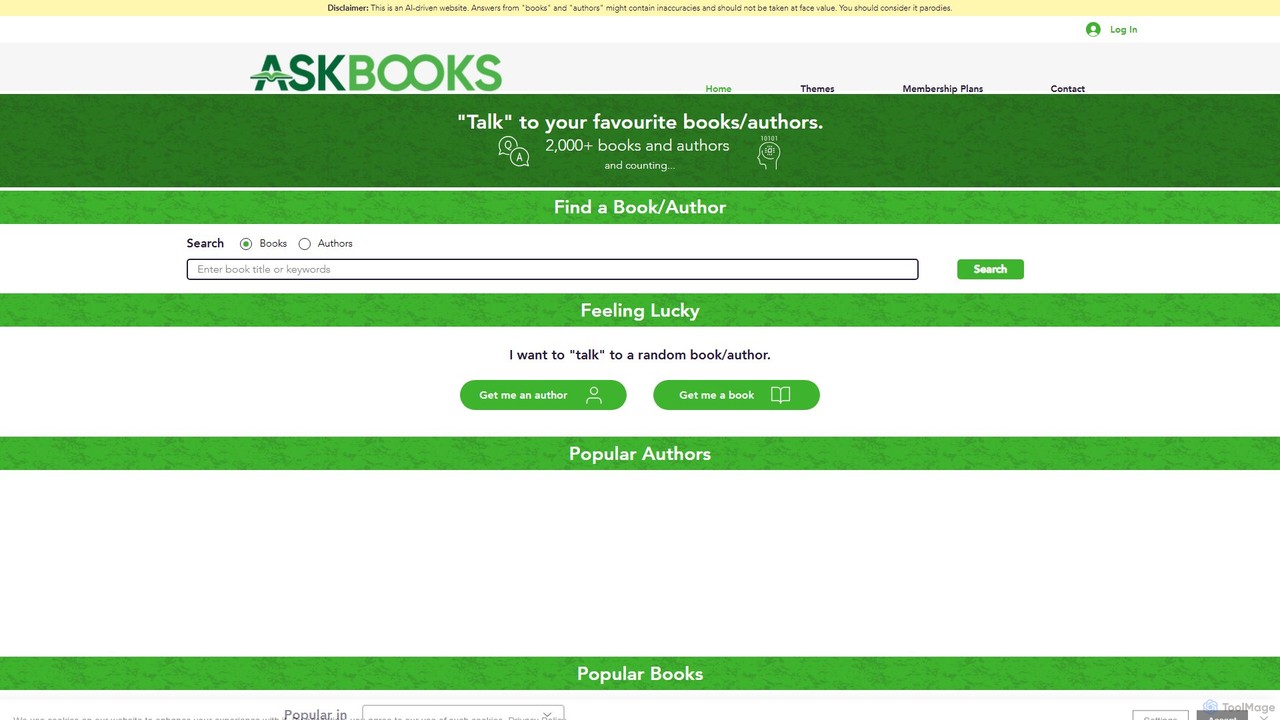
AskBooks is an innovative AI platform that allows you to have interactive conversations with over 2,000 books and …
AskBooks is an innovative AI platform that allows you to have interactive conversations with over 2,000 books and authors. Ask direct questions about plots, characters, and themes, and receive instant, AI-generated answers as if you were talking to the book or author themselves. It's a new way to explore and understand literature.
About Reading Comprehension
AI Reading Comprehension tools are a specialized category of software designed to analyze, interpret, and answer questions about written content. Leveraging Natural Language Processing (NLP), these tools go beyond simple summarization to grasp context, identify key arguments, and extract specific information from documents. They serve as powerful assistants for students, researchers, and professionals, accelerating learning and deepening the understanding of complex texts. This capability makes them a vital component within the broader field of AI for education.
Core Features
- Contextual Question Answering: Ask specific questions about a document and receive precise, context-aware answers based on the content.
- Key Information Extraction: Automatically identify and pull out entities like names, dates, key terms, and statistical data.
- Concept Simplification: Break down complex sentences, jargon, or dense paragraphs into simpler, more understandable explanations.
- Cross-document Analysis: Pose questions across multiple documents simultaneously to synthesize information and identify patterns.
Applicable Scenarios
These tools are invaluable in academia for literature reviews and study support. In the legal and financial sectors, they enable professionals to quickly analyze dense contracts and reports for critical information. Corporate training and knowledge management departments also use them to make internal documentation searchable and easier to understand for employees.
Selection Criteria
When choosing a tool, evaluate its accuracy in answering nuanced questions and its support for various file formats (PDF, DOCX, URL). Consider its multilingual capabilities, integration options with note-taking or research apps, and the user interface's ease of use for highlighting and annotating text. The pricing model, whether per-page or subscription-based, is also a key factor.

Reading ComprehensionUse Cases
Accelerating Academic Research
A graduate student is working on a literature review involving over 50 research papers. Instead of manually reading each one, they upload the papers to an AI Reading Comprehension tool. They can then ask direct questions like, 'What were the key limitations mentioned in these studies regarding method X?' or 'Compare the conclusions of Paper A and Paper B on topic Y.' The tool synthesizes answers from the documents, allowing the student to quickly identify relevant papers, extract key findings, and spot research gaps in a fraction of the time it would take manually.
Efficient Legal Contract Review
A paralegal needs to review a 150-page service agreement to identify risks and non-standard clauses. They upload the document to an AI reading tool. Using the Q&A feature, they ask, 'What are the termination conditions for the client?' and 'List all clauses related to data privacy and compliance.' The AI instantly locates and presents the relevant sections. This allows the paralegal to quickly create a summary of key points for the supervising attorney, reducing review time from hours to minutes and minimizing the risk of overlooking critical details.
Interactive Student Study Aid
A college student is preparing for a biology exam. They upload their digital textbook and lecture notes into a reading comprehension app. Instead of just re-reading, they interact with the material by asking questions like, 'Explain the process of photosynthesis in simpler terms' or 'What is the main function of the Golgi apparatus?' The AI provides clear, concise explanations and can even generate flashcards or a quiz based on key concepts from the text. This active learning approach improves retention and helps the student identify areas where they need more study.
Analyzing Financial Reports for Insights
A financial analyst needs to quickly understand the performance of several companies by reviewing their quarterly reports. They upload the PDF reports into an AI tool. They can then query all documents at once, asking: 'What did each company state about their revenue guidance for the next quarter?' The tool extracts and compiles the forward-looking statements from each report into a single, comparable view. This allows the analyst to rapidly compare company outlooks and identify market trends without having to manually search through hundreds of pages of dense financial text.
Streamlining Corporate Knowledge Management
An employee needs to find information on a specific internal process buried within a large corporate knowledge base of hundreds of documents. Instead of using keyword search which returns dozens of irrelevant links, they use an AI-powered Q&A interface. They ask, 'What is the step-by-step process for submitting an expense report for international travel?' The AI reads through all relevant HR and finance documents and provides a single, synthesized answer with a clear checklist. This provides immediate, accurate information and saves significant employee time.
Fact-Checking for Content Creators
A journalist is writing an article on a complex scientific topic. To ensure accuracy, they upload several source reports and academic papers into their AI reading assistant. As they write, they can quickly verify details by asking the AI, 'According to source C, what was the exact percentage reported?' or 'Do any of the sources contradict the claim that X causes Y?' The tool helps them cross-reference information efficiently, identify inconsistencies, and find direct quotes to support their arguments, ultimately improving the quality and credibility of their final article.