ToolMage
Sign in

Best 1 Robotics Platforms for Education

Popular Robotics Platforms in Education include Unitree, helping you work more efficiently.

Unitree
Paid

Unitree

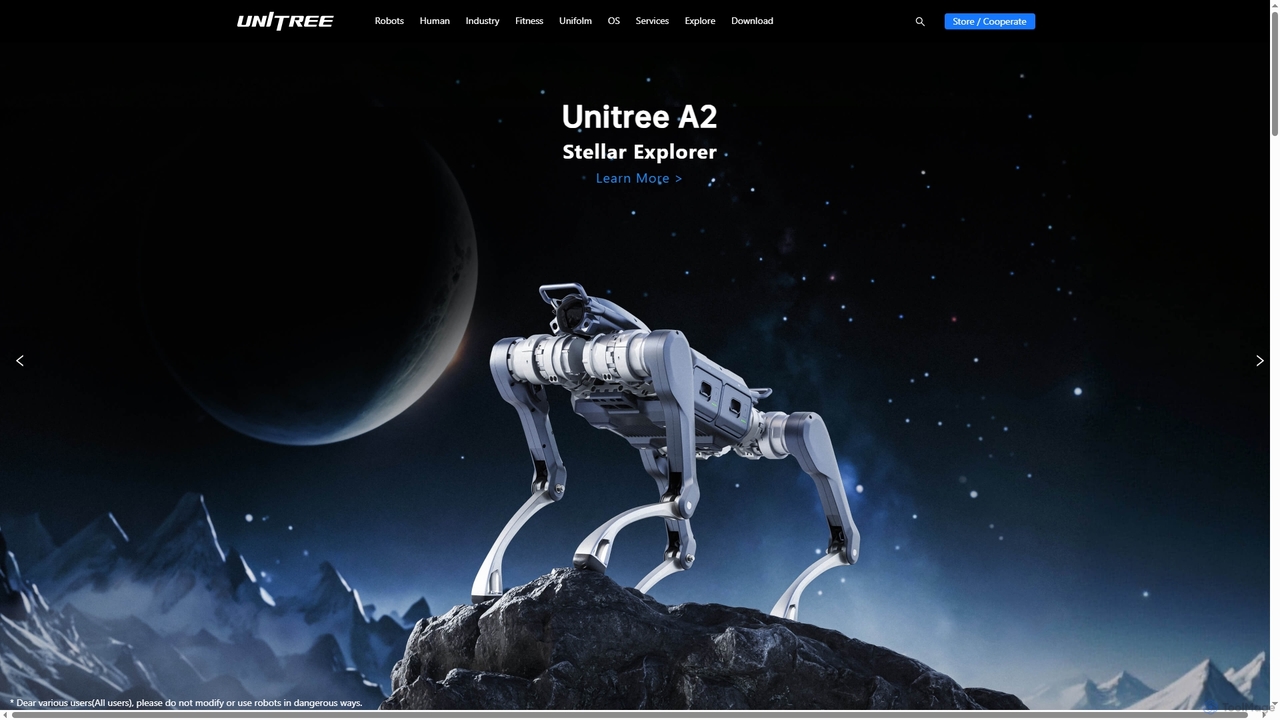
Unitree is a world-renowned robotics company specializing in the R&D, production, and sales of high-performance legged and humanoid robots, robotic arms, and advanced perception systems like 4D LiDAR. They offer innovative solutions for consumer, industrial, and research applications globally.

Personal Robotics
Visits 616.8KFavorites 134Likes 163

About Robotics Platforms

Robotics Platforms are integrated hardware and software ecosystems designed for the development, programming, and deployment of robotic solutions. These platforms typically combine physical robot components or simulation environments with advanced software tools, enabling users to design, test, and control complex robotic behaviors. They serve as foundational tools for innovation in automation, research, and are particularly vital in educational settings for teaching STEM concepts and practical engineering skills.

Core Features

  • Integrated Development Environment (IDE): Provides tools for coding, debugging, and managing robotic projects efficiently.
  • Simulation & Virtual Testing: Offers virtual environments to test robot behavior and algorithms without requiring physical hardware.
  • Hardware Abstraction Layer (HAL): Simplifies interaction with diverse robot hardware components, motors, and sensors.
  • Sensor & Actuator Integration: Supports seamless connection and control of various sensors (e.g., cameras, lidar) and actuators (e.g., motors, grippers).
  • AI & Machine Learning Modules: Includes components for implementing intelligent behaviors such as computer vision, autonomous navigation, and decision-making.

Applicable Scenarios

Robotics Platforms are widely used by students, researchers, and engineers to bring robotic concepts to life. They are essential for developing autonomous systems, conducting advanced robotics research, and prototyping industrial automation solutions. Their versatility makes them suitable for both academic learning and professional innovation.

How to Choose

When selecting a Robotics Platform, consider its hardware compatibility with your desired robot types, the breadth of its software ecosystem (libraries, APIs, community support), and its learning curve, especially for educational purposes. Evaluate scalability for future projects and the availability of comprehensive documentation and tutorials.

Robotics Platforms use cases

1

Teaching Foundational Robotics in Schools

Educators in K-12 and vocational schools utilize robotics platforms to introduce students to basic programming, mechanics, and electronics. Students can build simple robots, program them to perform tasks like obstacle avoidance or line following, fostering problem-solving skills and an early interest in STEM fields through hands-on experience.

2

Developing Autonomous Navigation Systems

University researchers and engineers leverage advanced robotics platforms to develop and test sophisticated autonomous navigation algorithms for mobile robots. This involves integrating sensor data (Lidar, cameras), mapping environments, and programming path planning and obstacle avoidance, often within realistic simulation environments before physical deployment.

3

Prototyping Industrial Automation Solutions

Manufacturing engineers use robotics platforms to design, simulate, and prototype robotic arms or automated guided vehicles (AGVs) for factory automation. They can program precise movements, integrate with existing production lines, and optimize workflows in a virtual setting, significantly reducing development time and costs before physical implementation.

4

Training for Robotics Competitions

Student teams participating in robotics competitions (e.g., FIRST Robotics, RoboCup) rely on these platforms to program their custom-built robots. They develop complex strategies, fine-tune sensor inputs, and optimize motor control to achieve specific competition objectives, enhancing teamwork and practical engineering application skills.

5

Personal Robotics and Home Automation Projects

Hobbyists and individual developers use accessible robotics platforms to build custom robots for personal use, such as smart home assistants, educational toys, or remote-controlled devices. These platforms provide the necessary tools to integrate various components, write control logic, and bring creative robotic ideas to fruition.

6

Simulating Robotic Operations in Hazardous Environments

Researchers and emergency response teams employ robotics platforms with advanced simulation capabilities to model and test robot operations in dangerous or inaccessible environments, like disaster zones or outer space. This allows for safe experimentation with remote manipulation, data collection, and emergency procedures without risking human lives or expensive equipment.

Robotics Platforms FAQ

What are Robotics Platforms?

Robotics Platforms are comprehensive ecosystems comprising hardware components, software tools, and development environments designed for building, programming, and deploying robots. They provide the necessary infrastructure for users to create, simulate, and control robotic systems, ranging from simple educational bots to complex industrial automatons.

How do Robotics Platforms benefit education?

Robotics Platforms are invaluable educational tools that offer hands-on learning experiences in STEM subjects like computer science, engineering, and physics. They enable students to apply theoretical knowledge, develop problem-solving skills, and foster creativity by designing, building, and programming their own robots, preparing them for future technological careers.

What are the key components of a typical Robotics Platform?

A typical Robotics Platform includes an Integrated Development Environment (IDE) for coding, simulation software for virtual testing, and libraries for hardware interaction. It also features support for various sensors (e.g., cameras, ultrasonic) and actuators (e.g., motors, servos), often with modules for integrating AI and machine learning capabilities.

Can Robotics Platforms be used for commercial development?

Yes, many Robotics Platforms are robust enough for commercial development. They are frequently used by startups and R&D departments for rapid prototyping, testing, and even deploying specialized robotic solutions in fields like logistics, healthcare, and manufacturing. Their modularity and extensive toolsets accelerate the development cycle for market-ready products.

What should I consider when choosing a Robotics Platform for a project?

When choosing a Robotics Platform, consider the specific requirements of your project, including the type of robot you intend to build and its intended application. Evaluate the platform's hardware compatibility, the availability of a strong software ecosystem and community support, its ease of use for your skill level, and the overall cost-effectiveness for your budget and scalability needs.