ToolMage
Sign in

Best 1 Student AI tools for Education

Popular Student AI tools in Education include Studyable, helping you work more efficiently.

Studyable
Freemium

Studyable

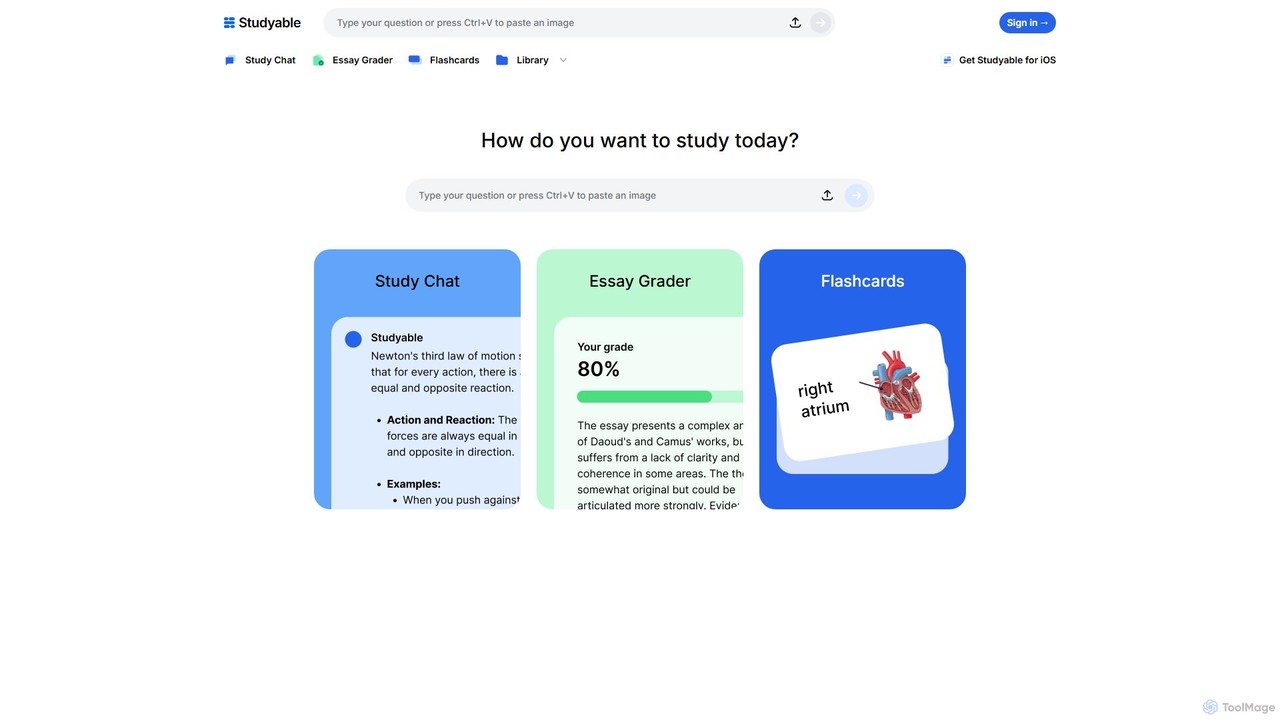
Studyable is an AI-powered academic platform offering a suite of tools for students. It provides instant homework help via photo recognition, a detailed essay grader, an interactive study chat, and an automatic flashcard generator to enhance learning and academic performance.

Student
Visits 82.6KFavorites 137Likes 121

About Student

Student AI tools are AI-powered applications specifically designed to assist students across various academic disciplines and tasks. These tools leverage natural language processing, machine learning, and data analysis to personalize learning experiences, automate routine academic tasks, and provide comprehensive study support. They aim to enhance learning efficiency, improve academic performance, and streamline the entire educational journey for students from K-12 to higher education.

Core Features

  • Intelligent Writing Assistant: Offers grammar and style checks, structural suggestions for essays, and automated citation formatting to improve academic writing.
  • Study Material Summarization: Quickly extracts key points from articles, textbooks, or lecture transcripts, generating concise summaries or mind maps for efficient review.
  • Personalized Learning Paths: Recommends customized learning resources and exercises based on a student's progress, understanding, and identified knowledge gaps.
  • Academic Q&A: Provides instant answers to academic questions, explains complex concepts, and offers step-by-step solutions for problem-solving.
  • Time Management & Planning: Helps students organize assignments, set deadlines, create study schedules, and optimize their academic workflow.

Applicable Scenarios

Students across all levels utilize these tools for diverse academic needs. For instance, university students can use them for literature reviews, drafting research papers, and ensuring proper citation. High school students benefit from personalized tutoring for challenging subjects and efficient note-taking. Additionally, these tools are invaluable for language learners seeking grammar correction and pronunciation practice.

How to Choose

When selecting a student AI tool, consider its functional breadth to ensure it covers your primary needs like writing, research, or learning. Evaluate the accuracy and reliability of its generated content and information sources. Assess its user-friendliness for intuitive navigation and ease of use. Finally, examine its privacy and data security policies, along with its cost-effectiveness to align with your budget and academic requirements.

Featured tool rankings

Student use cases

1

Drafting Academic Papers & Reports

Students utilize AI tools for literature review, generating content outlines, performing grammar and spelling checks, and automatically adjusting citation formats, significantly boosting writing efficiency and quality. This helps university students produce well-structured, error-free research papers and essays, saving hours on manual proofreading and formatting.

2

Efficiently Summarizing Study Materials

Input lengthy textbook chapters, academic papers, or lecture recordings into AI to quickly generate concise summaries, key concept lists, or mind maps, helping students grasp main points and save reading time. This is particularly useful for students preparing for exams or needing to quickly review large volumes of information across multiple subjects.

3

Personalized Exam Preparation

AI intelligently generates customized practice questions and mock tests based on a student's learning history and knowledge mastery, identifying weak areas and offering targeted revision advice to enhance exam readiness. This adaptive approach ensures students focus their efforts where they are most needed, leading to improved scores and confidence.

4

Real-time Academic Q&A

When encountering difficulties or unclear concepts during study, students can ask AI for immediate, detailed explanations, problem-solving steps, or relevant background knowledge, aiding comprehension of complex subjects. This instant access to information acts as a virtual tutor, providing support outside of traditional classroom hours.

5

Foreign Language Learning & Speaking Practice

AI provides smart translation, grammar correction, pronunciation assessment, and conversational practice, helping students improve their foreign language proficiency, especially in vocabulary acquisition and developing a sense of language. This interactive environment allows for consistent practice and immediate feedback, crucial for mastering a new language.

6

Project Management & Study Planning

Students use AI tools to plan course assignments, project deadlines, set learning goals, and reminders, optimizing time allocation to ensure tasks are completed on schedule and fostering academic self-discipline. This helps in managing complex academic workloads and maintaining a balanced study-life schedule, preventing last-minute rushes.

Student FAQ

What are Student AI Tools?

Student AI tools are AI-powered applications specifically designed to assist students with various academic tasks, from research and writing to learning and organization. They leverage technologies like natural language processing and machine learning to offer personalized learning experiences, automate routine academic tasks, and provide comprehensive study support. Their primary goal is to enhance learning efficiency, improve academic performance, and streamline the educational journey.

What are the main functions of Student AI Tools?

Student AI tools offer a range of functions including writing assistance (grammar, style, citations), content summarization (abstracts, notes, mind maps), personalized learning (practice questions, study plans, knowledge recommendations), academic Q&A (concept explanations, problem-solving steps), language learning (translation, error correction, speaking practice), and time management (task planning, reminders). These diverse capabilities aim to cover most aspects of a student's academic life.

How to choose the right Student AI Tool?

When selecting a student AI tool, consider your core academic needs (e.g., writing, research, specific subject learning). Evaluate the tool's functional breadth and accuracy, ensuring its outputs are reliable and factually correct. Look for user-friendliness with an intuitive interface and easy learning curve. Crucially, examine its privacy and data security policies to protect your personal and academic information. Finally, assess its cost-effectiveness relative to the features offered and your budget.

How do Student AI Tools differ from traditional learning methods?

Student AI tools offer personalized learning paths tailored to individual progress, unlike traditional uniform teaching. They provide enhanced efficiency by automating tasks like summarization and grammar checks, and offer instant feedback for questions and corrections. While traditional methods rely on human interaction, AI tools offer interactive learning experiences through simulations and adaptive exercises. However, AI serves as a powerful aid, not a replacement for critical thinking and active learning.

What should students be aware of when using AI tools?

Students should always exercise critical thinking and verify information generated by AI, as it may contain biases or inaccuracies. Avoid over-reliance on AI; it's a supplementary tool, not a substitute for independent thought and learning. Adhere to academic integrity guidelines to ensure ethical use and prevent plagiarism. Be mindful of data privacy policies to protect personal information. Lastly, focus on skill development by learning to effectively integrate AI into your study process rather than just copying outputs.