vinish
A suite of free, specialized AI and developer tools created by Oracle ACE Pro Vinish Kapoor. The platform …
A suite of free, specialized AI and developer tools created by Oracle ACE Pro Vinish Kapoor. The platform offers an AI-powered Hate Speech Detector, an Image Anomaly Detector, and a variety of powerful utilities for Oracle SQL developers, all accessible directly through the web.
aispaceship
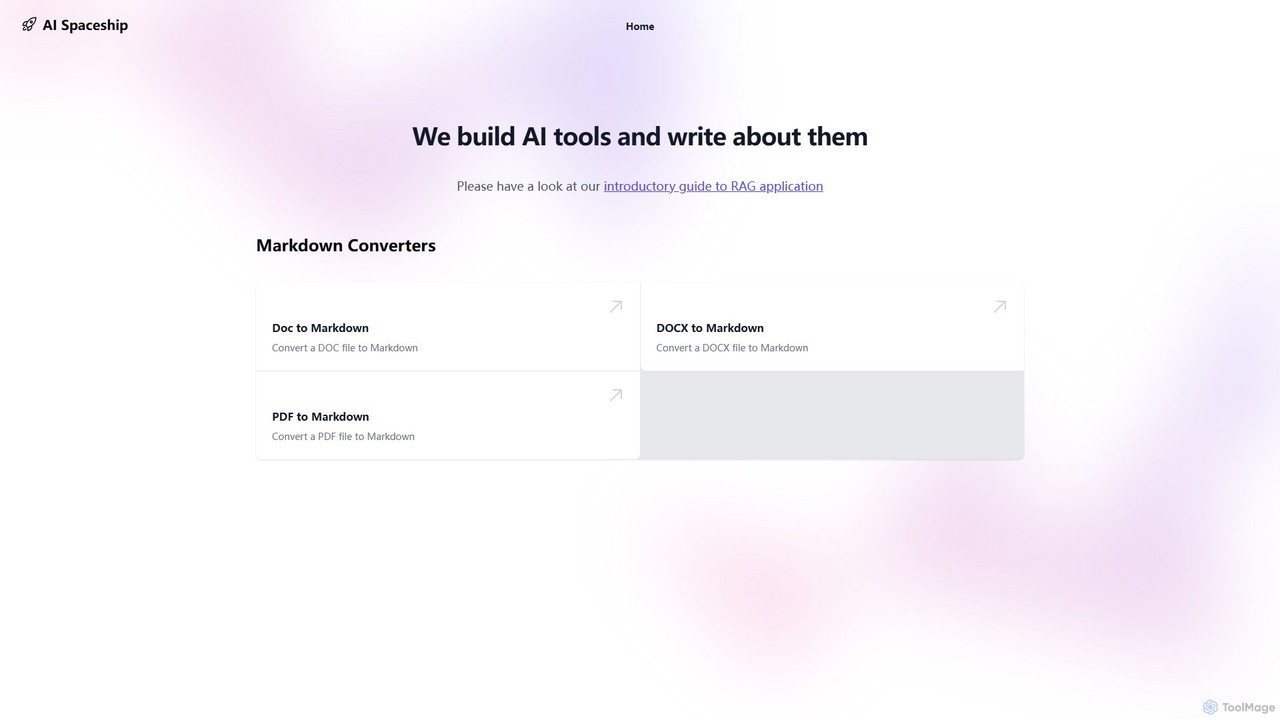
aispaceship offers a suite of free, web-based AI tools, specializing in document conversion. Effortlessly convert DOC, DOCX, and …
aispaceship offers a suite of free, web-based AI tools, specializing in document conversion. Effortlessly convert DOC, DOCX, and PDF files to clean Markdown with a simple drag-and-drop interface. The platform also provides educational content on AI topics, such as RAG applications, making it a valuable resource for developers, writers, and tech enthusiasts.
About Technical Writing
AI Technical Writing tools are specialized applications designed to automate and enhance the creation of clear, accurate, and consistent technical documentation. These tools leverage Natural Language Processing (NLP) and machine learning models to analyze complex information, such as source code or product specifications, and generate structured content like user manuals, API references, and knowledge base articles. Their primary value lies in accelerating the documentation process, enforcing style guides, and improving the overall quality and readability of technical content for end-users and developers. This ensures that complex products and services are easier to understand and use.
Core Features
- Automated Content Generation: Creates draft documentation directly from source code comments, API specifications (e.g., OpenAPI), or feature descriptions.
- Style and Terminology Enforcement: Automatically checks content against predefined style guides to ensure consistency in tone, formatting, and terminology across all documents.
- Clarity and Readability Analysis: Provides suggestions to simplify complex sentences, use active voice, and improve the overall structure for better comprehension.
- Code Snippet Management: Helps in formatting, explaining, and keeping code examples up-to-date within the documentation.
- Multi-Format Publishing: Enables easy export of documentation to various formats like HTML, PDF, and Markdown for web portals, print, or developer hubs.
Use Cases
These tools are primarily used by technical writers, software developers, product managers, and support engineers. Common applications include generating and maintaining API reference guides, creating comprehensive software user manuals, building internal and external knowledge bases, and producing consistent release notes for product updates. They are crucial in industries like software development, SaaS, and manufacturing where precise documentation is essential.
How to Choose
When selecting an AI Technical Writing tool, consider its integration capabilities with your existing workflows, such as code repositories (e.g., GitHub, GitLab) and help desk software. Evaluate the level of customization available for style guides and templates. Also, assess its support for various input sources (code, API files, text) and the quality of its generated content. Finally, consider collaboration features and the pricing model to ensure it fits your team's size and budget.

Technical WritingUse Cases
Automating API Reference Documentation
A software development team needs to provide comprehensive and always-up-to-date documentation for their public API. Manually writing and updating this documentation is time-consuming and prone to errors. By using an AI Technical Writing tool, they can connect it directly to their OpenAPI (Swagger) specification file. The tool automatically generates a complete, interactive API reference guide, including endpoints, parameters, request examples, and response schemas. Whenever the API spec is updated, the documentation is regenerated in minutes, ensuring accuracy and saving the development team hundreds of hours per product cycle.
Creating Consistent Software User Manuals
A technical writer is tasked with creating a 200-page user manual for a new enterprise software product. Ensuring consistent terminology (e.g., 'user' vs. 'customer', 'settings' vs. 'preferences') and tone across all chapters is a major challenge. An AI Technical Writing tool helps by maintaining a central glossary and style guide. As the writer drafts new sections, the tool flags inconsistencies and suggests corrections in real-time. It can also help structure content by generating outlines based on feature lists, ensuring all functionalities are covered systematically. This results in a higher-quality, more professional manual that is easier for end-users to navigate and understand.
Building a Searchable Internal Knowledge Base
A customer support team is overwhelmed with repetitive questions. They decide to build an internal knowledge base to help agents find answers quickly. Using an AI Technical Writing tool, they can process existing resources like support ticket logs, internal memos, and developer notes. The AI helps categorize information, suggests relevant tags, and drafts structured articles in a consistent format. It can also identify knowledge gaps by analyzing common search queries that yield no results. This accelerates the creation of a comprehensive, easily searchable knowledge base, reducing agent response times and improving the consistency of support provided to customers.
Generating SDK Documentation from Code Comments
A platform company releases SDKs for multiple programming languages (Java, Python, JavaScript). Manually documenting each SDK is a massive undertaking. A developer can use an AI Technical Writing tool that integrates with their code repository. The tool parses source code comments (like Javadoc or Python docstrings) and automatically generates structured documentation for classes, methods, and parameters. It ensures the documentation format is consistent across all languages and can publish the output directly to a developer portal. This process turns code comments into a valuable asset, drastically reducing documentation time and improving the developer experience for third-party integrators.
Simplifying Complex Concepts for Training Materials
A corporate trainer needs to create training modules for the sales team about a new, highly technical product. The source material consists of dense engineering whitepapers. Using an AI Technical Writing tool, the trainer can input these complex documents and ask the AI to simplify the language, define jargon, and create analogies. The tool helps restructure the content into digestible lessons with clear learning objectives and summaries. This allows the trainer to quickly produce accurate and easy-to-understand training materials, significantly reducing preparation time and ensuring the non-technical sales team can confidently articulate the product's value to customers.
Maintaining and Translating Product Documentation
A global SaaS company needs to maintain its product documentation in five different languages. When a new feature is released, updating all language versions simultaneously is a logistical nightmare. An AI Technical Writing tool with localization features can streamline this. The technical writer first updates the source document in English. The tool then identifies the changed sections and uses its AI translation capabilities to generate drafts for the other four languages. While a human translator still reviews for nuance, this process reduces the translation workload by over 70% and ensures that all users, regardless of their language, receive timely and accurate product updates.