
ToolMage
Sign in

Best 1 Technology Blog AI tools for Education

Popular Technology Blog AI tools in Education include DeepakNess, helping you work more efficiently.

DeepakNess
Free

DeepakNess

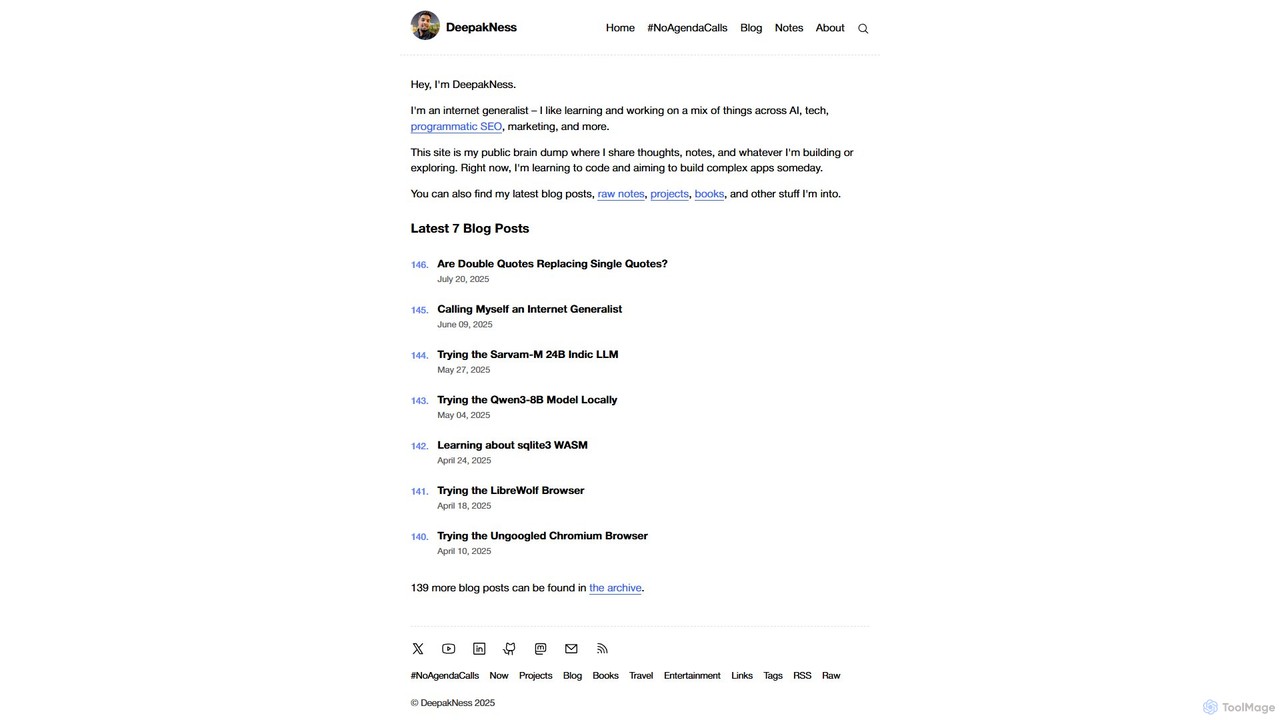
DeepakNess is a personal knowledge hub and blog by an 'internet generalist'. It offers in-depth articles, tutorials, and project explorations across AI, programmatic SEO, web development, and marketing. A valuable resource for developers, marketers, and tech enthusiasts seeking practical, hands-on insights.

Ai Education
Visits 148.5KFavorites 116Likes 118

About Technology Blog

AI Technology Blog tools are specialized content creation platforms that automate the generation of articles, tutorials, and analyses on technological subjects. These tools leverage advanced language models trained on vast datasets of technical information to produce relevant, structured, and often SEO-optimized content. Their primary value lies in enabling tech companies, developers, and marketers to consistently publish high-quality content, establishing thought leadership and educating their audience with greater efficiency. They streamline the entire content lifecycle, from topic ideation to final draft.

Core Features

  • Technical Content Generation: Creates drafts for articles, how-to guides, and product reviews with accurate technical terminology.
  • Trend-Based Topic Ideation: Suggests relevant and timely blog post ideas based on current industry trends and keyword analysis.
  • SEO Optimization Suite: Includes features for keyword integration, meta description generation, and content structuring to improve search engine rankings.
  • Factual Data Integration: Capable of incorporating recent statistics, research findings, and news to enhance content credibility.
  • Code Snippet Generation: Provides formatted code examples in various programming languages to support technical tutorials.

Applicable Scenarios

These tools are widely used by SaaS companies and tech startups for their content marketing efforts to attract organic traffic. Individual developers and IT consultants use them to build a personal brand and share expertise without spending excessive time on writing. Additionally, digital marketing agencies leverage them to scale content production for multiple tech clients efficiently.

Selection Criteria

When choosing a Technology Blog tool, evaluate the model's accuracy with complex technical concepts and its ability to cite sources. Assess the depth of its SEO features, such as keyword research and competitor analysis. Consider its integration capabilities with content management systems like WordPress and the level of customization available for tone of voice and formatting.

Technology Blog use cases

1

Content Marketing for a SaaS Company

A marketing manager at a B2B SaaS company needs to increase organic traffic and generate qualified leads. They use an AI Technology Blog tool to create a consistent stream of high-quality content. The tool helps identify trending topics in their niche, such as 'AI in cybersecurity' or 'cloud cost optimization'. It then generates detailed, SEO-optimized articles and tutorials that explain complex concepts simply. This results in higher search engine rankings, attracting IT professionals and decision-makers to their site and establishing the company as an industry authority.

2

Building a Developer's Personal Brand

A software developer wants to share their expertise and build a professional reputation but lacks the time for consistent writing. They use an AI tool to streamline the creation of their personal tech blog. The developer provides outlines and key technical points for a tutorial on a new JavaScript framework. The AI expands these points into a full-length, well-structured article, complete with formatted code snippets and explanations. This allows the developer to publish weekly tutorials, saving over 70% of writing time, growing their audience, and attracting career opportunities.

3

Scaling Content for a Tech Marketing Agency

A digital marketing agency serves multiple clients in the tech industry, each requiring regular blog content. To scale operations without hiring more writers, the agency integrates an AI Technology Blog tool into its workflow. For each client, they create a unique profile with specific tone-of-voice and keyword preferences. The tool generates first drafts for various topics, from cloud computing to machine learning. The agency's editors then review, refine, and add unique insights. This process doubles their content output, ensuring all clients receive timely, relevant, and on-brand articles.

4

Creating an IT Consulting Knowledge Base

An IT consulting firm wants to create a comprehensive online knowledge base to educate potential clients and showcase their expertise. They use an AI tool to generate foundational articles on topics like network security, data migration, and IT infrastructure management. The consultants provide the core expertise and prompts, and the AI structures this information into clear, easy-to-understand blog posts. This accelerates the creation of a valuable resource hub, which not only helps in lead generation but also serves as a reference for existing clients, reducing repetitive support queries.

5

Automating Tech News Summaries and Reports

A small tech news website needs to cover industry events and product launches quickly to compete with larger publications. The editorial team uses an AI Technology Blog tool to rapidly process press releases and announcement transcripts. The tool generates concise summaries and initial draft reports highlighting the key features and implications. This allows the journalists to focus on adding in-depth analysis and original quotes, reducing the time to publication by half and enabling them to provide timely coverage of breaking news in the tech sector.

6

Generating Educational Content for Coding Bootcamps

An instructor at a coding bootcamp needs to create supplementary learning materials for students. They use an AI Technology Blog tool to generate tutorials and explanations on foundational topics like 'Data Structures in Python' or 'Introduction to APIs'. The instructor provides the curriculum outline, and the AI tool produces well-structured articles with clear explanations and relevant code examples. This saves the instructor significant preparation time, provides students with a consistent and high-quality resource library, and allows for easy updates as technologies evolve.

Technology Blog FAQ

What is an AI Technology Blog tool?

An AI Technology Blog tool is a specialized software application that uses artificial intelligence, particularly large language models, to automate the creation of content for technology-focused blogs. Unlike general AI writers, these tools are specifically trained to understand and generate text about complex technical subjects, including software development, cybersecurity, cloud computing, and AI trends. They assist with the entire content creation process, from suggesting trending topics and generating article drafts to optimizing content for search engines and even creating relevant code snippets.

How to choose the right AI tool for a technology blog?

Choosing the right tool involves evaluating several key factors. First, assess its Technical Accuracy: the tool should understand nuanced technical jargon and generate factually correct content. Second, look at its SEO Capabilities; features like keyword research, SERP analysis, and content optimization are crucial. Third, consider Integration and Workflow, such as direct publishing to WordPress or other CMS platforms. Finally, evaluate Customization and Control, including the ability to set a specific tone of voice, define an audience, and provide detailed outlines for the AI to follow. It's often best to test a few options with topics you are an expert in to gauge their quality.

What's the difference between a general AI writer and a Technology Blog tool?

The primary difference lies in their training data and specialization. A general AI writer is a versatile tool designed to create a wide range of content, from marketing copy to emails. A Technology Blog tool is a specialized AI writer that has been fine-tuned on a massive corpus of technical documentation, academic papers, code repositories, and tech news. This specialization results in several advantages for technical content:

  • Higher Accuracy: Better understanding of technical terms and concepts.
  • Relevant Examples: Ability to generate accurate code snippets and relevant examples.
  • Industry Awareness: More up-to-date with current tech trends and terminology.
  • Structured Output: Often better at creating structured content like tutorials and how-to guides.
In essence, while a general writer can attempt to write a tech article, a specialized tool is more likely to produce accurate, credible, and useful content for a technical audience.

Can these tools write accurate, up-to-date technical content?

The accuracy and timeliness of content from AI Technology Blog tools can vary. High-quality tools often use Retrieval-Augmented Generation (RAG), which allows them to access and incorporate information from the current internet to provide up-to-date details. However, for highly complex or rapidly evolving topics, AI-generated content should always be considered a first draft. It is crucial for a human expert to review, fact-check, and add their unique insights and experience. This human-in-the-loop approach ensures the final content is not only accurate and current but also carries the authority and nuance that only an expert can provide.

Who can benefit from using an AI Technology Blog tool?

A wide range of professionals and organizations can benefit from these tools. Key users include:

  • Tech Companies & Startups: To scale their content marketing, generate leads, and establish themselves as industry leaders.
  • Software Developers & Engineers: To share their knowledge, build a personal brand, and create tutorials without spending extensive time writing.
  • Marketing Agencies: To efficiently produce high-quality technical content for multiple clients in the tech sector.
  • IT Consultants: To create a knowledge base that educates clients and showcases their firm's expertise.
  • Technical Educators: To quickly generate supplementary learning materials, examples, and explanations for students.
Essentially, anyone who needs to produce technical content regularly but faces time or resource constraints can find significant value in these specialized AI tools.