peeranha
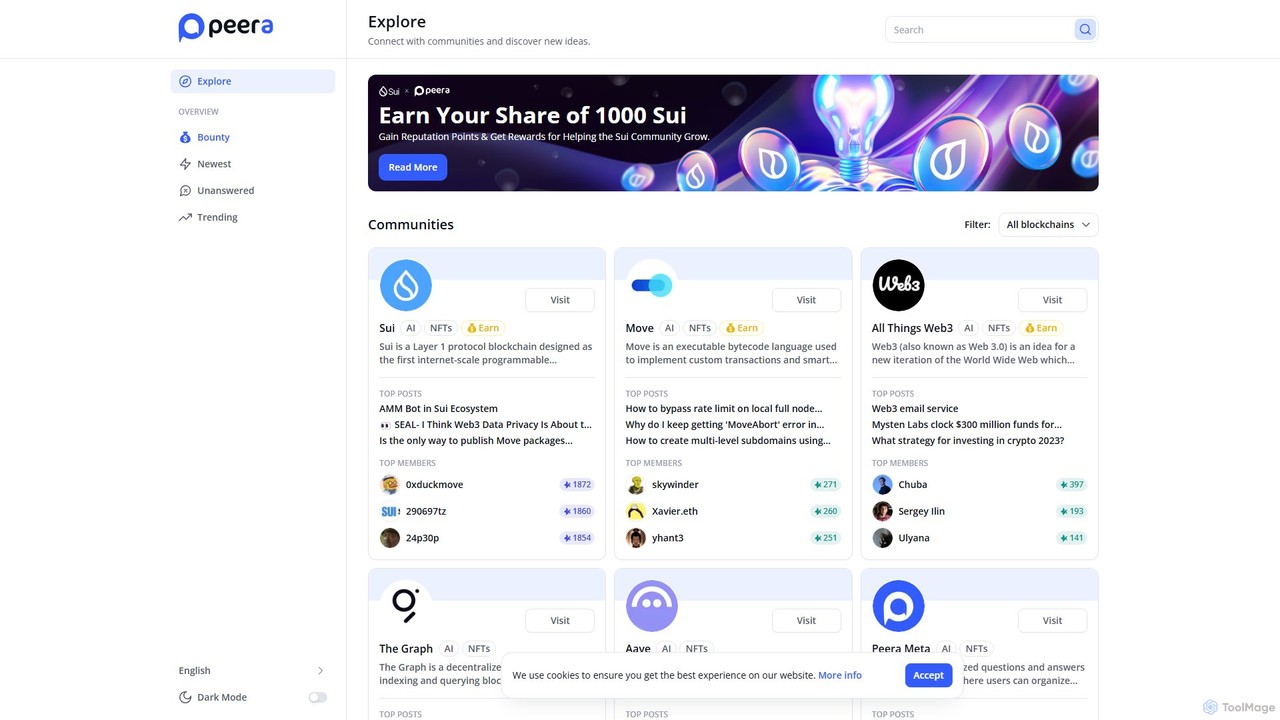
peeranha is a decentralized question-and-answer protocol for the Web3 ecosystem. It connects developers, users, and enthusiasts across various …
peeranha is a decentralized question-and-answer protocol for the Web3 ecosystem. It connects developers, users, and enthusiasts across various blockchain communities like Sui, Polygon, and The Graph. Users can ask technical questions, share knowledge, and earn cryptocurrency rewards and reputation points for their valuable contributions, fostering a collaborative and incentivized learning environment.
About Web3
Web3 AI tools are applications designed to simplify the learning and development process within the decentralized web. These tools leverage artificial intelligence, such as natural language processing and machine learning, to interpret, generate, and audit complex components like smart contracts and dApps. Their primary value lies in lowering the barrier to entry for newcomers and accelerating workflows for experienced developers, making blockchain technology more accessible. By automating code generation and providing intelligent security analysis, they serve as essential educational aids in the Web3 ecosystem.
Core Features
- AI-Powered Code Generation: Automatically creates boilerplate code for smart contracts and dApps based on natural language prompts.
- Smart Contract Auditing: Utilizes AI to scan code for common vulnerabilities, security risks, and inefficiencies, providing explanations and suggestions.
- Blockchain Data Interpretation: Translates complex on-chain data and transaction logs into understandable insights and visualizations.
- Interactive Learning Environments: Offers AI-driven simulations and tutorials for hands-on practice with blockchain concepts without real-world risk.
- Natural Language to Query: Enables users to query blockchain data using plain language instead of specialized query languages.
Applicable Scenarios
These tools are particularly useful for aspiring blockchain developers, computer science students, and experienced programmers transitioning into the Web3 space. They are also valuable for security auditors who need to quickly identify potential flaws in smart contracts, and for product managers prototyping decentralized applications. Educational institutions use them to create more engaging and practical blockchain curricula.
Selection Criteria
When choosing a Web3 AI tool, consider the specific blockchains and smart contract languages (e.g., Solidity, Rust) it supports. Evaluate the depth of its security analysis and the quality of its code generation. For educational purposes, assess the interactivity of its learning modules and the clarity of its explanations. Finally, consider its integration capabilities with standard development environments like Hardhat or Foundry.
Web3Use Cases
Understanding Complex Smart Contracts for Beginners
A computer science student new to blockchain is tasked with understanding an existing DeFi protocol's smart contract written in Solidity. Instead of manually deciphering hundreds of lines of complex code, the student inputs the contract into an AI Web3 tool. The tool generates a line-by-line explanation in plain English, identifies key functions like 'swap' or 'stake', and visualizes the contract's logic flow. This process transforms a multi-day research task into a few hours of guided learning, significantly accelerating their understanding of real-world Web3 applications.
Accelerating dApp Prototyping for Developers
A freelance developer wants to build a prototype for a decentralized voting dApp. They use an AI Web3 tool by providing a simple prompt: 'Create a Solidity smart contract for a voting system with proposals and a one-vote-per-address rule.' The AI generates a functional, well-commented contract in minutes. It also suggests a basic front-end structure using React. This allows the developer to skip hours of initial setup and boilerplate coding, enabling them to focus directly on refining the core logic and user experience for their client presentation.
Conducting Educational Security Audits
A cybersecurity student is learning to identify vulnerabilities in smart contracts. They use an AI auditing tool to analyze a sample contract known to have flaws. The AI tool quickly flags a potential reentrancy vulnerability and a case of integer overflow. More importantly, it provides a detailed explanation of why these are security risks, shows the specific lines of code responsible, and offers code snippets demonstrating the correct, secure implementation. This interactive feedback loop provides a practical, safe environment for learning the critical skill of smart contract security auditing.
Simplifying On-Chain Data Analysis for Researchers
A market researcher without deep technical skills needs to analyze user activity on a popular NFT marketplace. Instead of learning a complex query language like Dune SQL, they use a Web3 AI tool with a natural language interface. They can ask questions like, 'What was the average sale price of CryptoPunks last month?' or 'Show me the top 5 wallets by transaction volume this week.' The AI translates these questions into the appropriate queries, retrieves the on-chain data, and presents it in an easy-to-understand chart, making blockchain data accessible to non-developers.
Creating Interactive Educational Tutorials
An educator wants to create a hands-on tutorial for their 'Introduction to Blockchain' course. They use an AI Web3 platform to build an interactive simulation. In this environment, students can deploy a sample smart contract, send transactions to it, and see the state changes on a simulated blockchain in real-time. The AI provides contextual hints and feedback, correcting common mistakes and explaining concepts like 'gas fees' and 'transaction finality' as students encounter them. This creates a much more engaging and effective learning experience than static reading materials.
Validating a Web3 Idea for Product Managers
A product manager has an idea for a new NFT-based loyalty program but lacks the technical resources to build a proof-of-concept. Using a no-code/low-code AI Web3 tool, they describe the desired functionality: 'Create an NFT collection where tokens are awarded to users based on purchase history.' The AI generates the necessary smart contracts and a simple web interface to mint and view the NFTs. This allows the PM to create a functional demo in a single day, which they can use to validate the concept with stakeholders and potential users before committing development resources.