Engineering Best in category 1 results Mechanical Engineering AI Tool

Popular AI tools in the Mechanical Engineering field of Engineering include Leo AI, etc., helping you quickly improve efficiency.

Leo AI

Leo AI

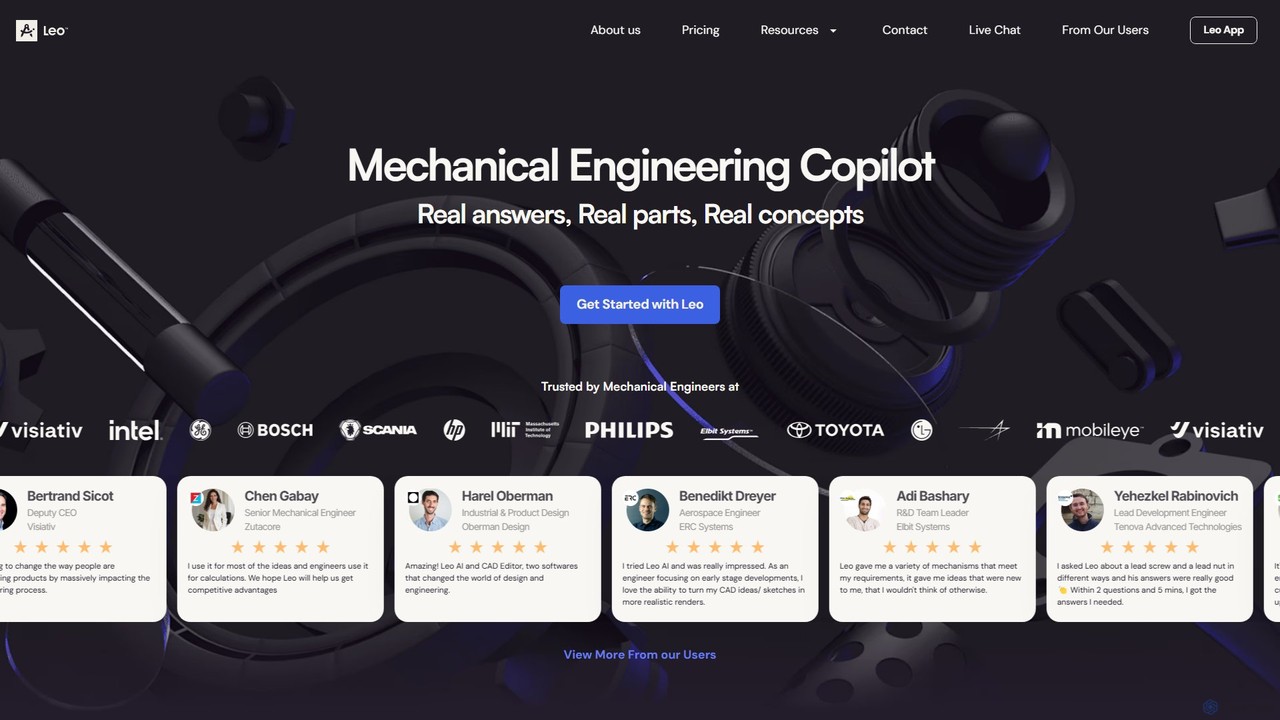
Leo AI is an AI-powered engineering design copilot specifically for mechanical engineers. It accelerates product design by answering …

105.9K

About Mechanical Engineering

Mechanical Engineering AI tools are specialized software solutions that leverage artificial intelligence to enhance the design, analysis, simulation, and optimization of mechanical systems. These tools integrate machine learning, computational fluid dynamics (CFD), and finite element analysis (FEA) with AI algorithms to predict performance, identify design flaws, and automate complex engineering tasks. They empower engineers to accelerate product development cycles, improve structural integrity, and achieve greater efficiency in manufacturing processes.

Core Features

  • Generative Design: Automatically explores thousands of design variations based on specified parameters, materials, and performance goals.
  • Predictive Maintenance: Uses sensor data and AI to forecast equipment failures, optimizing maintenance schedules and reducing downtime.
  • AI-driven Simulation & Analysis: Accelerates complex simulations like CFD and FEA, providing faster and more accurate insights into system behavior.
  • Robotics & Automation Optimization: Enhances the programming and control of industrial robots for improved precision, speed, and adaptability in manufacturing.
  • Material Science AI: Predicts material properties and suggests optimal material selections for specific engineering applications.

Use Cases

Mechanical engineering AI tools are crucial for industries like automotive, aerospace, manufacturing, and energy. They assist design engineers in creating lighter, stronger components, enable production managers to optimize assembly lines, and help R&D teams innovate new materials and processes.

How to Choose

When selecting mechanical engineering AI tools, consider the specific engineering discipline (e.g., structural, thermal, fluid dynamics), integration with existing CAD/CAE software, the complexity of problems it can solve, and the level of customization offered. Evaluate the accuracy of its predictive models and the clarity of its analytical outputs.

Mechanical EngineeringUse Cases

1

Optimizing Automotive Component Design

Automotive engineers use AI generative design to create lightweight yet strong chassis components, reducing material usage and improving fuel efficiency. By inputting performance requirements and constraints, the AI explores thousands of iterations, identifying optimal geometries that traditional methods might miss. This accelerates the design phase and enhances vehicle safety and performance.

2

Predictive Maintenance for Industrial Machinery

Manufacturing plants deploy AI tools to monitor the operational data of critical machinery, such as CNC machines or robotic arms. The AI analyzes vibration, temperature, and pressure readings to predict potential component failures before they occur. This allows maintenance teams to schedule proactive repairs, minimizing unexpected downtime and extending equipment lifespan.

3

Accelerating Aerospace Structural Analysis

Aerospace engineers leverage AI-driven simulation platforms to rapidly analyze the structural integrity of aircraft components under various flight conditions. The AI can quickly process complex FEA models, identifying stress points and potential fatigue areas with higher accuracy than traditional methods. This significantly reduces simulation time, enabling faster design iterations and ensuring compliance with stringent safety standards.

4

Robotics Path Planning and Collision Avoidance

In automated factories, AI algorithms are used to optimize the movement paths of robotic arms for assembly or welding tasks. The AI learns from operational data to create more efficient, collision-free trajectories, improving cycle times and reducing wear on the robots. This leads to higher throughput and safer working environments on the production floor.

5

Designing Advanced Heat Exchangers

Thermal engineers utilize AI tools to design more efficient heat exchangers for HVAC systems or industrial processes. By specifying heat transfer requirements and spatial constraints, the AI generates novel geometries and internal structures that maximize thermal performance while minimizing material volume. This results in more compact, energy-efficient cooling and heating solutions.

6

Material Selection for High-Performance Products

Product development teams use AI-powered material databases and prediction models to select the best materials for new high-performance products, such as medical implants or sports equipment. The AI can predict how different alloys or composites will behave under specific loads and environmental conditions, ensuring optimal performance, durability, and cost-effectiveness.

Mechanical EngineeringFrequently Asked Questions