Standard Wizard
An AI-powered search engine designed for engineers to instantly find and access relevant technical and engineering standards. It …
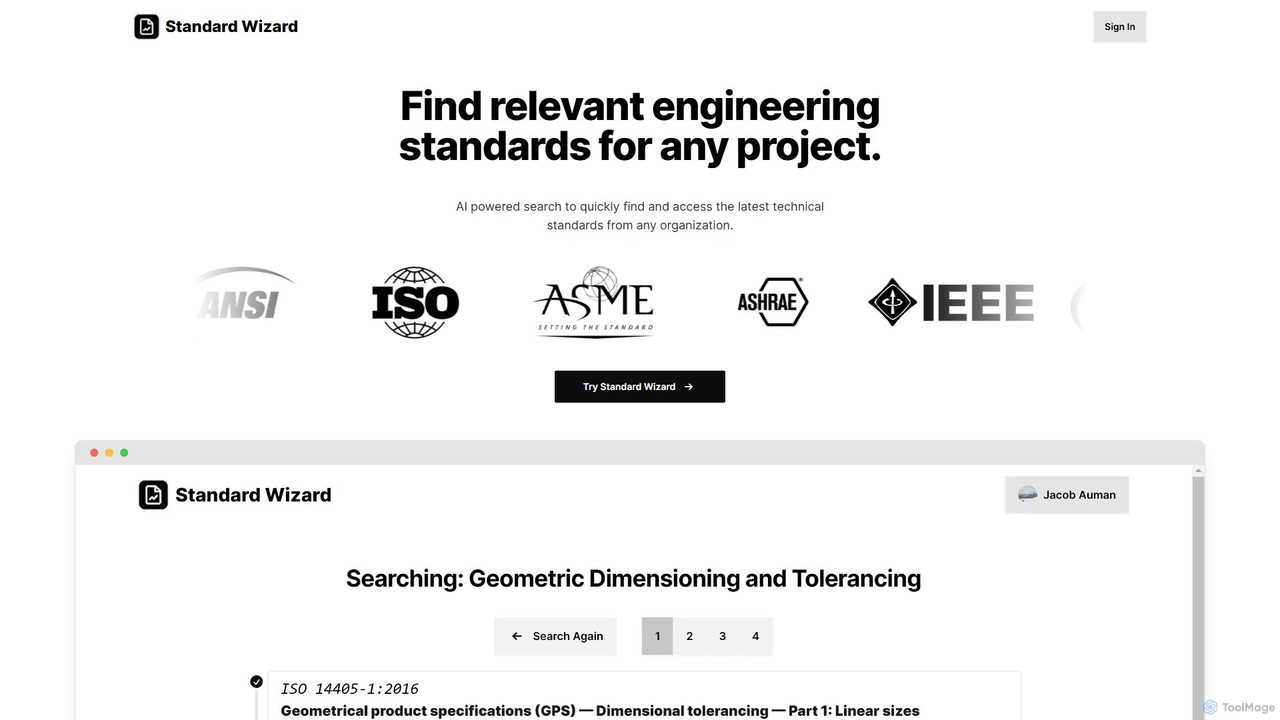
An AI-powered search engine designed for engineers to instantly find and access relevant technical and engineering standards. It utilizes semantic search across a database of over 28,000 standards, providing AI-generated summaries to accelerate research and ensure compliance for any project.
About Technical Standards
AI Technical Standards tools are specialized engineering software that uses artificial intelligence to search, analyze, and manage complex standards documents. Leveraging Natural Language Processing (NLP), these tools interpret dense technical language to identify key requirements and cross-reference clauses across multiple standards like ISO or IEEE. This capability significantly accelerates compliance checks and product development by making critical information accessible and understandable. Unlike simple document viewers, they provide semantic analysis, reducing the risk of misinterpretation and non-compliance.
Core Features
- Semantic Search: Finds relevant clauses based on contextual meaning, not just keyword matches.
- Compliance Checking: Automatically compares product specifications or process documents against standard requirements to identify gaps.
- Standard Comparison: Highlights differences between different versions of a standard or between related standards.
- Requirement Extraction: Automatically identifies and lists all mandatory requirements (e.g., clauses with 'shall' or 'must') from a document.
- Automated Summarization: Generates concise summaries of lengthy and complex sections of a standard.
Use Cases
These tools are primarily used by quality managers, compliance officers, and design engineers in regulated industries such as aerospace, automotive, medical devices, and manufacturing. They are essential for preparing for audits, conducting impact analysis of new standard revisions, and ensuring designs comply with all relevant regulations from the outset.
How to Choose
When selecting a tool, consider the following: Does it support the specific standards your organization uses (e.g., ISO, ASTM, IEC)? What is the depth of its analytical capabilities—does it only search or also perform gap analysis? Can it integrate with your existing Quality Management System (QMS) or Product Lifecycle Management (PLM) software? Finally, evaluate its user interface for ease of use by your team.

Technical StandardsUse Cases
Accelerating Product Compliance Audits
A compliance officer at a medical device company is preparing for an ISO 13485 audit. Instead of manually reviewing hundreds of pages of design documents against the standard, they use an AI tool. They upload the documentation, and the AI automatically cross-references it against every mandatory clause in the standard, flagging potential non-conformities with direct links to the relevant text. This process reduces audit preparation time from weeks to days and significantly lowers the risk of unexpected audit findings.
Analyzing Standard Revisions for Impact
A quality manager in an automotive plant needs to understand the impact of a new IATF 16949 revision. Using an AI tool, they upload both the old and new versions of the standard. The tool performs a side-by-side comparison, automatically highlighting all changed, added, or removed clauses. It also generates a summary report of the key changes, allowing the manager to quickly identify which internal processes and documents need updating, saving dozens of hours of manual review and preventing compliance lapses.
Ensuring Design Compliance from the Start
An aerospace design engineer is developing a new component that must comply with multiple AS9100 and MIL-STD standards. Instead of manually searching through dense PDF documents, the engineer uses an AI tool's semantic search. They can ask plain-language questions like, "What are the material traceability requirements for critical fasteners?" The tool instantly retrieves the exact, relevant clauses from all applicable standards, ensuring the design is compliant from the very beginning and preventing costly rework later in the development cycle.
Automating Regulatory Intelligence Monitoring
A regulatory affairs specialist at a global electronics firm needs to track changes in RoHS and REACH standards. They configure an AI tool to monitor specific standards bodies and regulations. The tool automatically alerts the team when new drafts or revisions are published, providing an AI-generated summary of the changes. This transforms a reactive, manual process into a proactive, automated one, ensuring the company can adapt to regulatory changes quickly and avoid penalties for non-compliance.
Generating Compliance Requirement Checklists
A project manager for a new software project needs to ensure compliance with ISO/IEC 27001 for information security. They use an AI tool to process the standard document. The AI's requirement extraction feature automatically identifies all clauses containing mandatory actions (e.g., 'The organization shall...'). It then exports these requirements into a structured checklist format, compatible with their project management software. This creates a comprehensive and actionable compliance plan in minutes, ensuring no requirement is overlooked during development.
Facilitating Cross-Functional Standards Training
A training coordinator in a large manufacturing organization needs to onboard new employees on the company's ISO 9001 quality management system. They use an AI tool's summarization feature to create easy-to-understand overviews of key sections of the standard. During the training session, they use the tool's semantic search to instantly answer specific questions from trainees, such as "What does the standard say about corrective actions?" This makes the dense material more accessible and engaging for non-experts, improving knowledge retention and overall quality awareness.