ToolMage
Sign in

Best 1 Credit Risk Management AI tools for Finance

Popular Credit Risk Management AI tools in Finance include finbots.ai, helping you work more efficiently.

finbots.ai
Paid

finbots.ai

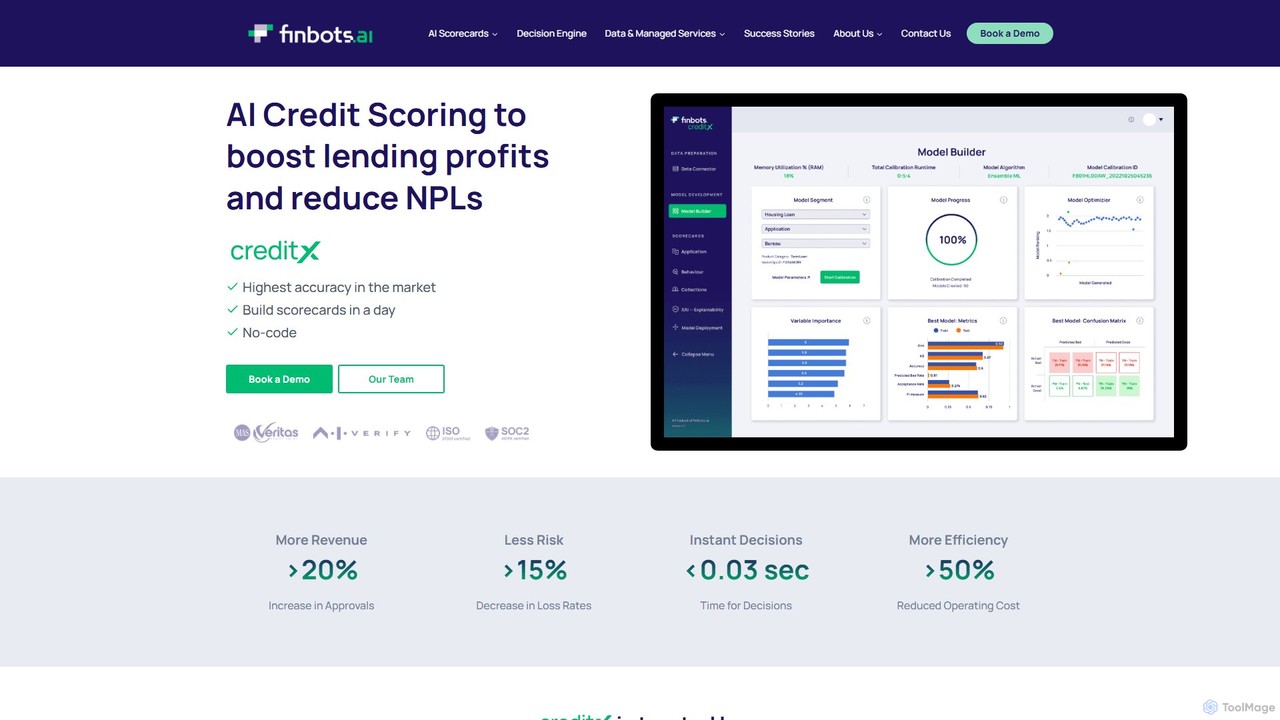
finbots.ai is an AI-powered credit risk management platform for lenders. Its core product, creditX, is a no-code SaaS solution that enables banks, fintechs, and financial institutions to rapidly build, validate, and deploy high-accuracy credit scorecards. It significantly reduces risk, increases loan approvals, and enhances operational efficiency.

Data Analytics
Visits 6.9KFavorites 142Likes 130

About Credit Risk Management

Credit Risk Management AI tools are specialized solutions that leverage artificial intelligence and machine learning to assess, monitor, and mitigate credit risks. These tools analyze vast datasets, including financial history, behavioral patterns, and macroeconomic indicators, to provide accurate risk predictions and automate decision-making processes. They empower financial institutions to make more informed lending decisions, optimize portfolio performance, and ensure regulatory compliance by identifying potential defaults and vulnerabilities proactively.

Core Features

  • Automated Credit Scoring: Generates precise credit scores for applicants using advanced algorithms, reducing manual review time.
  • Early Warning Systems: Identifies deteriorating credit health in existing portfolios through continuous monitoring and anomaly detection.
  • Portfolio Risk Analysis: Provides a comprehensive view of credit exposure across entire portfolios, including concentration risk and stress testing capabilities.
  • Regulatory Compliance Support: Assists in adhering to complex financial regulations by automating data aggregation and reporting for risk models.
  • Fraud Detection Integration: Incorporates capabilities to detect suspicious activities and potential fraud attempts within credit applications and transactions.

Use Cases

These tools are indispensable for banks, lending institutions, fintech companies, and credit unions. They are used by credit analysts to streamline loan origination, by risk managers to maintain portfolio health, and by compliance officers to meet stringent regulatory requirements, ensuring robust financial stability and growth.

How to Choose

When selecting a Credit Risk Management AI tool, prioritize solutions with strong data integration capabilities for diverse sources, transparent and explainable AI models (XAI) for auditability, and scalability to handle growing data volumes. Evaluate its regulatory compliance features, customization options for specific risk appetites, and the vendor's support for model validation and ongoing maintenance.

Credit Risk Management use cases

1

Automated Loan Application Assessment

Loan officers and credit analysts can leverage AI tools to rapidly evaluate new loan applications. By feeding applicant data, including financial history, credit scores, and behavioral information, into the AI model, they receive an objective risk score and a recommended decision. This process significantly accelerates loan origination, ensures consistent decision-making across the board, and reduces the manual effort traditionally required for comprehensive credit checks, leading to faster customer onboarding.

2

Proactive Credit Portfolio Monitoring

Risk managers and portfolio managers in financial institutions utilize AI tools for continuous, proactive monitoring of their existing loan portfolios. The AI system constantly analyzes payment patterns, economic indicators, and other relevant data points to identify early warning signs of potential default or deteriorating credit health. By receiving timely alerts, managers can intervene quickly, restructure loans, or adjust strategies to minimize potential losses and maintain the overall quality and stability of their credit portfolios.

3

Stress Testing and Scenario Analysis

Financial risk analysts and compliance officers employ Credit Risk Management AI tools to conduct rigorous stress testing and scenario analysis. These tools simulate the impact of various adverse economic conditions, such as recessions, interest rate hikes, or industry-specific shocks, on the credit portfolio. By modeling potential credit losses and capital adequacy under these scenarios, institutions can assess their resilience, identify vulnerabilities, and develop robust risk mitigation strategies to meet regulatory requirements and internal risk appetite frameworks.

4

Tailored Credit Product Design

Product developers and marketing teams in lending institutions leverage AI to design highly personalized credit offerings. By analyzing extensive customer data, including demographics, transaction history, and risk profiles, AI can identify distinct customer segments and their specific financial needs and risk appetites. This insight enables the creation of customized loan products, credit limits, and pricing strategies that are more attractive to target customers, leading to increased customer acquisition and an optimized balance between risk and reward for the institution.

5

Regulatory Compliance and Reporting Automation

Compliance officers and internal auditors rely on AI-powered Credit Risk Management tools to ensure adherence to complex financial regulations such as Basel III, IFRS 9, and local banking laws. These tools automate the collection, validation, and aggregation of vast amounts of data required for risk calculations and regulatory reports. By streamlining these processes, institutions can ensure accuracy, consistency, and timeliness in their submissions, significantly reducing the compliance burden, minimizing the risk of regulatory fines, and improving overall audit readiness.

6

Fraud Detection and Anomaly Identification

Fraud prevention specialists and security analysts integrate Credit Risk Management AI tools to enhance their ability to detect suspicious activities indicative of credit fraud. AI algorithms analyze vast amounts of transaction data, application forms, and behavioral metrics to identify unusual patterns or deviations from normal credit behavior that human analysts might miss. This capability allows for the early detection of fraudulent attempts, protecting financial institutions from significant losses and safeguarding the integrity of their lending operations.

Credit Risk Management FAQ

What are AI tools for Credit Risk Management?

AI tools for Credit Risk Management are software solutions that use artificial intelligence and machine learning to analyze credit data, predict defaults, and manage risk exposure. They leverage advanced algorithms to process vast datasets, identify complex patterns, and automate risk assessment processes. These tools aim to enhance the accuracy of credit decisions, improve portfolio performance, and ensure compliance with regulatory standards, offering a more dynamic and data-driven approach than traditional methods.

How do I choose the right AI solution for credit risk management?

Choosing the right AI solution involves several key factors. First, assess its data integration capabilities to ensure it can connect with your existing systems and diverse data sources. Second, prioritize solutions with transparent and explainable AI (XAI) models, crucial for regulatory compliance and auditability. Third, consider scalability to accommodate future growth and increasing data volumes. Finally, evaluate the vendor's expertise, support for model validation, and ongoing maintenance, alongside its features for specific regulatory compliance requirements.

What are the main benefits of using AI in credit risk management?

The main benefits of using AI in credit risk management include significantly improved accuracy in risk prediction, leading to fewer defaults and better lending decisions. AI enables faster processing of applications and continuous, real-time monitoring of portfolios, enhancing operational efficiency. It also helps in identifying subtle risk patterns that human analysts might miss, reduces human bias in decision-making, and supports robust regulatory compliance through automated reporting and stress testing, ultimately leading to optimized capital allocation and reduced losses.

What AI technologies are commonly used in credit risk management?

Credit risk management AI tools commonly employ a range of advanced technologies. Machine learning algorithms, such as neural networks, gradient boosting, and support vector machines, are fundamental for predictive modeling and credit scoring. Natural Language Processing (NLP) is used to analyze unstructured data from loan applications, news articles, or social media for additional risk insights. Big data processing capabilities are essential to handle the massive volumes of financial and behavioral data, while predictive analytics and statistical modeling form the core for forecasting future credit events.

How do AI-powered credit risk management tools differ from traditional methods?

AI-powered credit risk management tools differ significantly from traditional methods by offering enhanced capabilities in data processing, pattern recognition, and adaptability. Traditional methods often rely on statistical models, expert rules, and limited datasets, which can be prone to human bias and struggle with complex, non-linear relationships. AI tools, conversely, can process vast, diverse datasets (structured and unstructured), identify subtle, non-obvious risk indicators, and continuously learn and adapt to changing market conditions, providing more dynamic, accurate, and efficient risk assessments with reduced operational costs.