ToolMage
Sign in

Best 1 Financial Advisor AI tools for Finance

Popular Financial Advisor AI tools in Finance include MoneyMade, helping you work more efficiently.

MoneyMade
Free

MoneyMade

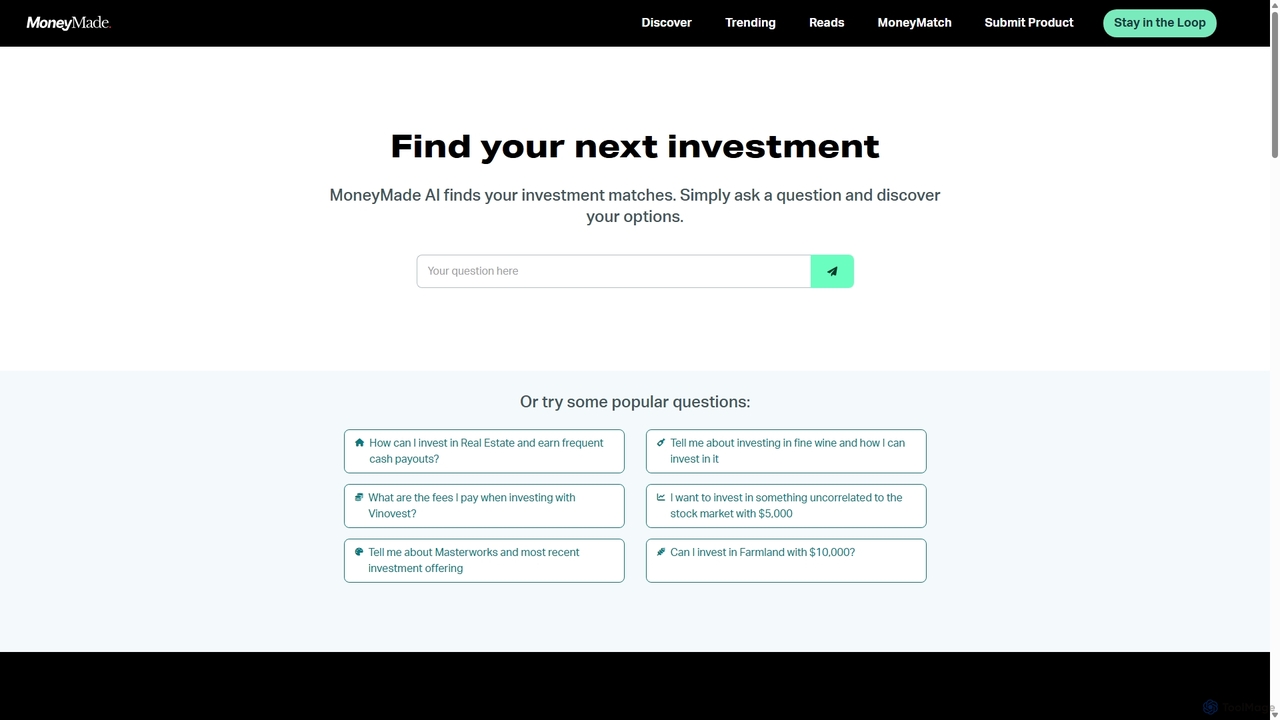
MoneyMade is an AI-powered investment discovery platform designed to help users find and compare opportunities, particularly in alternative assets. Its AI chat assistant provides personalized recommendations based on user goals. The platform features a comprehensive marketplace of over 180 investment platforms across categories like real estate, fine art, crypto, and farmland, complete with detailed information and educational content to empower informed financial decisions.

Financial Advisor
Visits 37.9KFavorites 106Likes 97

About Financial Advisor

AI Financial Advisor tools are intelligent platforms that use algorithms and machine learning to provide personalized financial guidance and automated investment management. They analyze your financial data, risk tolerance, and goals to create and manage investment portfolios, functioning similarly to a human advisor. These tools make sophisticated financial planning accessible by automating tasks like portfolio rebalancing, tax optimization, and market analysis. This approach offers a data-driven, low-cost alternative for managing personal wealth and planning for long-term financial objectives.

Core Features

  • Portfolio Analysis & Recommendation: Assesses your current investments and suggests data-driven adjustments to align with your goals.
  • Automated Rebalancing: Automatically buys and sells assets to maintain your target portfolio allocation over time.
  • Goal-Based Planning: Creates tailored investment strategies for specific objectives like retirement, home purchase, or education.
  • Tax Optimization: Implements strategies such as tax-loss harvesting to help reduce your tax burden on investment gains.
  • Market Forecasting: Utilizes predictive models to identify potential market trends and investment opportunities.

Use Cases

These tools are ideal for individual investors, from beginners seeking a guided entry into the market to experienced investors wanting to automate portfolio management. They are widely used for retirement planning, wealth accumulation, and managing diversified investment accounts like IRAs and taxable brokerage accounts.

How to Choose

When selecting an AI Financial Advisor, consider the management fees, the range of investment options (e.g., ETFs, stocks), the level of personalization available, and the platform's security measures. Also, evaluate the minimum investment requirement and whether the tool offers access to human advisors for more complex needs.

Financial Advisor use cases

1

Automated Portfolio Building for New Investors

An individual just starting their investment journey uses an AI Financial Advisor to navigate the complexities of the market. After answering a series of questions about their financial goals, income, and risk tolerance, the AI platform automatically constructs a diversified portfolio of low-cost Exchange-Traded Funds (ETFs). The tool handles all the initial investments and sets up recurring deposits, providing a simple, hands-off way to begin building wealth without requiring extensive financial knowledge.

2

Strategic Retirement Planning and Simulation

A professional in their 40s wants to ensure they are on track for retirement. They link their existing retirement accounts (like a 401(k) and IRA) to an AI Financial Advisor. The tool analyzes their current savings rate, projected expenses, and investment allocation. It then runs thousands of simulations to forecast the likelihood of reaching their retirement goal and suggests specific adjustments, such as increasing monthly contributions or shifting to a slightly more aggressive portfolio to improve outcomes.

3

Efficient Portfolio Rebalancing for Busy Professionals

An experienced investor with a busy career lacks the time for daily portfolio monitoring. They use an AI Financial Advisor to automate rebalancing. As market fluctuations cause their asset allocation to drift from its target (e.g., 60% stocks, 40% bonds), the AI automatically executes trades to bring it back in line. This ensures the portfolio's risk level remains consistent with their strategy without requiring manual intervention.

4

Automating Tax-Loss Harvesting

An investor with a significant taxable brokerage account uses an AI advisor to minimize their tax liability. The platform continuously monitors their portfolio for opportunities to sell investments at a loss. These losses are then used to offset capital gains from other investments, potentially lowering their year-end tax bill. The AI automatically handles these transactions while maintaining the portfolio's overall risk and diversification profile.

5

Identifying Investment Opportunities with AI

An active investor seeks to supplement their own research with data-driven insights. They use an AI Financial Advisor that provides advanced market analysis and trend forecasting. The tool scans vast amounts of market data, news, and financial reports to identify undervalued assets or emerging sector trends. It then provides actionable alerts and research, helping the investor make more informed decisions faster than manual analysis would allow.

6

Unified Financial Planning for Couples

A couple is planning to buy a house and save for their child's education. They use an AI Financial Advisor to link and view all their separate and joint accounts in one place. The tool helps them create a unified budget and set up specific investment goals for each objective. It provides a clear roadmap, showing how much they need to save collectively and how to invest those funds to reach their shared financial milestones on schedule.

Financial Advisor FAQ

What is an AI Financial Advisor?

An AI Financial Advisor is a digital platform that uses algorithms to provide automated, data-driven financial planning and investment management services. Unlike simple budgeting apps, these tools offer personalized advice on building a portfolio, planning for retirement, and optimizing investments based on your specific financial situation and goals. They function as a virtual advisor, making sophisticated wealth management more accessible and affordable.

How do I choose the right AI Financial Advisor tool?

To choose the right tool, consider these factors:

  • Fees: Compare management fees, expense ratios of underlying investments, and any subscription costs.
  • Investment Options: Check if the platform offers a diverse range of assets like ETFs, stocks, or socially responsible investments that align with your strategy.
  • Personalization & Features: Evaluate its ability to tailor advice to your goals and whether it offers features like tax optimization or access to human advisors.
  • Security: Ensure the platform uses strong encryption and is regulated by relevant financial authorities (e.g., SEC in the US).
What's the difference between an AI and a human financial advisor?

The primary differences lie in cost, accessibility, and the type of advice. AI advisors typically have lower fees, are available 24/7, and provide objective, data-driven recommendations. Human advisors charge more but offer personalized guidance for complex financial situations (like estate planning), provide emotional support during market volatility, and can build a deep, long-term relationship. Many investors use a hybrid approach, leveraging AI for portfolio management and a human for holistic planning.

Are AI Financial Advisors safe and trustworthy?

Reputable AI Financial Advisors are generally safe. They are typically registered with financial regulatory bodies and use bank-level security measures like two-factor authentication and strong encryption to protect your data and assets. In the United States, many services also offer SIPC insurance, which protects your securities up to $500,000 in case the brokerage firm fails. However, it's crucial to research the platform's reputation and security protocols before investing.

Who is the ideal user for an AI Financial Advisor?

AI Financial Advisors are ideal for several types of users. They are excellent for beginners who need guidance to start investing, for cost-conscious individuals seeking low-fee portfolio management, and for tech-savvy investors who prefer a hands-off, automated approach. They are also suitable for people with straightforward financial goals. Individuals with very complex financial needs, large estates, or a strong preference for face-to-face interaction might still prefer a traditional human advisor.