ToolMage
Sign in

Best 1 Insurance Analysis AI tools for Finance

Popular Insurance Analysis AI tools in Finance include Claritate, helping you work more efficiently.

Claritate
Freemium

Claritate

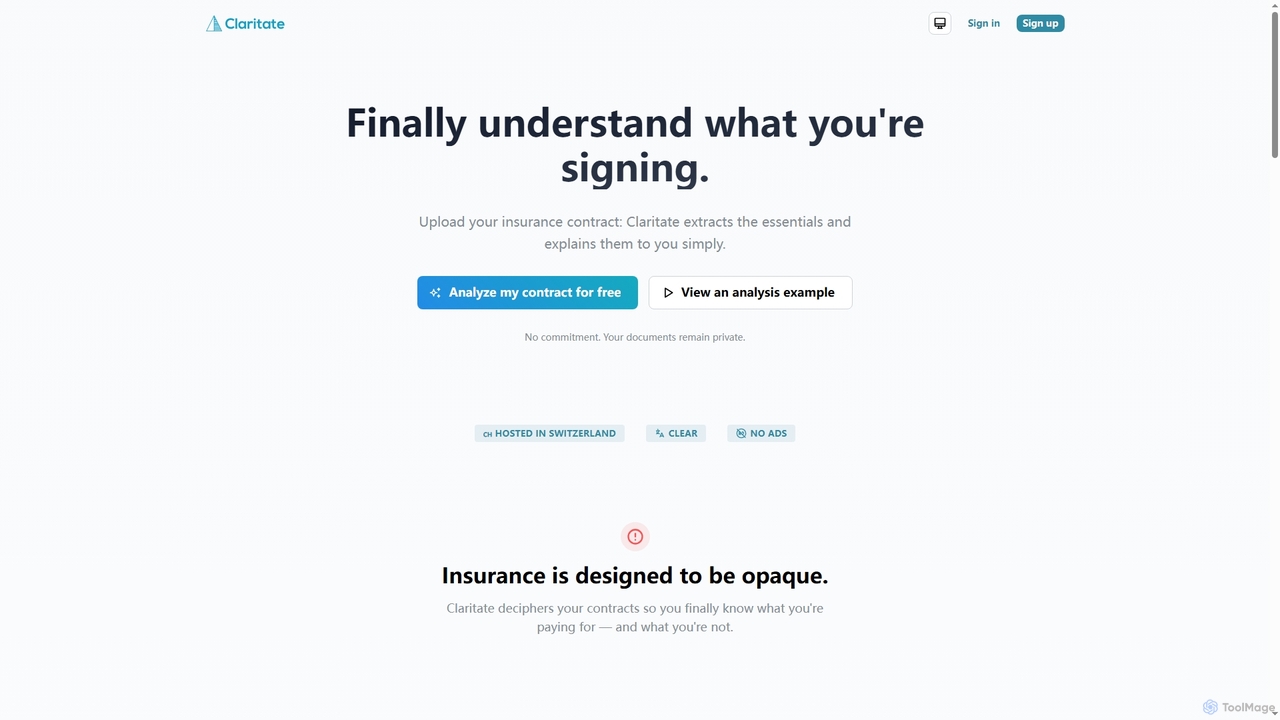
Claritate is an AI-powered tool designed to simplify complex insurance contracts. Users upload their PDF documents to receive clear, human-language summaries, understand coverage details, costs, and exclusions, and get direct answers to specific questions, empowering them to make informed decisions about their insurance policies.

Insurance Analysis
Visits 6.1KFavorites 127Likes 146

About Insurance Analysis

Insurance Analysis tools are AI-powered platforms designed to process, interpret, and derive insights from vast amounts of insurance-related data. These tools leverage machine learning and predictive analytics to assess risks, optimize pricing, and personalize policy recommendations. They enable insurers, brokers, and policyholders to make data-driven decisions, enhancing efficiency and accuracy across the insurance lifecycle.

Core Features

  • Risk Assessment & Underwriting: Automates the evaluation of risk factors for policy applicants, determining eligibility and premium rates.
  • Fraud Detection: Identifies suspicious patterns and anomalies in claims data, flagging potential fraudulent activities.
  • Personalized Policy Recommendation: Analyzes customer profiles and behaviors to suggest tailored insurance products and coverage options.
  • Claims Processing Automation: Streamlines claims handling from submission to payout by automating data extraction and validation.
  • Actuarial Modeling & Pricing Optimization: Utilizes advanced algorithms to forecast liabilities and optimize premium structures for profitability.

Use Cases

Insurance companies use these tools to enhance their underwriting processes, accurately price policies, and detect fraudulent claims. Financial advisors leverage them to provide clients with personalized insurance advice, while regulators can monitor market fairness and compliance.

How to Choose

When selecting an Insurance Analysis tool, consider its data integration capabilities with existing systems, the accuracy and explainability of its AI models, compliance with industry regulations, and the specific analytical features (e.g., fraud detection, risk modeling) most critical to your operations.

Insurance Analysis use cases

1

Automating Underwriting Decisions

An insurance underwriter uses an AI insurance analysis tool to instantly assess applicant risk profiles based on hundreds of data points, significantly reducing manual review time and ensuring consistent policy issuance. This leads to faster policy approvals and a more efficient underwriting process, allowing the underwriter to focus on complex cases.

2

Detecting Fraudulent Claims

A claims investigator employs the tool to scan incoming claims for unusual patterns, inconsistencies, or historical red flags, allowing them to prioritize high-risk cases and prevent substantial financial losses. The AI's ability to process vast amounts of data quickly enhances the accuracy of fraud detection, saving the company significant resources.

3

Optimizing Insurance Product Pricing

An actuary utilizes the AI platform to run complex simulations with various market conditions and demographic data, fine-tuning premium rates to remain competitive while maintaining profitability. This dynamic pricing capability allows insurers to respond quickly to market changes and customer segments, ensuring optimal revenue generation and risk management.

4

Personalizing Client Policy Recommendations

A financial advisor inputs a client's financial situation, lifestyle, and future goals into the tool, which then generates a customized portfolio of insurance products (life, health, property) tailored to their specific needs. This personalized approach enhances client trust and satisfaction, leading to higher conversion rates and long-term client relationships for the advisor.

5

Predicting Policyholder Churn

A customer retention manager uses the analysis tool to identify policyholders at high risk of cancelling their policies, enabling proactive outreach with retention offers or personalized service improvements. By predicting churn before it happens, insurers can implement targeted strategies to retain valuable customers, significantly reducing customer acquisition costs and improving overall loyalty.

6

Streamlining Claims Processing

An insurance claims department integrates the AI tool to automate initial claims triage, document verification, and even minor payout approvals, drastically speeding up resolution times and improving customer satisfaction. This automation frees up human adjusters to focus on complex or contested claims, leading to more efficient operations and reduced administrative overhead.

Insurance Analysis FAQ

What are AI Insurance Analysis tools?

AI Insurance Analysis tools are specialized software applications that use artificial intelligence, including machine learning and predictive analytics, to analyze vast datasets within the insurance sector. They help automate complex tasks like risk assessment, fraud detection, and claims processing, providing data-driven insights to improve operational efficiency and decision-making for insurers and related financial entities.

How do AI tools enhance insurance risk assessment?

AI tools enhance risk assessment by processing and correlating a multitude of data points—from historical claims and demographic information to external economic indicators—far beyond human capacity. They identify subtle patterns and predict potential risks with greater accuracy, allowing insurers to set more precise premiums and make informed underwriting decisions, leading to a healthier risk portfolio.

What's the difference between traditional insurance analytics and AI insurance analysis?

Traditional insurance analytics primarily relies on historical data and statistical methods to identify trends and report past performance. AI insurance analysis, however, uses advanced machine learning algorithms to not only analyze historical data but also to predict future outcomes, detect complex fraud patterns, and personalize recommendations in real-time, offering more dynamic and proactive insights. AI provides a forward-looking, adaptive approach compared to the retrospective view of traditional methods.

Can AI Insurance Analysis tools detect fraud effectively?

Yes, AI Insurance Analysis tools are highly effective in detecting fraud. They can analyze massive volumes of claims data, identify anomalies, suspicious networks, and behavioral patterns that human investigators might miss. By continuously learning from new data, these tools improve their ability to flag potentially fraudulent claims, significantly reducing losses for insurance companies and enhancing the integrity of the insurance system.

Who benefits most from using Insurance Analysis AI?

Insurance companies, brokers, and financial advisors benefit most from Insurance Analysis AI. Insurers gain improved underwriting accuracy, reduced fraud losses, and optimized pricing. Brokers and advisors can offer more personalized and data-backed policy recommendations, enhancing client trust and satisfaction. Policyholders indirectly benefit from more accurate pricing, faster claims processing, and tailored coverage options.

How to choose the right AI Insurance Analysis tool?

Choosing the right AI Insurance Analysis tool involves several key considerations. First, assess its integration capabilities with your existing systems (CRM, policy administration). Second, evaluate the accuracy, explainability, and transparency of its AI models, especially for critical functions like risk assessment and fraud detection. Third, ensure compliance with relevant industry regulations (e.g., GDPR, CCPA). Finally, consider the specific features that align with your primary business needs, such as advanced actuarial modeling, claims automation, or customer personalization capabilities.