
Fewsats
Fewsats is a secure payment infrastructure designed specifically for AI agents. It enables AI to make transactions for …
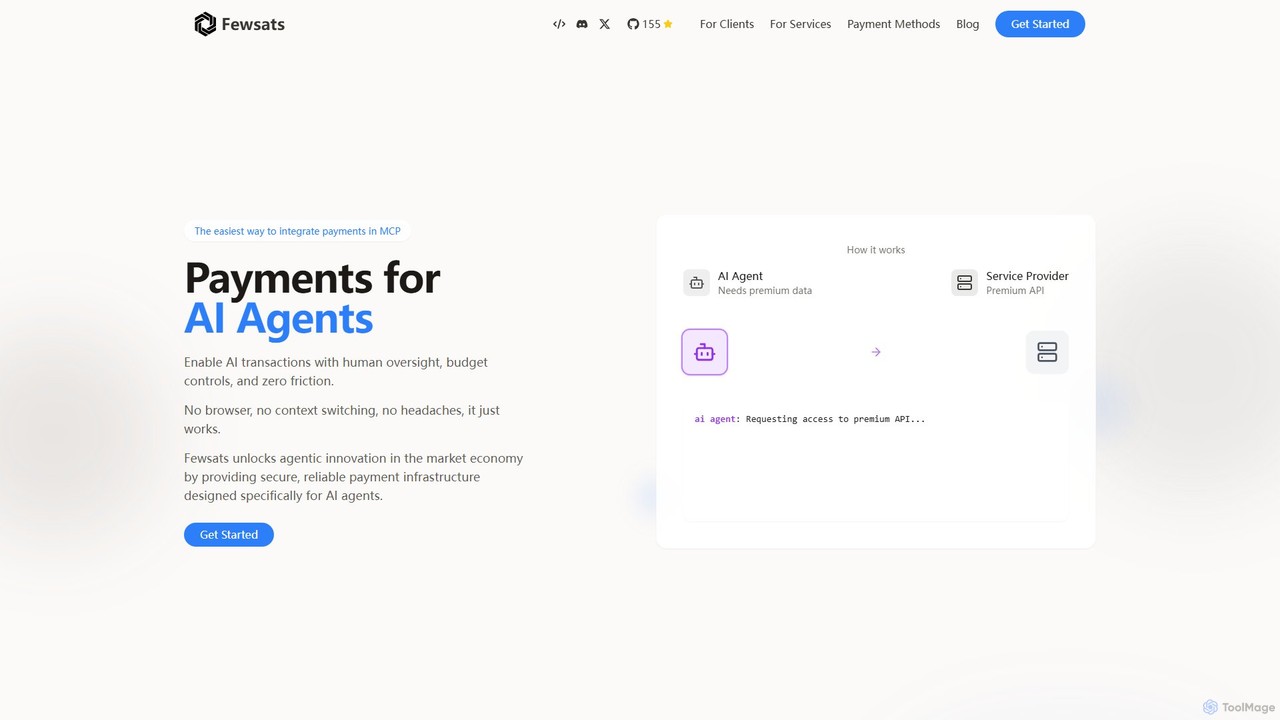
Fewsats is a secure payment infrastructure designed specifically for AI agents. It enables AI to make transactions for services like premium APIs, with complete human oversight, budget controls, and a frictionless experience. It empowers developers to build more capable autonomous agents that can participate in the market economy.
About Payment Gateway
AI Payment Gateways are services that securely authorize and process online transactions for businesses using artificial intelligence. These tools leverage machine learning algorithms to analyze transaction data in real-time, identifying complex fraud patterns and assessing risk with high accuracy. This not only protects merchants and customers from financial loss but also optimizes payment approval rates by reducing false declines. Unlike traditional systems, AI-driven gateways continuously learn and adapt to new threats, ensuring robust security and a smoother checkout experience.
Core Features
- AI-Powered Fraud Detection: Analyzes hundreds of data points per transaction to identify and block fraudulent attempts in real-time.
- Dynamic Risk Scoring: Assigns a dynamic risk score to each payment, enabling automated and more accurate transaction decisions.
- Smart Transaction Routing: Intelligently directs payments to the optimal acquiring bank to maximize success rates and minimize processing fees.
- Automated Chargeback Management: Uses AI to analyze dispute data, gather evidence, and automate the chargeback representation process.
- Behavioral Analytics: Models customer purchasing behavior to distinguish legitimate users from fraudulent actors, reducing friction for good customers.
Use Cases
AI Payment Gateways are essential for e-commerce platforms, subscription-based SaaS businesses, online marketplaces, and digital service providers. For instance, an international online store uses it to reduce cross-border fraud, while a subscription service leverages it to minimize involuntary churn from failed recurring payments.
How to Choose
When selecting an AI Payment Gateway, consider its integration capabilities with your existing e-commerce platform (like Shopify or WooCommerce). Evaluate the sophistication of its AI fraud detection models and its compliance with standards like PCI DSS. Also, analyze the pricing structure, including transaction fees and any monthly costs, and assess its support for global currencies and local payment methods if you sell internationally.
Payment GatewayUse Cases
Real-Time Fraud Prevention for Online Stores
An e-commerce manager for a high-volume online fashion retailer uses an AI payment gateway to combat sophisticated fraud. The system analyzes customer behavior, device fingerprints, IP geolocation, and transaction history in milliseconds. When a high-risk order is detected—such as an unusual purchase amount from a new device routed through a proxy—the gateway automatically flags it for manual review or blocks it, preventing fraudulent chargebacks. This has led to a 70% reduction in successful fraudulent transactions and protected the store's profit margins without adding friction for legitimate customers.
Optimizing Subscription Billing and Reducing Churn
A SaaS company providing project management software relies on recurring revenue. They implement an AI payment gateway to reduce involuntary churn caused by failed payments. The gateway's 'smart retry' logic attempts to process failed transactions at times when they are most likely to succeed (e.g., after payday). It also automatically communicates with card networks to update expired or replaced card details. This automated process has recovered over 15% of previously failed recurring payments, directly boosting customer retention and stabilizing monthly recurring revenue (MRR).
Streamlining Payouts for Online Marketplaces
An online marketplace connecting freelance graphic designers with clients uses an AI payment gateway to manage complex payouts. When a client pays for a project, the gateway automatically splits the payment, deducting the marketplace's commission and routing the remainder to the freelancer's account. The AI component helps verify seller identities to comply with KYC (Know Your Customer) regulations and assesses the risk of each transaction to prevent payment fraud between parties. This automation saves the platform hundreds of administrative hours per month and ensures timely, compliant payments to its global user base.
Personalizing Checkout with Dynamic Payment Methods
A global e-learning platform selling courses worldwide uses an AI payment gateway to increase conversion rates. The gateway's AI analyzes a user's location, device, and past transaction data to dynamically display the most relevant payment options. For a user in Germany, it might prioritize Sofort and Giropay, while for a user in the Netherlands, iDEAL would be shown first. For mobile users, digital wallets like Apple Pay or Google Pay are prominently displayed. This personalization removes friction from the checkout process, making it faster and more intuitive, which has resulted in a 10% uplift in completed purchases.
Automating Chargeback Dispute Resolution
A large online retailer dealing with thousands of transactions daily faces a significant number of chargeback disputes. They use an AI payment gateway with an automated dispute management feature. When a chargeback is filed, the AI system automatically gathers and submits compelling evidence, such as delivery confirmations, IP logs of the purchase, and customer communication records. It analyzes the reason code for the chargeback and tailors the evidence packet accordingly. This automation has increased their chargeback win rate by 40% and freed up their finance team to focus on more strategic tasks instead of manual evidence collection.
Enhancing Security with Behavioral Biometrics
A digital banking application integrates an AI payment gateway to secure high-value transfers. Beyond standard checks, the AI employs behavioral biometrics. It analyzes how a user interacts with the app—their typing speed, mouse movements, and phone handling angles. If a user's behavior deviates significantly from their established profile during a transaction, even with the correct password, the system triggers an additional verification step, like a one-time password or biometric scan. This advanced security layer has successfully prevented account takeover fraud in 99% of detected cases, building customer trust.