ToolMage
Sign in

Best 2 Payment AI tools for Finance

Popular Payment AI tools in Finance include WhoMakeMoney and NoDial, helping you work more efficiently.

WhoMakeMoney
Freemium

WhoMakeMoney

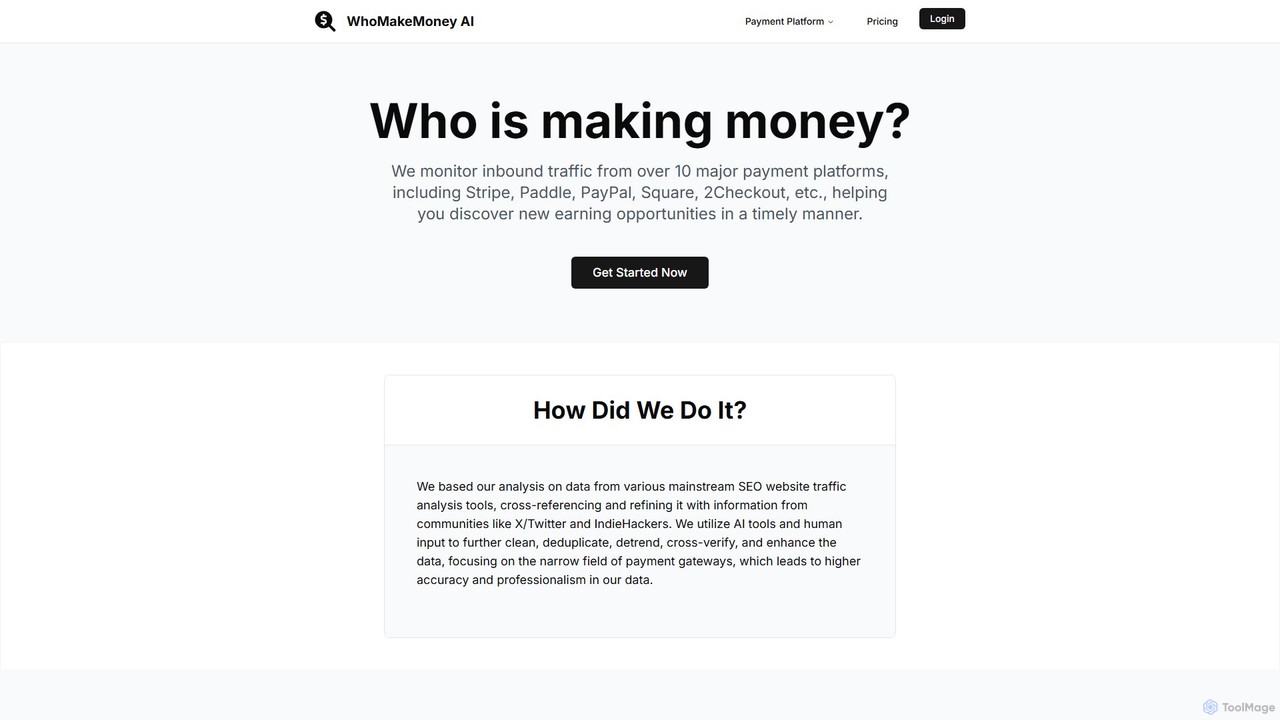
WhoMakeMoney is an AI-powered market intelligence platform that monitors inbound traffic to major payment gateways like Stripe, Paddle, and PayPal. It helps entrepreneurs, indie hackers, and businesses discover emerging trends, validate ideas, and identify new money-making opportunities by analyzing which websites are successfully generating revenue.

Market Research
Visits 3.3KFavorites 136Likes 110
NoDial
Paid

NoDial

NoDial is a powerful tool for professionals using Calendly, designed to eliminate no-shows by requiring a refundable deposit. It seamlessly integrates with Stripe to handle payments and offers one-click refunds, real-time lead tracking, and support for over 130 currencies. This helps users save time, secure their revenue, and ensure clients are committed to their appointments.

Payment
Visits 3.3KFavorites 133Likes 133

About Payment

AI Payment tools are a category of advanced software solutions that leverage artificial intelligence to automate, optimize, and secure financial transactions. These tools utilize machine learning, natural language processing, and predictive analytics to streamline payment processing, enhance fraud detection, and improve overall financial operations. They empower businesses to manage diverse payment methods efficiently, reduce operational costs, and deliver a seamless customer experience in the rapidly evolving digital economy.

Core Features

  • Automated Transaction Processing: Efficiently handles high volumes of payments, from initiation to settlement, across various channels.
  • Advanced Fraud Detection: Employs machine learning algorithms to identify and prevent suspicious activities and fraudulent transactions in real-time.
  • Payment Gateway Integration: Seamlessly connects with multiple payment gateways and financial systems for broader compatibility and reach.
  • Customer Support Automation: Utilizes AI chatbots and NLP to resolve payment-related queries and disputes quickly.
  • Financial Reporting & Analytics: Provides deep insights into payment trends, customer behavior, and operational performance through data analysis.

Applicable Scenarios

E-commerce businesses use these tools to manage secure online transactions and subscription billing. Financial institutions deploy them for high-volume payment processing and robust fraud prevention. SaaS providers benefit from automated recurring billing and churn prediction based on payment data.

How to Choose

When selecting an AI Payment tool, prioritize robust security features and compliance with standards like PCI DSS. Evaluate its integration capabilities with existing CRM, ERP, and accounting systems. Consider scalability to handle future transaction volumes and assess the clarity and fairness of its pricing model. Finally, examine the sophistication of its AI capabilities, especially for fraud detection and predictive analytics.

Featured tool rankings

Payment use cases

1

Automated Fraud Detection for E-commerce

E-commerce managers utilize AI Payment tools to continuously monitor transaction patterns, identify anomalies, and automatically flag or block suspicious payments in real-time. This proactive approach significantly reduces chargebacks, protects revenue, and enhances customer trust by preventing fraudulent activities before they impact the business.

2

Optimizing Subscription Billing for SaaS Platforms

SaaS companies deploy AI to manage complex recurring billing cycles, predict potential customer churn by analyzing payment history and behavior, and automate dunning processes for failed payments. This ensures consistent revenue collection, minimizes involuntary churn, and frees up finance teams from manual follow-ups.

3

Enhancing Customer Support for Payment Inquiries

Financial service providers and online retailers integrate AI-powered chatbots to handle a high volume of customer queries related to payment status, billing discrepancies, refund processes, and account issues. These chatbots provide instant, accurate responses 24/7, improving customer satisfaction and reducing the workload on human support agents.

4

Streamlining Cross-Border Payments for Global Operations

International businesses leverage AI Payment solutions to navigate the complexities of global transactions. These tools automate currency conversions, optimize payment routing to minimize fees, and ensure compliance with diverse international financial regulations, making cross-border payments faster, more cost-effective, and transparent.

5

Personalized Payment Recommendations in Retail

Retail businesses employ AI to analyze individual customer purchasing habits and preferences, offering tailored payment options at checkout. This could include suggesting specific credit card rewards, buy-now-pay-later schemes, or preferred digital wallets, thereby improving conversion rates and enhancing the overall shopping experience.

6

Real-time Financial Reconciliation for Large Enterprises

Large organizations use AI to automate the reconciliation of transactions across multiple bank accounts, payment gateways, and internal ledgers. The AI identifies and flags discrepancies instantly, generates comprehensive reports, and significantly reduces the time and effort traditionally spent on manual reconciliation, ensuring financial accuracy and compliance.

Payment FAQ

What are AI Payment tools?

AI Payment tools are software solutions that use artificial intelligence, such as machine learning and natural language processing, to automate and enhance various aspects of financial transactions. They are designed to improve efficiency, security, and customer experience in payment processing, from fraud detection to automated reconciliation.

How to choose the right AI Payment solution for my business?

To choose the right AI Payment solution, consider your specific business needs, such as transaction volume and types. Prioritize solutions with robust security and compliance features, seamless integration capabilities with your existing infrastructure, and proven scalability. Evaluate the sophistication of its AI for fraud detection and analytics, and compare pricing models to find a cost-effective fit.

What are the main benefits of using AI in payments?

The main benefits include increased efficiency through automation of routine tasks, enhanced security via sophisticated fraud detection, improved accuracy by minimizing manual errors, better customer experience with faster and more reliable transactions, and valuable insights from payment data analytics for strategic decision-making.

How do AI Payment tools enhance security?

AI Payment tools significantly enhance security through advanced fraud detection algorithms that analyze vast amounts of transaction data in real-time to identify unusual patterns and anomalies indicative of fraud. They can also implement dynamic authentication methods and ensure compliance with stringent security standards like PCI DSS, protecting both businesses and customers.

How do AI Payment tools differ from traditional payment systems?

Traditional payment systems primarily facilitate transactions based on predefined rules, while AI Payment tools go further by learning from data, adapting to new patterns, and making intelligent decisions. AI tools offer real-time, adaptive fraud detection, predictive analytics, and automated, intelligent processing that traditional systems lack, providing a more dynamic and secure payment environment.