SafeBet
SafeBet is an AI-powered platform that provides daily sports betting picks. By analyzing vast amounts of data across …
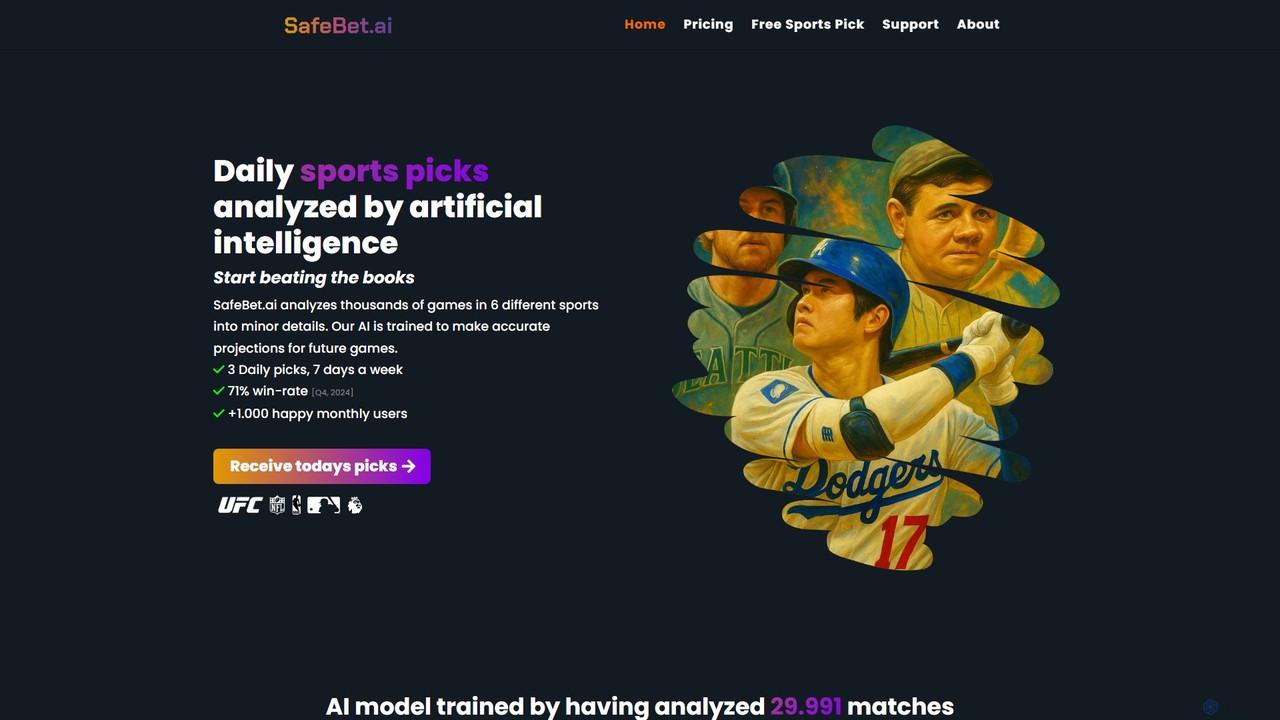
SafeBet is an AI-powered platform that provides daily sports betting picks. By analyzing vast amounts of data across sports like the NBA, NFL, and Soccer, it generates data-driven predictions to help users make informed, unemotional betting decisions. Picks are delivered via a private Telegram channel, complete with detailed reports and an 'AI Safe Score' to assess risk.
About Predictive Analytics
Predictive Analytics tools are a class of AI software that use historical data, statistical algorithms, and machine learning to identify the likelihood of future outcomes. These tools analyze patterns within large datasets to generate forecasts, build risk models, and provide forward-looking insights. Within the finance sector, they are instrumental for transforming raw data into actionable predictions, enabling proactive decision-making rather than reactive analysis. This capability allows financial institutions to anticipate market trends, mitigate risks, and identify new opportunities with greater accuracy.
Core Features
- Data Modeling: Creates statistical or machine learning models from historical financial data to forecast future events.
- Risk Scoring: Automatically assesses and quantifies the risk associated with a financial decision, such as a loan or investment.
- Trend Forecasting: Analyzes time-series data to predict future movements in markets, asset prices, or customer behavior.
- Fraud Detection: Identifies anomalies and suspicious patterns in real-time transaction data to prevent financial fraud.
- Scenario Simulation: Allows users to model the potential outcomes of different financial strategies or market conditions.
Use Cases
Predictive Analytics tools are widely used by financial institutions like banks, investment firms, and insurance companies. Key roles include risk managers assessing creditworthiness, quantitative analysts developing trading algorithms, and marketing teams predicting customer churn. For example, a bank might use these tools to decide whether to approve a loan application, while an investment fund could use them to forecast stock performance.
How to Choose
When selecting a Predictive Analytics tool for finance, consider several factors. Evaluate the tool's model accuracy and its ability to handle diverse financial datasets (e.g., market data, transaction records). Assess its integration capabilities with your existing systems like CRM or trading platforms. Also, consider the model's explainability (or 'black box' nature) for regulatory compliance and the level of technical expertise required to operate the tool effectively.

Predictive AnalyticsUse Cases
Automating Credit Risk Assessment
A loan officer at a regional bank uses a predictive analytics platform to streamline loan approvals. Instead of relying solely on traditional credit scores, the tool analyzes an applicant's transaction history, income stability, and macroeconomic indicators. The model generates a comprehensive risk score in minutes, highlighting potential default risks that manual analysis might miss. This allows the bank to make faster, more accurate lending decisions, reducing default rates by an estimated 15% and improving the customer application experience.
Real-time Financial Fraud Detection
A cybersecurity team at a large financial services company implements a predictive analytics model to combat fraud. The system analyzes thousands of transactions per second, comparing them against historical data and known fraud patterns. When a transaction deviates significantly from a customer's typical behavior—such as a large purchase from an unusual location—the model flags it in real-time and can automatically trigger an alert or block the transaction. This proactive approach significantly reduces financial losses and protects customer assets without causing friction for legitimate users.
Forecasting Stock Market Trends
An investment analyst at a hedge fund uses a predictive analytics tool to identify potential investment opportunities. The software processes vast amounts of data, including historical stock prices, trading volumes, corporate earnings reports, and even news sentiment analysis. By identifying complex patterns that are invisible to the human eye, the model generates forecasts on which stocks are likely to rise or fall. This empowers the analyst to build data-driven investment strategies, optimize portfolio allocation, and manage risk more effectively.
Predicting Customer Churn for Financial Services
A marketing manager at an online brokerage firm aims to reduce customer attrition. They use a predictive analytics tool that analyzes user behavior, such as trading frequency, portfolio value changes, login activity, and customer support interactions. The model identifies customers who are at a high risk of closing their accounts. Armed with this list, the marketing team can launch targeted retention campaigns, offering personalized incentives or proactive support to these at-risk customers, ultimately reducing churn and preserving revenue.
Developing Algorithmic Trading Strategies
A quantitative analyst ('quant') at an investment firm uses a predictive analytics platform to build and backtest automated trading strategies. The tool allows them to model complex relationships between various market signals, such as price volatility, moving averages, and economic data releases. The analyst can simulate how a strategy would have performed against historical market data, refining its parameters to optimize for risk and return. This process accelerates the development of profitable algorithms that can execute trades automatically at high speeds.
Optimizing Insurance Premium Pricing
An actuary at an insurance company uses predictive analytics to set more accurate and competitive policy premiums. The model analyzes a wide range of variables for each applicant, including demographics, historical claims data, and external risk factors. By predicting the likelihood and potential cost of a future claim with high accuracy, the company can offer personalized pricing. This ensures that premiums are fair, reflect the actual risk, and keep the company competitive in the market while maintaining profitability.