carvis
Carvis is an AI-powered platform designed for the auto repair industry. It revolutionizes shop operations by generating accurate …
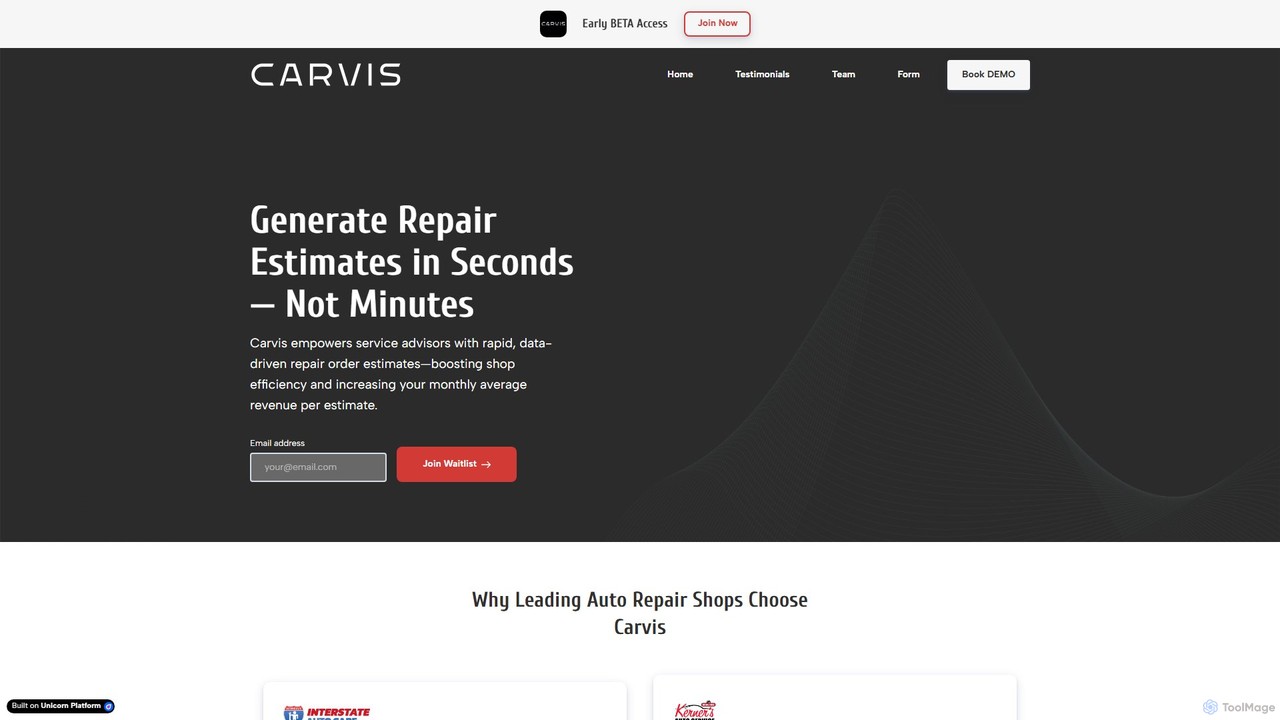
Carvis is an AI-powered platform designed for the auto repair industry. It revolutionizes shop operations by generating accurate repair estimates in seconds. By leveraging real-world repair data, Carvis provides actionable insights to optimize inventory, allocate labor, and streamline workflows. This helps shops increase efficiency, improve customer turnaround times, and boost overall profitability.
About Quotation And Estimation
AI Quotation and Estimation tools are specialized applications designed to automate the creation of accurate price quotes, project bids, and cost estimates. These tools leverage machine learning algorithms to analyze historical data, market prices, project requirements, and other variables to generate precise financial proposals. By processing complex inputs such as blueprints, scope documents, or material lists, they significantly reduce manual effort and improve the consistency of pricing. This capability makes them a crucial component of the financial workflow, particularly in the pre-sales and project planning stages.
Core Features
- Data-Driven Analysis: Utilizes historical project data and market rates to predict costs and timelines with higher accuracy.
- Automated Document Generation: Creates professional, branded quotes and proposals from customizable templates in various formats.
- Variable & Margin Calculation: Automatically factors in material costs, labor rates, overhead, and desired profit margins.
- Integration Capabilities: Connects with CRM, ERP, and project management software to streamline the sales-to-delivery workflow.
- Scenario Modeling: Allows users to test different pricing strategies and cost assumptions to find the optimal bid.
Applicable Scenarios
These tools are widely used across industries that rely on project-based or custom pricing. In construction and manufacturing, they analyze technical specifications to generate bids. For IT services and consulting firms, they help scope complex projects and create detailed service agreements. Freelancers and creative agencies also use them to quickly produce professional quotes for clients, ensuring consistent and profitable pricing.
Selection Criteria
When choosing an AI Quotation and Estimation tool, consider its industry-specific features and templates. Evaluate its integration capabilities with your existing software stack, such as CRM or accounting systems. Assess the accuracy of its estimation models and the quality of data sources it uses. Finally, consider the tool's scalability and pricing model to ensure it aligns with your business growth and budget.

Quotation And EstimationUse Cases
Generating Construction Project Bids
A general contractor needs to prepare a competitive bid for a commercial building project. Instead of spending days manually calculating costs, they upload the architectural blueprints and material specifications into an AI estimation tool. The AI analyzes the documents, identifies required materials, estimates labor hours based on historical data from similar projects, and calculates overhead costs. Within minutes, it generates a detailed, multi-page proposal with a precise cost breakdown, allowing the contractor to submit bids faster and with greater confidence in their profit margins.
Quoting Custom Manufacturing Orders
A custom parts manufacturer receives numerous daily requests for quotes (RFQs), each with unique specifications. A sales engineer uses an AI quotation tool integrated with their CAD software. When a customer submits a 3D model, the AI instantly analyzes its geometry, volume, and complexity. It cross-references this with material costs and machine time databases to calculate the exact production cost. The tool then generates a formal quote, including tiered pricing for different quantities, which is sent to the customer automatically, reducing quote turnaround time from hours to seconds.
Estimating IT Consulting Service Costs
An IT consulting firm needs to create a proposal for a complex digital transformation project. A project manager uses an AI estimation tool to scope the project. They input key parameters like the number of systems to integrate, required software licenses, estimated data migration volume, and the client's industry. The AI references a database of past projects to estimate the required man-hours for development, testing, and deployment. It then generates a detailed Statement of Work (SOW) with phased deliverables, resource allocation, and a comprehensive budget, improving proposal accuracy and client trust.
Automating Quotes for Freelance Projects
A freelance web developer receives multiple inquiries daily for similar types of websites (e.g., portfolio sites, small e-commerce stores). To save time, they use an AI quotation tool with pre-defined project templates. When a potential client fills out an inquiry form on their website, the data is sent to the tool. The AI selects the appropriate template, adjusts the price based on specific client requests (like extra pages or specific plugins), and instantly emails a professional, branded quote to the client. This automation allows the developer to respond immediately, increasing their chances of winning the project.
Pricing Complex SaaS Enterprise Deals
A sales team at a SaaS company is preparing a quote for a large enterprise client with complex needs. The quote involves variable pricing based on user tiers, API usage, data storage, and premium support packages. Using an AI-powered Configure, Price, Quote (CPQ) tool, the sales representative inputs the client's requirements. The AI calculates the optimal pricing by applying relevant discounts, bundling services, and ensuring compliance with company pricing rules. It generates a comprehensive proposal that clearly outlines all costs, preventing errors and ensuring a profitable, consistent pricing strategy across the sales team.
Estimating Costs for Event Planning
An event planning agency is tasked with organizing a large corporate conference. The planner uses an AI estimation tool to build a budget. They input variables such as the number of attendees, event duration, venue type, and catering preferences. The AI tool accesses a database of vendor pricing and historical event costs to provide an itemized estimate, including venue rental, A/V equipment, staffing, and cost-per-head for food and beverages. It also allows the planner to model different scenarios, such as changing the venue or catering options, to see the immediate impact on the total budget, facilitating faster client approvals.