Oniichat
Oniichat is an AI-powered chat platform designed for immersive role-playing and companionship with anime-style virtual characters, known as …
Oniichat is an AI-powered chat platform designed for immersive role-playing and companionship with anime-style virtual characters, known as Waifus. Create your own characters or interact with a diverse gallery of pre-made personalities for entertainment, storytelling, or virtual friendship.
aianimegirlfriend
Create, customize, and chat with your dream AI anime girlfriend. This iOS app offers a diverse catalog of …
Create, customize, and chat with your dream AI anime girlfriend. This iOS app offers a diverse catalog of waifus with unique personalities, deep roleplaying capabilities, and a powerful character creator. Engage in immersive conversations, get anime recommendations, and even receive AI-generated art of your companion.
roleplex
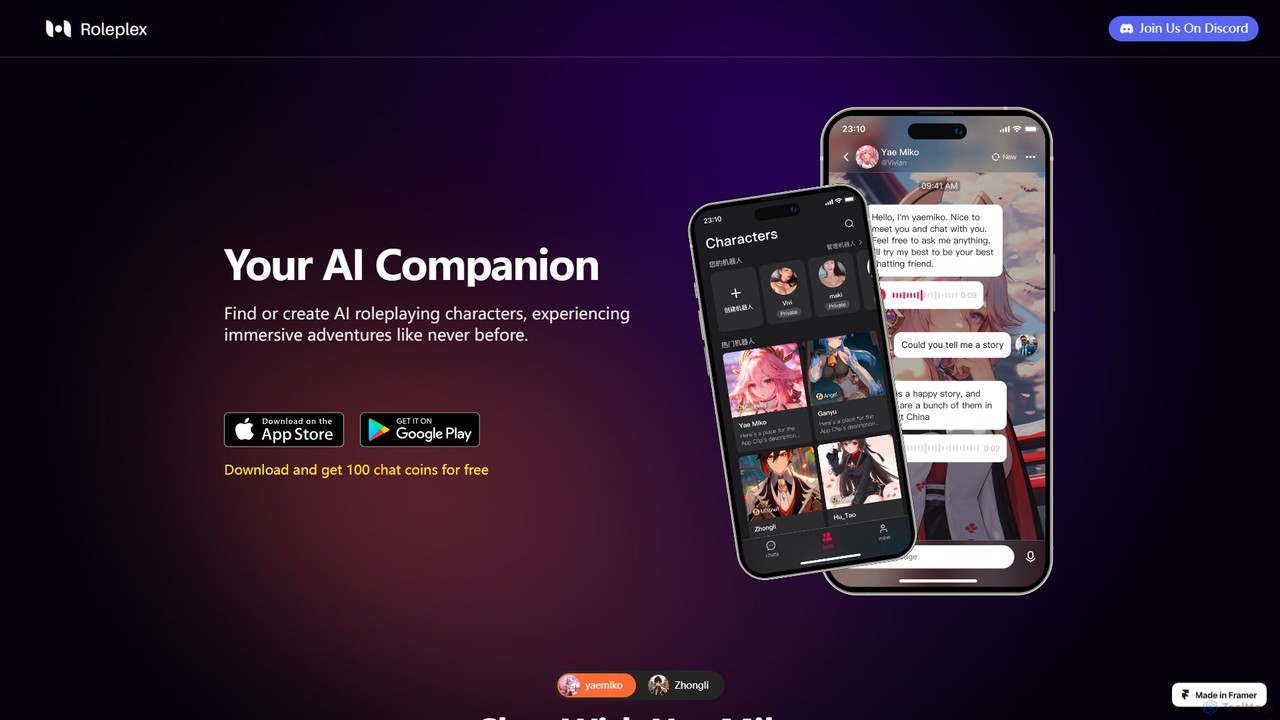
Roleplex is an AI companion app designed for immersive roleplaying and character chat. Find and interact with a …
Roleplex is an AI companion app designed for immersive roleplaying and character chat. Find and interact with a vast library of AI characters, including popular figures from games and anime, or create your own unique AI buddy. Engage in deep conversations, embark on adventures, and find a supportive friend through text and voice chat.
About Gaming
AI Gaming tools are a class of applications that use artificial intelligence to create, enhance, and interact with video games. These tools leverage generative models and machine learning algorithms to automate or assist in the production of game assets, behaviors, and environments. They empower developers and creators to build more dynamic, complex, and immersive worlds with greater efficiency. This technology is transforming game development by accelerating prototyping, scaling content creation, and enabling novel gameplay experiences.
Core Features
- Generative Asset Creation: Automatically produces 2D/3D models, textures, sound effects, and music based on text prompts or style inputs.
- Intelligent NPC Behavior: Creates non-player characters (NPCs) with dynamic, adaptive, and believable behaviors that react to player actions.
- Procedural Content Generation (PCG): Generates unique game levels, maps, quests, and narratives, increasing replayability.
- AI-Powered Dialogue Systems: Enables natural language conversations with in-game characters for more immersive storytelling.
- Automated Game Testing: Deploys AI agents to play the game, identify bugs, test balance, and discover exploits automatically.
Use Cases
AI Gaming tools are primarily used by game developers, from solo indie creators to large AAA studios. They are invaluable for artists, designers, and programmers looking to streamline their workflows. For instance, a small team can use AI to generate a wide variety of environmental assets, while a large studio can use it to create complex NPC social systems or automate quality assurance testing across massive open worlds.
How to Choose
When selecting an AI Gaming tool, consider its integration with your chosen game engine (e.g., Unity, Unreal Engine). Evaluate the quality and stylistic control of the generated content. Assess the tool's ease of use—whether it offers a simple interface or requires coding via an API. Finally, consider the pricing model, such as per-asset generation fees, monthly subscriptions, or enterprise licensing, to ensure it aligns with your project's budget and scale.

GamingUse Cases
Rapid Prototyping of Game Concepts
An indie game developer with limited resources needs to create a playable prototype quickly to pitch to investors. Using AI asset generation tools, they input text descriptions like 'cyberpunk city street at night' or 'fantasy warrior character concept' to generate dozens of visual ideas in minutes. This allows them to establish an art style and build a demo scene in their game engine within days, a process that would traditionally take weeks of manual modeling and illustration.
Creating Dynamic and Replayable Game Worlds
A studio developing an open-world RPG wants to ensure high replayability. They use AI-powered Procedural Content Generation (PCG) to create the game's world map, dungeons, and quests. The AI algorithm generates unique layouts, enemy placements, and loot distributions for each playthrough based on a set of design rules. This results in a world that feels vast and unpredictable, encouraging players to explore and start new games to discover new content.
Developing Realistic NPC Interactions
A narrative designer for a detective game wants NPCs to feel like real, intelligent witnesses. Instead of pre-scripted dialogue trees, they use an AI dialogue system. This system allows NPCs to understand natural language questions from the player, access a 'memory' of in-game events, and generate dynamic, context-aware responses. An NPC might become suspicious if asked the same question repeatedly or offer new information if the player presents new evidence, making interrogations feel authentic and unscripted.
Generating Unique In-Game Assets at Scale
An art team for a fantasy MMORPG needs to create thousands of unique icons for items like potions, scrolls, and swords. Manually creating each one is time-consuming. They use a generative AI tool trained on their game's art style. By providing simple text prompts like 'epic health potion, glowing red, ornate bottle', the AI generates hundreds of high-quality, stylistically consistent icon variations. The artists can then select the best ones or quickly edit them, reducing production time by over 80%.
Automated Game Testing and Balancing
A Quality Assurance (QA) team for a competitive multiplayer game needs to ensure the game is balanced and free of exploits before launch. They deploy AI agents that learn to play the game at a superhuman level. These agents play millions of matches, testing every character, weapon, and ability combination. The AI can identify overpowered strategies, discover game-breaking bugs, and provide detailed data that helps developers fine-tune game balance far more effectively than with human testers alone.
Enhancing Player Experience with AI Companions
In a single-player adventure game, developers want to provide a companion character that is genuinely helpful and not repetitive. They implement an AI companion that learns from the player's actions. If the player struggles with puzzles, the companion offers subtle hints. If the player prefers combat, the companion adapts its fighting style to complement the player's. This dynamic behavior makes the companion feel like a true partner, enhancing emotional engagement and personalizing the gameplay experience for each user.