ToolMage
Sign in

Best 1 Idea Generators for Fun

Popular Idea Generators in Fun include datebuilder, helping you work more efficiently.

datebuilder
Free

datebuilder

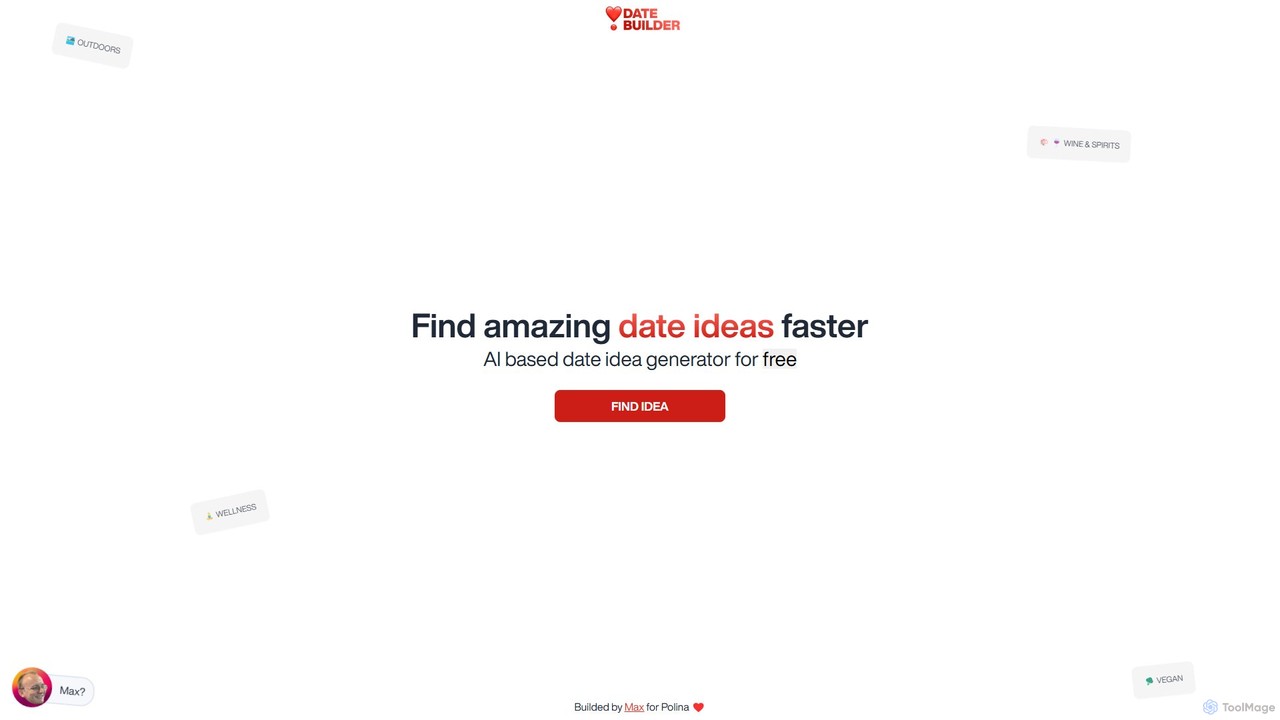
datebuilder is a free, AI-powered date idea generator designed to provide creative and personalized suggestions for couples. Simply select your interests, budget, and preferences, and the AI will craft unique date plans, from outdoor adventures to cozy nights in, helping you find the perfect romantic experience.

Idea Generators
Visits 3.4KFavorites 84Likes 88

About Idea Generators

Idea Generators are AI-powered tools designed to spark creativity and produce novel concepts from user prompts. These tools leverage large language models (LLMs) to analyze keywords, themes, or constraints, then synthesize unique suggestions, topics, and creative angles. Their primary value lies in overcoming mental blocks, accelerating brainstorming sessions, and providing fresh perspectives for various projects. Unlike simple search engines that retrieve existing information, Idea Generators create new combinations and possibilities, making them a dynamic part of the creative process.

Core Features

  • Keyword-Based Brainstorming: Users input core topics or keywords to receive a wide range of related ideas, titles, and concepts.
  • Customizable Parameters: Ability to set constraints such as tone (e.g., professional, witty), style, or industry to refine the generated output.
  • Diverse Output Formats: Generates ideas in various formats, including simple lists, mind maps, short paragraphs, or question-based prompts.
  • Serendipity Mode: Offers features to generate completely random or unexpected prompts to stimulate lateral thinking and break creative ruts.

Use Cases

Idea Generators are widely used by content creators for brainstorming blog posts and video scripts, marketers for developing campaign slogans and ad angles, and entrepreneurs for finding business or product names. Writers also use them to generate plot twists and character concepts, while students and researchers find them helpful for exploring new research topics and essay questions.

How to Choose

When selecting an Idea Generator, consider the specificity of its focus—some are general-purpose, while others specialize in areas like business naming or content marketing. Evaluate the flexibility of input controls and the variety of output formats. Also, consider the user interface's simplicity and whether the tool's pricing model aligns with your usage frequency and budget.

Featured tool rankings

Idea Generators use cases

1

Brainstorming Blog Topics for Content Creators

A content creator struggling with writer's block for their lifestyle blog needs fresh ideas. They input core themes like 'sustainable living' and 'minimalist home' into an AI Idea Generator. The tool instantly produces over 50 unique article titles and concepts, such as '10 Zero-Waste Kitchen Swaps That Save Money' and 'The Art of Decluttering Your Digital Life.' This process transforms a multi-hour brainstorming session into a few minutes of productive work, providing a content calendar's worth of inspiration.

2

Generating Startup Names and Slogans

An entrepreneur is launching a new productivity app but is stuck on branding. Using an Idea Generator, they input keywords like 'focus,' 'efficiency,' and 'workflow' and set the tone to 'modern' and 'tech-savvy.' The AI generates a list of potential names like 'Zenith Flow,' 'Momentum,' and 'Taskify,' along with corresponding slogans such as 'Your workflow, elevated.' This provides a strong starting point for market testing and brand development, saving significant time and agency costs.

3

Overcoming Writer's Block for Fiction Authors

A novelist is stuck on a crucial plot point in their mystery story. They use an Idea Generator, inputting character traits ('cynical detective,' 'secret past') and the setting ('rainy coastal town'). The tool suggests several intriguing plot twists, such as 'The main suspect is actually the detective's long-lost sibling' or 'The clue is hidden in a local weather pattern.' These unexpected prompts help the author break through their creative block and add a new layer of complexity to their narrative.

4

Developing Social Media Campaign Angles

A marketing team needs creative angles for a new energy drink campaign. Instead of traditional brainstorming, they use an Idea Generator with inputs like 'natural ingredients,' 'urban adventure,' and 'focus.' The tool generates campaign themes such as 'Fuel Your Concrete Jungle' and 'The Natural Solution to the 3 PM Slump.' These concepts move beyond simple product features, providing the team with unique narrative hooks for ad copy, influencer collaborations, and visual content, leading to a more engaging and memorable campaign.

5

Designing Game Quests and Characters

A small game development studio needs a wealth of side quests for their open-world RPG. Manually creating hundreds of unique ideas is time-consuming. They use an Idea Generator, inputting game lore elements like 'enchanted forest,' 'ancient curse,' and 'lost artifact.' The AI produces dozens of quest prompts, such as 'Help a cursed merchant find a flower that only blooms under a double moon' or 'Retrieve a stolen artifact from a society of intelligent goblins.' This rapidly populates their game world with engaging content.

6

Planning Content for YouTube Channels and Podcasts

A podcaster focusing on 'unsolved mysteries' wants to find unique topics that haven't been overdone. They use an Idea Generator and input phrases like 'historical disappearances' and 'cryptic codes.' The tool suggests episode ideas such as 'The Lost Colony of Roanoke: New Theories' and 'Decoding the Voynich Manuscript.' This allows the creator to quickly identify niche, high-interest topics, streamlining their research and production pipeline and helping their content stand out in a crowded market.

Idea Generators FAQ

What are AI Idea Generators?

AI Idea Generators are software tools that use artificial intelligence, typically large language models, to generate novel ideas, concepts, and creative prompts based on user input. Unlike a search engine that finds existing information, these tools synthesize new combinations of words and concepts to help users overcome creative blocks, brainstorm topics, find names for businesses, or develop plot points for stories. They act as a creative partner to spark inspiration.

How do I choose the right Idea Generator?

To choose the right tool, consider these factors:

  • Purpose: Do you need ideas for a specific domain like marketing slogans, or a general-purpose tool for creative writing?
  • Customization: Check if you can set parameters like tone, style, keywords, or negative keywords to guide the AI.
  • Output Quality and Variety: Evaluate if the tool provides genuinely creative ideas and offers different formats (e.g., lists, questions, paragraphs).
  • Ease of Use: A simple, intuitive interface allows you to generate ideas quickly without a steep learning curve.
What is the difference between an Idea Generator and a search engine?

The core difference is creation versus retrieval. A search engine (like Google) finds and ranks existing information from the web based on your query. An AI Idea Generator does not search for existing content; instead, it uses its language model to synthesize and create new, original combinations of ideas that may not exist anywhere else. A search engine answers 'What is known?', while an idea generator answers 'What is possible?'.

Who can benefit from using Idea Generators?

A wide range of individuals and professionals can benefit from these tools. This includes:

  • Content Creators: For brainstorming blog posts, YouTube video topics, and podcast episodes.
  • Marketers: For developing campaign slogans, ad copy angles, and content marketing ideas.
  • Entrepreneurs: For finding unique business names, product ideas, and brand taglines.
  • Writers and Authors: For generating plot twists, character names, and overcoming writer's block.
  • Students and Researchers: For exploring essay topics and finding new angles for research projects.
Are the ideas generated by these tools truly unique?

The ideas are unique in their specific combination and phrasing. AI models are trained on vast amounts of text and data, and they learn patterns, styles, and relationships between concepts. When you provide a prompt, the AI generates a statistically probable but new sequence of words. While the foundational concepts might be drawn from its training data, the resulting idea is a new synthesis. They are best used as a starting point or a source of inspiration, which a human then refines and develops into a truly original work.