ToolMage
Sign in

Best 1 Grammar Checker AI tools for General Writing

Popular Grammar Checker AI tools in General Writing include Engram, helping you work more efficiently.

Engram
Freemium

Engram

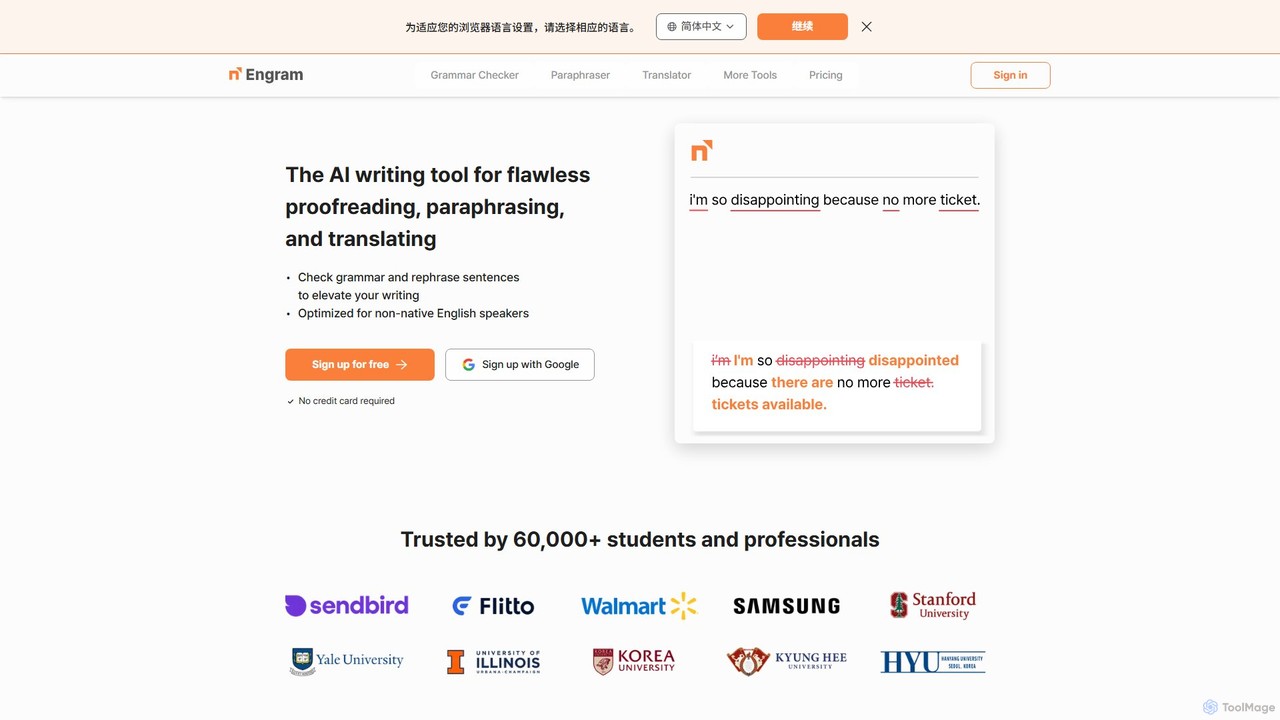
Engram is an AI-powered writing tool specifically designed for non-native English speakers. It offers flawless proofreading, contextual paraphrasing, and accurate translation to help users elevate their writing. Trusted by students and professionals, Engram corrects complex grammar errors and rephrases sentences to sound more natural, making English writing faster and stress-free.

Language Learning
Visits 216.2KFavorites 125Likes 137

About Grammar Checker

Grammar Checkers are AI-powered tools designed to automatically identify and correct errors in grammar, spelling, punctuation, and style within written text. Leveraging advanced natural language processing (NLP) and machine learning algorithms, these tools go beyond basic spell-checking to offer comprehensive linguistic analysis. They significantly enhance the clarity, professionalism, and overall quality of any written communication, making them an indispensable part of the general writing process for individuals and professionals alike.

Core Features

  • Grammar Correction: Automatically detects and suggests corrections for a wide range of grammatical errors, including subject-verb agreement, tense consistency, and sentence structure.
  • Spelling & Punctuation Check: Identifies misspelled words and incorrect punctuation usage, offering accurate alternatives.
  • Style & Readability Suggestions: Provides recommendations to improve sentence flow, word choice, conciseness, and overall readability, adapting to different writing styles.
  • Plagiarism Detection: Some advanced tools include features to check for unintentional plagiarism by comparing text against vast databases.
  • Multilingual Support: Offers grammar and and style checking capabilities across multiple languages, catering to a global user base.

Use Cases

Grammar checkers are widely used by students for academic papers, content creators for blog posts and articles, business professionals for emails and reports, and authors for manuscript refinement. They ensure that all written output is polished, error-free, and conveys the intended message clearly and effectively, saving significant time on manual proofreading.

How to Choose

When selecting a grammar checker, consider its accuracy in error detection, the breadth of language support, the depth of stylistic suggestions, and its integration capabilities with your existing writing platforms (e.g., word processors, browsers). Evaluate the pricing model, user interface, and whether it offers specialized checks for academic, business, or creative writing to match your specific needs.

Grammar Checker use cases

1

Refining Academic Papers

Students and researchers utilize grammar checkers to meticulously review essays, theses, and dissertations. The tools identify complex grammatical errors, ensure consistent citation formatting (if supported), and suggest improvements for academic tone and clarity, helping to avoid common mistakes that can impact grades or publication chances.

2

Polishing Professional Emails and Reports

Business professionals rely on grammar checkers to ensure their daily communications, from client emails to internal reports, are error-free and convey a professional image. These tools help maintain a high standard of written communication, preventing misunderstandings and enhancing credibility in corporate settings.

3

Optimizing Blog Posts and Web Content

Content creators and marketers use grammar checkers to proofread blog posts, articles, and website copy before publication. This ensures the content is engaging, easy to read, and free of errors that could detract from the message or negatively impact SEO, ultimately improving user experience and brand perception.

4

Editing Creative Writing and Manuscripts

Authors and novelists employ grammar checkers as an initial editing pass for their creative works. While not replacing human editors, these tools catch common grammatical slips, punctuation errors, and suggest stylistic improvements, allowing writers to focus on narrative and character development with a cleaner draft.

5

Ensuring Consistency in Technical Documentation

Technical writers and developers use grammar checkers to maintain accuracy and consistency in user manuals, API documentation, and software guides. The tools help enforce specific terminology, improve clarity, and ensure that complex technical information is presented in an understandable and error-free manner for end-users.

6

Improving Multilingual Communication

Individuals and teams working in international environments leverage grammar checkers with multilingual support. These tools assist non-native speakers in writing confidently and accurately in a second language, ensuring their messages are grammatically correct and culturally appropriate, thus facilitating effective global communication.

Grammar Checker FAQ

What are AI Grammar Checkers?

AI Grammar Checkers are software tools that use artificial intelligence, specifically natural language processing (NLP) and machine learning, to analyze text and identify grammatical errors, spelling mistakes, punctuation issues, and stylistic inconsistencies. Unlike basic spell checkers, they understand context and can suggest more nuanced improvements for clarity and conciseness, significantly enhancing the quality of written content.

How do AI Grammar Checkers differ from traditional spell checkers?

Traditional spell checkers primarily focus on identifying misspelled words based on a dictionary. AI Grammar Checkers, however, go much further by analyzing sentence structure, syntax, semantics, and context. They can detect complex grammatical errors (e.g., subject-verb agreement, tense shifts), punctuation errors, and offer stylistic suggestions to improve readability and tone, making them a more comprehensive writing assistant.

What features should I look for in a good Grammar Checker?

When choosing a grammar checker, prioritize high accuracy in error detection, comprehensive grammar and punctuation rules, and robust style suggestions tailored to different writing contexts (e.g., academic, business). Look for multilingual support if you write in multiple languages, seamless integration with your preferred writing platforms, and a user-friendly interface. Plagiarism detection and a personal dictionary can also be valuable additions.

Can Grammar Checkers replace human proofreaders or editors?

While AI Grammar Checkers are powerful tools for catching common errors and improving writing quality, they cannot fully replace human proofreaders or editors. Human editors offer nuanced understanding of context, tone, and audience, and can provide creative feedback or deep structural edits that AI tools currently cannot. Grammar checkers are best used as a first line of defense and a valuable assistant to human review.

Who benefits most from using a Grammar Checker?

Virtually anyone who writes can benefit, but they are particularly useful for students, content creators, business professionals, non-native English speakers, and authors. Students can improve academic writing, professionals can ensure error-free communications, and content creators can polish their online presence. Non-native speakers gain confidence, and authors can refine drafts before professional editing, saving time and improving output quality.