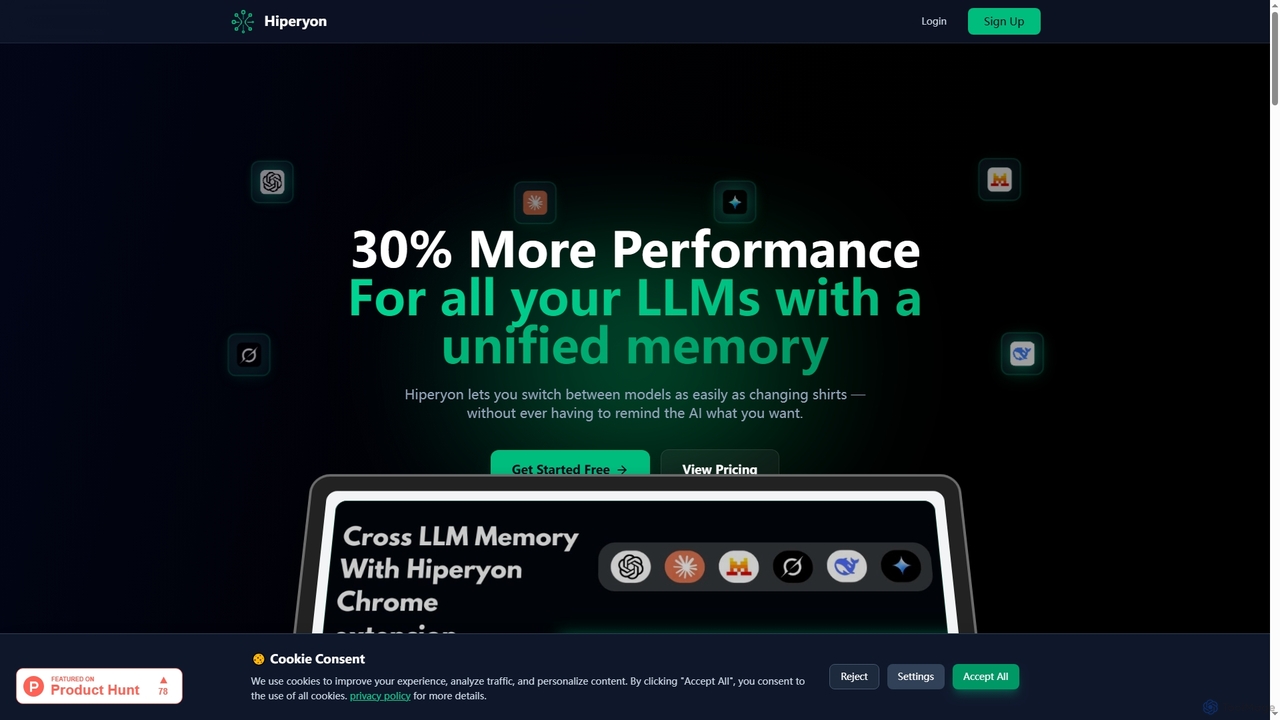
Large Language Models (LLMs) are advanced AI models specifically designed to understand, generate, and manipulate human language with remarkable fluency and coherence. Built upon deep learning architectures, particularly transformers, they process vast amounts of text data to learn complex linguistic patterns and world knowledge. These powerful models enable a wide array of applications, from sophisticated content creation and intelligent chatbots to complex data analysis and code generation, fundamentally transforming how humans interact with information and technology.
Core Features
- Natural Language Understanding (NLU): Accurately interprets user intent, context, and nuances in human language inputs.
- Natural Language Generation (NLG): Produces coherent, contextually relevant, and grammatically correct text in various styles and formats.
- Contextual Learning: Maintains conversational context over extended interactions, leading to more relevant and personalized responses.
- Multitasking Capabilities: Performs diverse language-related tasks such as summarization, translation, question answering, and sentiment analysis within a single model.
- Few-shot/Zero-shot Learning: Can perform new tasks with minimal or no specific training examples, leveraging its broad pre-trained knowledge.
Applicable Scenarios
LLMs are indispensable for content creators, developers, customer service teams, and researchers. Content marketers use them to draft articles and social media posts, while software engineers leverage them for code completion and debugging. Customer support centers deploy LLMs in chatbots for instant query resolution, and data analysts utilize them for extracting insights from unstructured text.
How to Choose
When selecting an LLM, consider its scale and performance (e.g., parameter count, benchmark scores), the specific tasks it excels at (e.g., creative writing, factual retrieval), integration capabilities with existing systems, and the cost-effectiveness of its API or deployment. Evaluate its fine-tuning options for domain-specific applications and its ethical guidelines for responsible AI use.