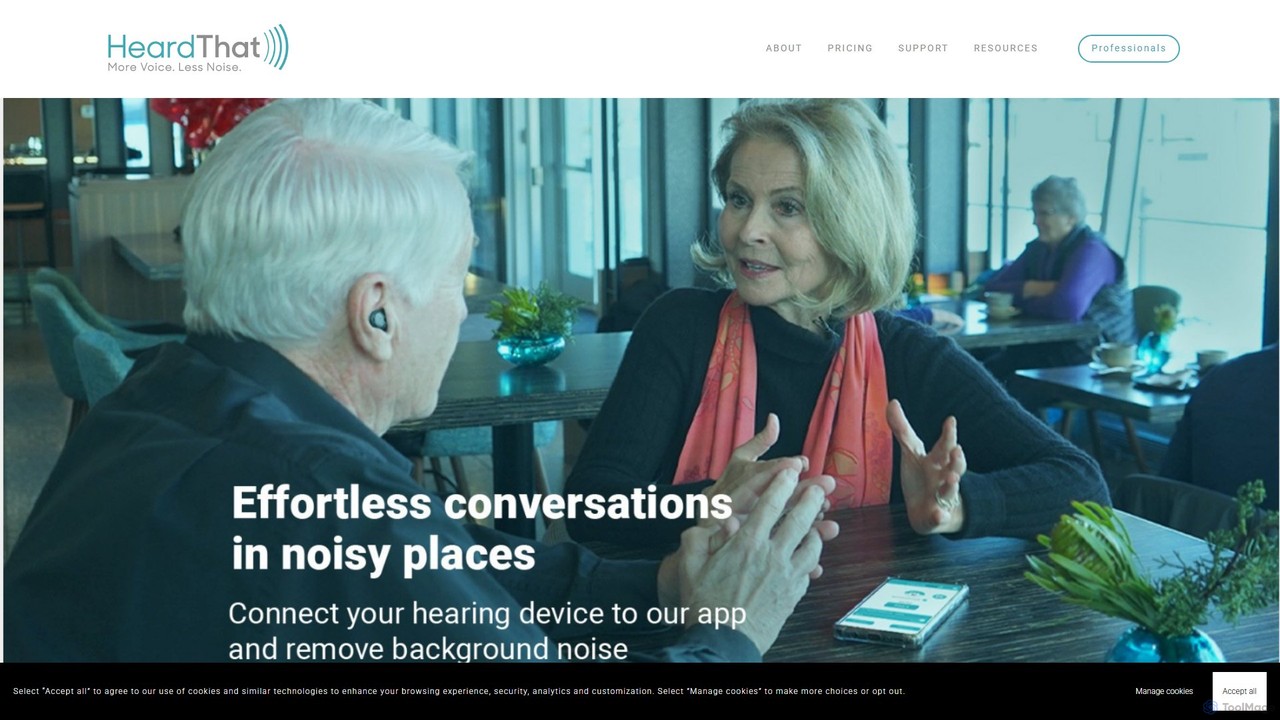
Hearing Assistance tools are AI-powered solutions designed to enhance auditory experiences and support individuals with hearing impairments. These tools leverage advanced AI, such as natural language processing and machine learning, to intelligently process and optimize sound in real-time. They provide functionalities like precise real-time transcription, intelligent noise reduction, and personalized sound amplification, significantly improving communication, environmental awareness, and overall quality of life. This sub-category within Health focuses on practical, accessible technologies that bridge auditory gaps, foster greater independence, and integrate seamlessly into daily routines by making sound more comprehensible and manageable.
Core Features
- Real-time Transcription: Converts spoken language into text instantly and accurately, aiding comprehension for users with hearing loss in diverse settings, from casual conversations to formal lectures and presentations.
- Intelligent Noise Reduction: Employs sophisticated algorithms to filter out distracting background noise, such as chatter, traffic, or music, to isolate and clarify speech, significantly improving listening comfort and focus in challenging auditory environments.
- Personalized Sound Amplification: Dynamically adapts audio levels and frequencies precisely to individual hearing profiles and preferences, optimizing clarity and audibility for specific sounds while preventing over-amplification or distortion.
- Speech-to-Text Communication: Facilitates seamless two-way communication by accurately transcribing speech from multiple speakers in a conversation, enabling easier and more equitable participation in group discussions and social interactions.
- Environmental Sound Recognition: Identifies and alerts users to important ambient sounds such as alarms, doorbells, car horns, or crying babies, providing crucial safety and awareness cues through customizable visual or haptic notifications.
Applicable Scenarios
AI Hearing Assistance tools are vital for enhancing daily communication, providing accessibility in public and professional settings, and supporting independent living. They are widely used by individuals with hearing loss to better engage in social interactions, reducing isolation and communication fatigue. Students utilize these tools to follow lectures with live captions, ensuring they grasp all educational content. Professionals leverage them to participate fully in meetings, with real-time transcripts aiding comprehension and record-keeping. Event organizers also deploy these technologies to make conferences, performances, and public announcements accessible, ensuring clear auditory information and effective interaction for all attendees, thereby fostering greater inclusivity.
How to Choose
When selecting a Hearing Assistance tool, consider its accuracy and latency for real-time processing, which is paramount for natural conversation flow and immediate comprehension. Evaluate its ability to effectively reduce various types of background noise without distorting speech, a critical factor for usability in diverse environments. Look for extensive personalized customization options for sound profiles, amplification settings, and alert preferences to match your unique hearing needs and lifestyle. Additionally, assess its compatibility with your existing devices (e.g., smartphones, smart glasses, traditional hearing aids) and overall ease of use, including battery life, portability, and intuitive interface, to ensure it seamlessly integrates into your daily life and provides reliable, consistent support.