Ubiehealth
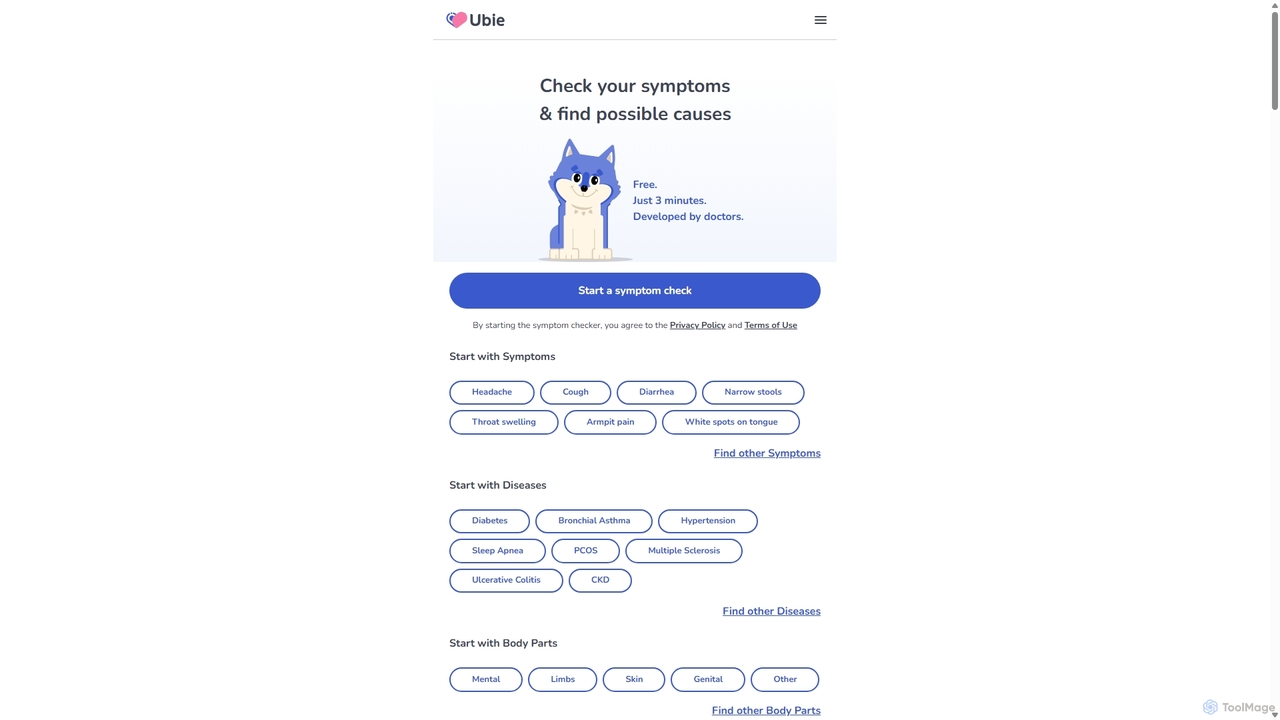
Ubiehealth is an AI-powered symptom checker developed by doctors. In just 3 minutes, it analyzes your symptoms through …
Ubiehealth is an AI-powered symptom checker developed by doctors. In just 3 minutes, it analyzes your symptoms through a personalized questionnaire and provides a free, detailed report on possible causes, recommended actions, and when to seek medical attention, empowering you to make informed health decisions.
About Medical Diagnosis
Medical Diagnosis AI tools are advanced systems that leverage artificial intelligence to assist healthcare professionals in identifying diseases, conditions, and health risks. These tools analyze vast amounts of medical data, including images, patient records, and genomic information, to provide insights that enhance diagnostic accuracy and speed. By automating complex data analysis, they support earlier detection and more personalized treatment planning, ultimately improving patient outcomes within the broader health sector.
Core Features
- Image Analysis: Automatically detect anomalies in X-rays, MRIs, CT scans, and pathology slides.
- Predictive Analytics: Forecast disease progression or patient risk based on historical data and biomarkers.
- Symptom Checker & Differential Diagnosis: Suggest potential diagnoses by analyzing patient-reported symptoms and medical history.
- Genomic Interpretation: Identify genetic markers associated with specific diseases or drug responses.
- EHR Data Mining: Extract and synthesize critical information from electronic health records for diagnostic support.
Applicable Scenarios
Radiologists use AI to flag suspicious lesions in scans, prioritizing urgent cases and reducing missed diagnoses. Pathologists employ AI for faster and more accurate analysis of tissue biopsies. Clinicians leverage AI-powered symptom checkers to broaden their differential diagnosis considerations, especially for rare diseases.
How to Choose
Evaluate the tool's diagnostic accuracy and validation against clinical benchmarks. Assess its integration capabilities with existing hospital information systems (HIS) and electronic health records (EHR). Consider regulatory approvals (e.g., FDA, CE Mark) and data privacy compliance (e.g., HIPAA, GDPR). Examine the interpretability of AI outputs and the level of human oversight required.

Medical DiagnosisUse Cases
Early Detection of Retinopathy
Ophthalmologists use AI to analyze retinal scans, identifying early signs of diabetic retinopathy or glaucoma, enabling timely intervention. This allows for proactive treatment, potentially preventing vision loss and significantly improving patient outcomes by catching diseases at their most treatable stages. The AI can process a high volume of scans efficiently, flagging suspicious cases for specialist review.
Automated Lung Nodule Detection
Radiologists deploy AI algorithms to automatically highlight potential lung nodules in CT scans, improving detection rates and reducing review time. This is particularly valuable in screening programs where a large volume of scans needs to be processed, helping to identify early-stage lung cancer more consistently and efficiently than manual review alone.
Personalized Cancer Treatment Planning
Oncologists utilize AI to analyze a patient's genomic profile and tumor characteristics, suggesting optimal chemotherapy or immunotherapy regimens. This enables highly personalized treatment strategies that are tailored to the individual's unique biological makeup, leading to improved efficacy and reduced side effects compared to one-size-fits-all approaches.
Rapid Stroke Diagnosis from Brain Scans
Emergency physicians employ AI to quickly identify acute ischemic stroke regions in brain imaging, accelerating treatment decisions within critical time windows. This rapid analysis is crucial for conditions like stroke, where every minute saved in diagnosis and treatment can significantly impact patient recovery and reduce long-term disability.
Dermatology Lesion Classification
Dermatologists use AI-powered tools to classify skin lesions as benign or potentially malignant from dermoscopic images, aiding in early melanoma detection. This augments human expertise, providing a consistent and objective assessment that can help prioritize cases for biopsy and reduce unnecessary procedures, leading to more efficient and accurate skin cancer screening.
Predictive Sepsis Risk Assessment
Intensive care units integrate AI systems to continuously monitor patient vital signs and lab results, predicting the onset of sepsis hours before clinical symptoms appear. This proactive warning system allows medical teams to intervene earlier, significantly improving survival rates and reducing the severity of sepsis, a life-threatening condition.