ToolMage
Sign in

Best 1 Medical Research AI tools for Health

Popular Medical Research AI tools in Health include flowtrials, helping you work more efficiently.

flowtrials
Free

flowtrials

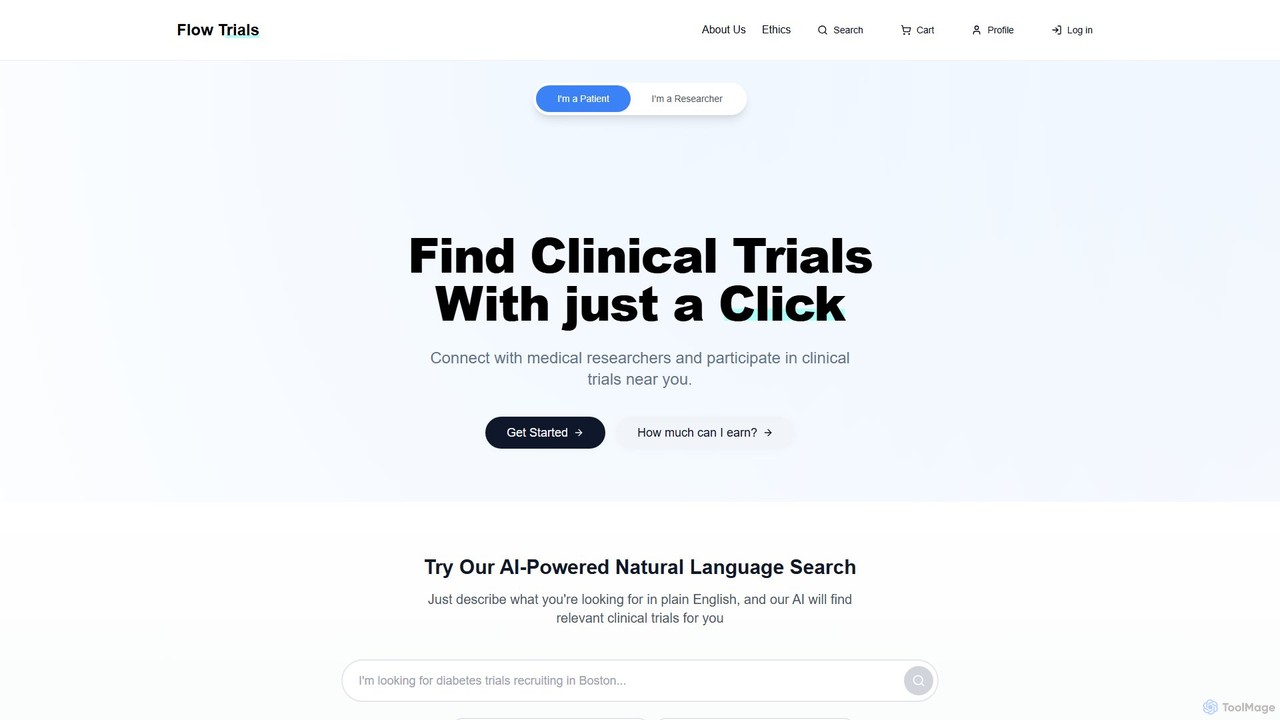
An AI-powered platform that connects patients with clinical trials. It uses natural language search to help users easily find relevant studies based on their condition and location, simplifying the process of participating in medical research.

Medical Research
Visits 5.9KFavorites 143Likes 169

About Medical Research

Medical Research AI tools are specialized platforms designed to accelerate and enhance scientific discovery and development within the healthcare sector. These tools leverage advanced artificial intelligence and machine learning algorithms to process vast amounts of biomedical data, generate insights, and automate complex research tasks. They significantly improve efficiency, accuracy, and the pace of innovation in areas like drug discovery, diagnostics, and personalized medicine.

Core Features

  • Genomic and Proteomic Analysis: Advanced algorithms for interpreting complex genetic and protein data, identifying biomarkers, and understanding disease mechanisms.
  • Drug Discovery and Development: AI-driven identification of novel drug targets, virtual screening of compounds, prediction of molecular properties, and optimization of drug candidates.
  • Clinical Trial Optimization: Tools for patient cohort selection, predictive modeling of trial outcomes, real-time monitoring of adverse events, and data analysis to streamline clinical research.
  • Medical Image Analysis: AI for automated detection, segmentation, and quantification of features in medical images (e.g., X-rays, MRI, CT scans) to aid diagnosis and research.
  • Scientific Literature Review: AI-powered systems to rapidly search, synthesize, and extract relevant information from vast databases of scientific publications.

Use Cases

These tools are indispensable for pharmaceutical companies, academic research institutions, and biotechnology firms. They are used by scientists, clinicians, and data analysts to tackle challenges ranging from fundamental biological inquiries to applied clinical development, enabling faster breakthroughs and more targeted interventions.

How to Choose

When selecting Medical Research AI tools, consider the specific research domain (e.g., oncology, neuroscience), data security and compliance with regulations (e.g., HIPAA, GDPR), integration capabilities with existing lab information systems, the accuracy and interpretability of AI models, and the level of technical support provided.

Medical Research use cases

1

Accelerating Drug Discovery and Development

Pharmaceutical researchers utilize AI tools to identify potential drug candidates and optimize their molecular structures. By analyzing vast chemical libraries and biological pathways, AI can predict compound efficacy and toxicity, significantly reducing the time and cost associated with traditional drug screening methods and accelerating the journey from target identification to preclinical testing.

2

Optimizing Clinical Trial Design and Execution

Clinical research organizations leverage AI to enhance the efficiency and success rates of clinical trials. AI algorithms assist in identifying suitable patient cohorts, predicting potential trial outcomes, and monitoring patient responses in real-time. This leads to more targeted trials, reduced costs, and faster approval processes for new therapies, benefiting both researchers and patients.

3

Personalized Medicine and Treatment Recommendation

Researchers in personalized medicine use AI to analyze individual patient data, including genomics, medical history, and lifestyle factors. This enables the development of highly tailored treatment plans and drug recommendations. AI helps identify specific biomarkers that predict drug response or disease progression, moving healthcare towards more precise and effective interventions for each patient.

4

Advanced Medical Image Analysis for Diagnostics

Radiologists and medical researchers employ AI tools to analyze complex medical images such as X-rays, MRIs, and CT scans. AI algorithms can detect subtle anomalies, segment organs or tumors, and quantify disease progression with high accuracy, often surpassing human capabilities. This aids in earlier and more precise diagnosis of diseases like cancer, neurological disorders, and cardiovascular conditions.

5

Epidemiological Research and Public Health Surveillance

Public health researchers utilize AI to analyze large-scale epidemiological data, track disease outbreaks, and predict future health trends. By processing data from various sources like electronic health records, social media, and environmental sensors, AI tools can identify risk factors, monitor population health, and inform public health interventions, contributing to more effective disease prevention and control strategies.

6

Automated Scientific Literature Review and Synthesis

Medical researchers and academics use AI-powered tools to efficiently navigate and synthesize vast amounts of scientific literature. These tools can automatically extract key findings, identify research gaps, and summarize complex studies, saving countless hours. This allows researchers to stay updated with the latest advancements, formulate new hypotheses, and conduct more comprehensive meta-analyses, accelerating knowledge discovery.

Medical Research FAQ

What are AI tools for Medical Research?

AI tools for Medical Research are advanced software applications that leverage artificial intelligence and machine learning to assist in various stages of medical and biological research. They are designed to process, analyze, and interpret complex biomedical data, automate repetitive tasks, and generate insights that accelerate scientific discovery. These tools are crucial for enhancing efficiency and accuracy in areas like drug development, diagnostics, and personalized medicine.

How do AI tools accelerate drug discovery?

AI tools accelerate drug discovery by automating and enhancing several key processes. They can rapidly screen vast libraries of chemical compounds to identify potential drug candidates, predict their binding affinity to target proteins, and model their pharmacokinetic properties (absorption, distribution, metabolism, excretion). This significantly reduces the need for costly and time-consuming laboratory experiments, allowing researchers to focus on the most promising compounds and shorten the overall drug development timeline.

What is the difference between AI tools for Medical Research and general Health AI tools?

While both fall under the broader 'Health' category, AI tools for Medical Research are specifically tailored for scientific inquiry, drug development, and clinical studies. They focus on tasks like genomic analysis, drug target identification, and clinical trial optimization. General Health AI tools, on the other hand, often address broader applications such as patient engagement, wellness tracking, administrative efficiency in hospitals, or basic diagnostic support, without the deep scientific research focus of Medical Research AI.

What factors should be considered when choosing an AI tool for medical research?

When selecting an AI tool for medical research, several factors are crucial. First, consider the tool's specific functionality and its relevance to your research domain (e.g., genomics, imaging, drug discovery). Second, evaluate data security and compliance with regulations like HIPAA or GDPR. Third, assess its integration capabilities with existing laboratory information systems (LIMS) or electronic health records (EHR). Finally, examine the model's interpretability, the vendor's technical support, and the scalability of the solution to handle future data volumes.

How do AI tools contribute to personalized medicine research?

AI tools significantly advance personalized medicine research by enabling the analysis of vast and diverse patient data sets. They can integrate genomic, proteomic, clinical, and lifestyle data to identify unique biomarkers and predict individual responses to treatments. This allows researchers to develop highly tailored therapeutic strategies, optimize drug dosages, and stratify patients into specific groups for targeted interventions, moving away from a 'one-size-fits-all' approach to healthcare.