Healthcare Best in category 1 results Clinical Skills AI Tool

Popular AI tools in the Clinical Skills field of Healthcare include Neural Consult, etc., helping you quickly improve efficiency.

Neural Consult

Neural Consult

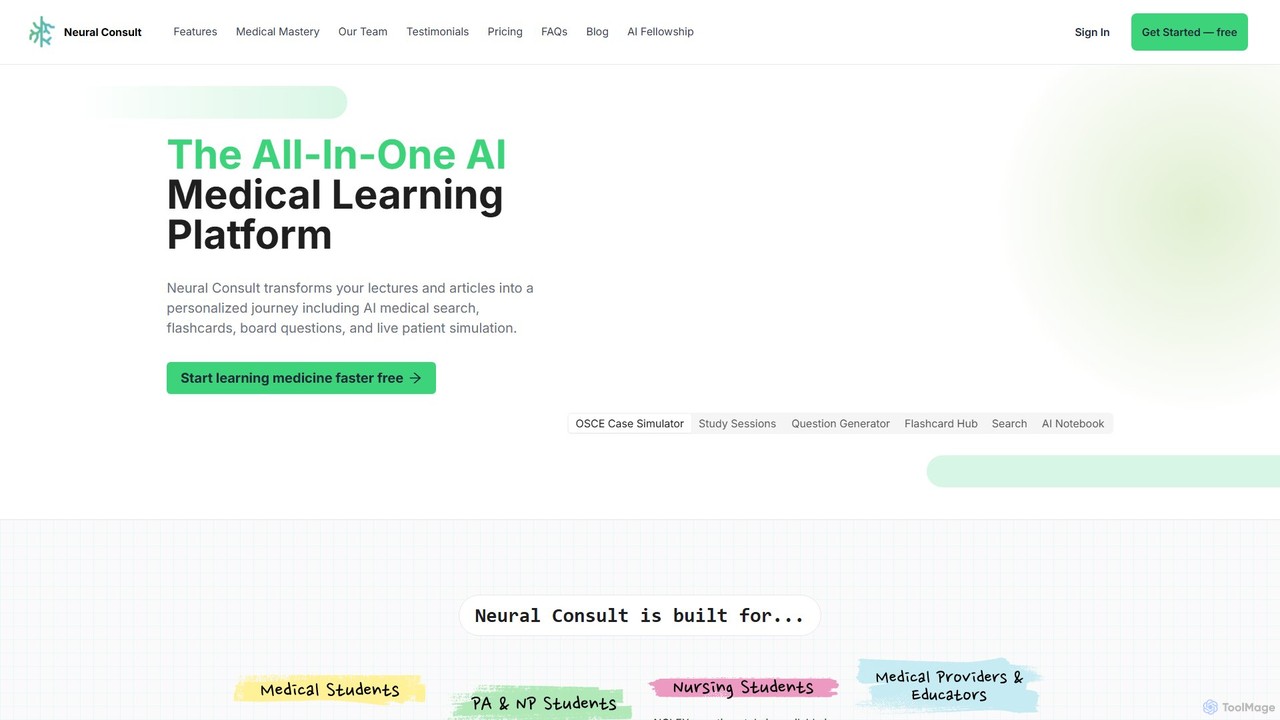
Neural Consult is an all-in-one AI medical learning platform for medical, PA, and nursing students. It transforms your …

381.8K

About Clinical Skills

AI Clinical Skills tools are a specialized category of software designed to teach, practice, and assess medical competencies in a controlled, virtual environment. These platforms leverage technologies like virtual reality (VR), augmented reality (AR), and sophisticated algorithms to create interactive and realistic training scenarios. They enable healthcare professionals to refine procedural techniques, diagnostic reasoning, and patient communication skills without any risk to real patients. This approach provides objective, data-driven feedback to accelerate learning and improve clinical outcomes.

Core Features

  • Realistic Simulation: Creates high-fidelity virtual patients and anatomical models for immersive practice of procedures like surgery or examinations.
  • Interactive Scenarios: Offers dynamic case studies where user decisions directly impact the virtual patient's condition and scenario outcome.
  • Performance Analytics: Provides detailed, objective metrics on user performance, tracking things like precision, speed, errors, and decision-making processes.
  • Real-time Feedback & Guidance: Delivers immediate, AI-driven feedback during simulations and can offer step-by-step guidance using AR overlays.
  • Communication Training: Utilizes AI-powered virtual patients that can understand and respond to verbal communication, allowing for practice in empathy and history-taking.

Applicable Scenarios

These tools are primarily used in medical education and professional development. Medical schools and nursing programs use them to provide students with early, safe clinical exposure. Hospitals and healthcare systems deploy them for resident training, continuing medical education (CME), and verifying the competency of clinical staff on new procedures or equipment.

How to Choose

When selecting an AI Clinical Skills tool, consider the clinical validity and realism of the simulations. Evaluate the depth and actionability of the performance analytics and feedback mechanisms. Assess hardware requirements (e.g., VR headsets, haptics) and their compatibility with your existing infrastructure. Finally, check for integration capabilities with Learning Management Systems (LMS) and ensure compliance with healthcare data privacy regulations like HIPAA.

Clinical SkillsUse Cases

1

Virtual Surgical Training for Residents

A surgical resident needs to master a complex laparoscopic procedure before performing it on a real patient. Using an AI-powered VR simulator, they can practice the entire surgery in a risk-free environment. The system provides realistic haptic feedback, simulates complications, and tracks every movement. After each session, the AI generates a detailed performance report highlighting areas for improvement, such as instrument handling precision, procedure time, and economy of motion. This allows for repetitive, deliberate practice, significantly shortening the learning curve and boosting confidence in the operating room.

2

Practicing Patient Communication Skills

A medical student is learning how to conduct sensitive patient interviews, such as breaking bad news or taking a sexual history. They interact with an AI-powered virtual patient on a computer or in VR. This virtual patient understands natural language, shows realistic emotions, and responds dynamically based on the student's conversational approach. The AI analyzes the student's word choice, tone, and empathy levels, providing instant, private feedback. This allows students to practice and refine these crucial soft skills in a standardized, repeatable way without the emotional burden on real standardized patients.

3

Emergency Response Team Simulation

An emergency room team, including doctors, nurses, and paramedics, needs to train for a rare but critical event like a mass casualty incident. They enter a multi-user VR simulation that replicates a chaotic emergency scene. Each team member performs their role, communicating and collaborating to triage and treat virtual patients. The AI-driven scenario adapts in real-time, introducing new challenges based on the team's actions. This training improves teamwork, communication under pressure, and adherence to protocols, preparing the team to function effectively during a real crisis.

4

Assessing Diagnostic Reasoning Skills

A residency program director wants to objectively assess the clinical reasoning of their trainees. Residents use a platform that presents them with complex virtual patient cases. They must gather information through simulated interviews and physical exams, order virtual lab tests and imaging, and formulate a differential diagnosis. The AI engine tracks their entire process, analyzing which questions they asked, which tests they ordered, and how they interpreted the results. This provides a detailed, objective report on their diagnostic skills, identifying cognitive biases or knowledge gaps for targeted educational intervention.

5

AR-Assisted Procedural Guidance

A junior surgeon is performing a complex needle biopsy for the first time. They wear augmented reality (AR) glasses that overlay a 3D model of the patient's internal anatomy, derived from their CT scan, directly onto the patient's body. The AI system provides real-time visual cues, guiding the needle's trajectory to the target lesion while avoiding critical structures like blood vessels. This technology acts as a 'GPS' for surgery, enhancing precision, reducing procedure time, and improving patient safety, especially for less experienced clinicians.

6

Standardized Nursing Skills Assessment

A hospital's nursing education department needs to ensure all nurses are proficient in critical skills like catheter insertion and wound care. Instead of subjective, time-consuming check-offs with instructors, nurses complete these procedures on a simulation platform. The AI automatically scores their performance based on predefined criteria, such as adherence to sterile technique, correct sequencing of steps, and efficiency. This provides a standardized, objective method for competency verification, simplifies compliance tracking, and allows educators to focus their time on nurses who require additional coaching.

Clinical SkillsFrequently Asked Questions