ToolMage
Sign in

Best 1 Medical Data Analysis AI tools for Healthcare

Popular Medical Data Analysis AI tools in Healthcare include insightsaio, helping you work more efficiently.

insightsaio
Paid

insightsaio

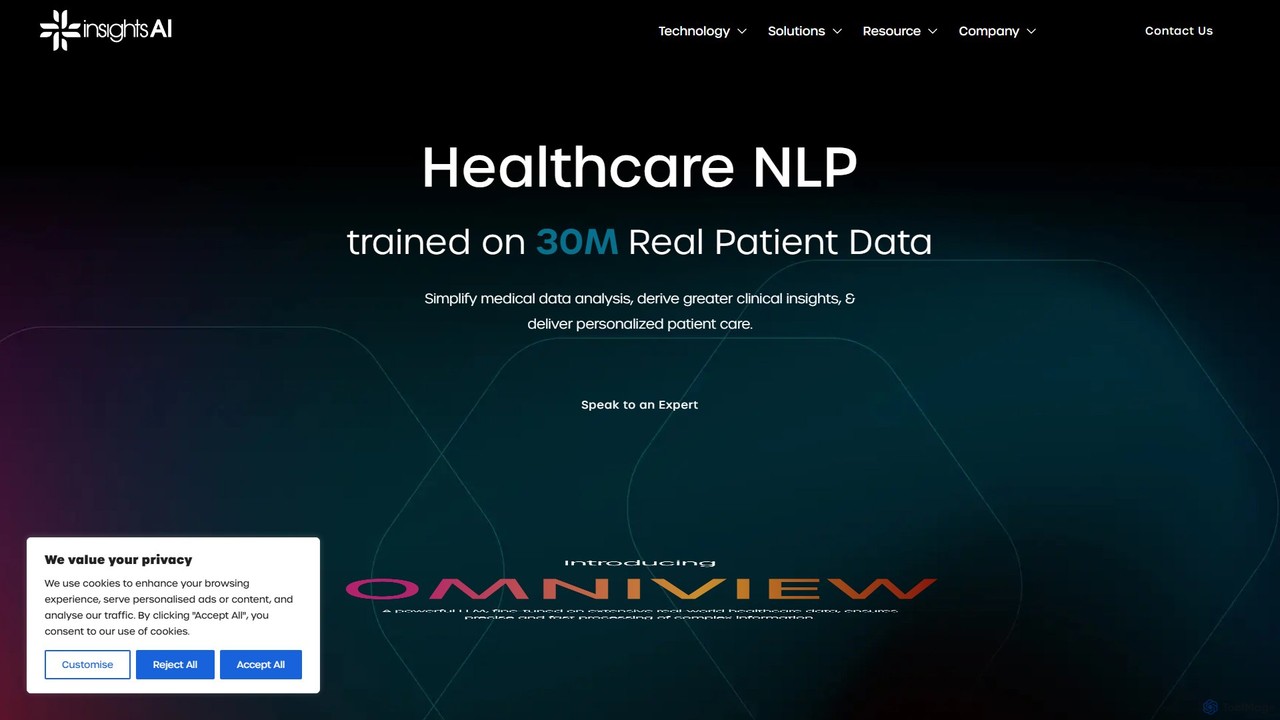
Insights AI offers a specialized healthcare NLP platform, Omniview, an LLM fine-tuned on 30 million real patient records. It provides high-precision APIs for medical data analysis, clinical insight extraction, data de-identification, and annotation. The platform ensures HIPAA compliance and data security with flexible on-premise or cloud deployment, designed to enhance clinical research and personalize patient care.

Natural Language Processing
Visits 5.9KFavorites 160Likes 149

About Medical Data Analysis

Medical Data Analysis tools are AI-powered platforms designed to process and interpret complex health datasets. They leverage machine learning, natural language processing (NLP), and advanced statistical models to uncover patterns, predict outcomes, and generate actionable insights from sources like electronic health records (EHRs), clinical trials, and genomic data. These tools are instrumental in accelerating medical research, enhancing diagnostic precision, and developing personalized patient treatment plans. Their ability to handle vast, unstructured, and multimodal data sets them apart from traditional analytical software.

Core Features

  • Predictive Modeling: Builds models to forecast disease progression, patient risk, and treatment outcomes based on historical data.
  • EHR Data Processing: Extracts and structures information from electronic health records, including unstructured clinical notes using NLP.
  • Genomic Sequence Analysis: Analyzes DNA/RNA sequences to identify genetic markers, mutations, and correlations with diseases.
  • Clinical Trial Optimization: Identifies ideal patient cohorts for trials and analyzes results to determine drug efficacy and safety.
  • Real-World Evidence (RWE) Synthesis: Aggregates and analyzes data from various sources outside of clinical trials to understand long-term treatment effects.

Use Cases

These tools are primarily used by pharmaceutical companies for drug discovery, clinical research organizations (CROs) for trial management, hospitals for operational efficiency and clinical decision support, and public health agencies for epidemiological surveillance. For example, a researcher might use a tool to identify biomarkers for a specific cancer, or a hospital administrator could analyze patient flow data to reduce wait times.

How to Choose

When selecting a Medical Data Analysis tool, consider its compliance with regulations like HIPAA and GDPR. Evaluate its compatibility with your specific data types (e.g., genomic, imaging, EHR). Assess the transparency and validation methods of its AI models. Also, consider its integration capabilities with existing hospital information systems (HIS) or lab information management systems (LIMS).

Medical Data Analysis use cases

1

Accelerating Drug Discovery with Clinical Trial Data

A clinical research scientist at a pharmaceutical company is tasked with analyzing data from a multi-site Phase II trial for a new oncology drug. Using a medical data analysis tool, they upload patient data, including biomarkers, treatment responses, and adverse events. The AI platform rapidly identifies a specific genetic marker that correlates with a significantly higher positive response rate. This insight allows the company to refine the patient selection criteria for the pivotal Phase III trial, increasing the likelihood of success and potentially shortening the time to market.

2

Predicting Patient Readmission Risks in Hospitals

A hospital analytics team aims to reduce costly 30-day patient readmissions. They feed years of anonymized EHR data—including diagnoses, lab results, medications, and demographic information—into a predictive modeling tool. The AI generates a risk score for each discharged patient in real-time. This enables case managers to focus proactive follow-up care, such as telehealth check-ins and home health visits, on the highest-risk individuals, leading to improved patient outcomes and significant cost savings.

3

Personalized Cancer Treatment through Genomic Analysis

An oncologist is treating a patient with a rare form of lung cancer that has not responded to standard chemotherapy. They use an AI analysis tool to process the patient's tumor genome sequence. The platform cross-references the patient's specific mutations against a vast database of genomic research and clinical trial outcomes. It identifies a targeted therapy drug, originally approved for a different type of cancer, that is highly likely to be effective against the patient's unique mutation profile, enabling a data-driven, personalized treatment decision.

4

Tracking Disease Outbreaks with Epidemiological Data

During a flu season, a public health official needs to monitor and predict potential outbreaks to allocate resources effectively. They use an AI tool to analyze aggregated, anonymized data from hospital admissions, syndromic surveillance systems, and pharmacy sales across different regions. The system identifies anomalous spikes and predicts hotspots where outbreaks are likely to occur in the next two weeks. This allows the agency to proactively distribute vaccines and launch public awareness campaigns in targeted areas.

5

Uncovering Insights from Unstructured Clinical Notes

A medical researcher is studying the long-term side effects of a widely used medication. Manually reviewing thousands of patient records is infeasible. They employ a medical data analysis tool with advanced NLP capabilities to scan unstructured text from physicians' notes and patient reports within an EHR database. The tool extracts and categorizes mentions of symptoms and adverse events, revealing a previously under-reported correlation between the drug and a specific neurological side effect, prompting further investigation.

6

Optimizing Hospital Emergency Department Flow

A hospital operations manager is facing challenges with overcrowding and long wait times in the emergency department (ED). They use an AI analysis platform to process real-time data from their EHR system, including patient arrival times, triage levels, lab test orders, and bed assignments. The tool visualizes bottlenecks in the patient journey and simulates the impact of potential changes, such as reallocating staff or modifying triage protocols. This data-driven approach helps the manager implement changes that reduce patient wait times and improve overall ED efficiency.

Medical Data Analysis FAQ

What is AI Medical Data Analysis?

AI Medical Data Analysis involves using specialized software tools that apply machine learning and NLP to interpret large, complex health datasets. These tools go beyond simple statistics to identify hidden patterns, predict future outcomes, and generate clinical or research insights from sources like EHRs, genomic data, and clinical trials. Their primary goal is to support evidence-based medicine, accelerate research, and improve healthcare operations.

How do I choose the right Medical Data Analysis tool?

To choose the right tool, consider these factors:

  • Data Compatibility: Ensure it supports your specific data formats (e.g., DICOM for images, VCF for genomics, HL7 for EHRs).
  • Regulatory Compliance: Verify that the tool is compliant with necessary regulations in your region, such as HIPAA in the US or GDPR in Europe.
  • Model Transparency: Look for tools that offer explainable AI (XAI), allowing you to understand how the model reaches its conclusions.
  • Integration: Check its ability to integrate with your existing infrastructure, like hospital information systems or research databases.
What's the difference between Medical Data Analysis and general Business Intelligence (BI) tools?

The key difference lies in specificity and compliance. Medical Data Analysis tools are purpose-built to handle the unique complexities and formats of health data, such as genomic sequences or clinical notes. They incorporate domain-specific algorithms and are designed to comply with strict healthcare privacy regulations like HIPAA. General BI tools are designed for business metrics (e.g., sales, marketing) and typically lack the specialized analytical functions and regulatory safeguards required for medical applications.

What types of data can these AI tools analyze?

These tools are designed to handle a wide variety of structured and unstructured health data. Common types include:

  • Electronic Health Records (EHRs): Patient demographics, diagnoses, lab results, and medications.
  • Genomic and Proteomic Data: DNA/RNA sequences and protein expression data.
  • Clinical Trial Data: Patient outcomes, adverse events, and biomarker information.
  • Medical Imaging Data: While some tools specialize in this, many analysis platforms can incorporate findings from images (e.g., tumor size).
  • Unstructured Text: Clinical notes, pathology reports, and scientific literature.
Who are the primary users of Medical Data Analysis tools?

The primary users are professionals who work with large-scale health data. This includes clinical researchers and scientists in pharmaceutical and biotech companies who analyze trial data for drug discovery. It also includes hospital administrators and data analysts optimizing operations and patient outcomes. Additionally, bioinformaticians, geneticists, and public health officials use these tools for genomic research and epidemiological surveillance.