
ToolMage
Sign in

Best 1 Medical Record Analysis AI tools for Healthcare

Popular Medical Record Analysis AI tools in Healthcare include brighterway, helping you work more efficiently.

brighterway
Paid

brighterway

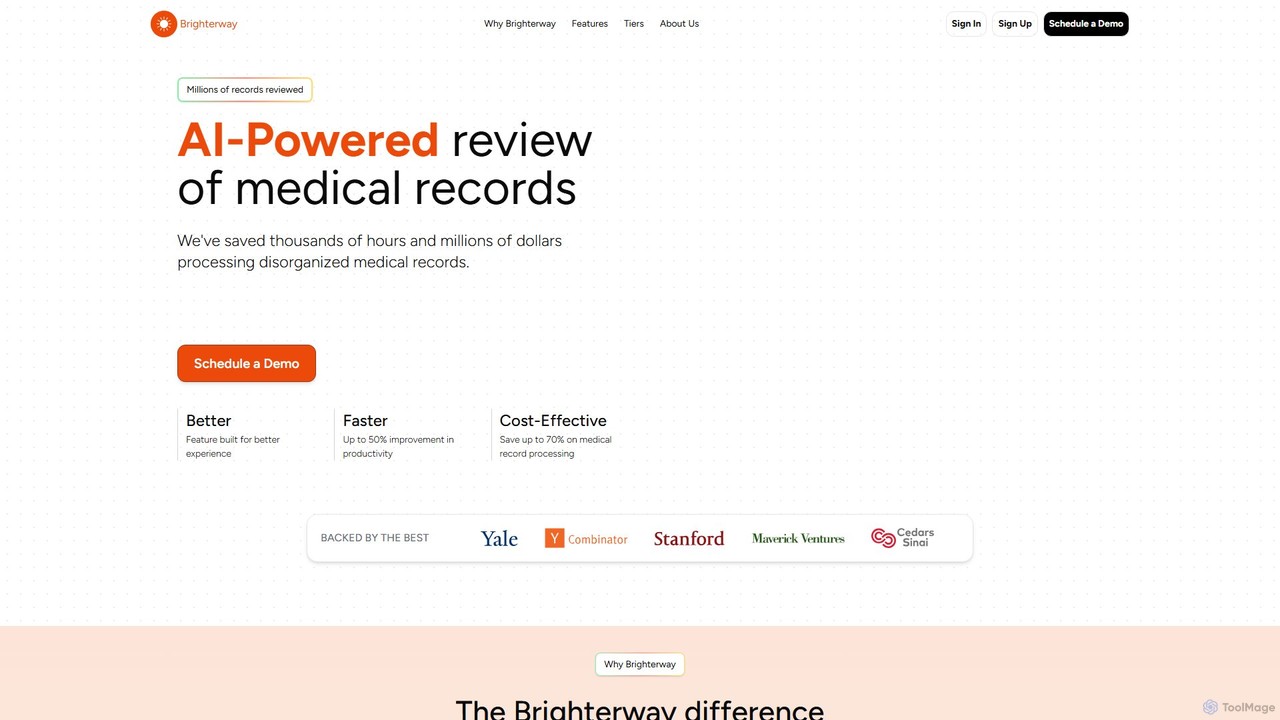
Brighterway is an AI-powered platform designed for the medical and legal industries to streamline the review of complex medical records. It automates the sorting and summarization of disorganized documents, significantly improving productivity and reducing costs. The platform is fine-tuned by MDs and AI researchers to ensure clinical accuracy and relevance, offering customizable solutions and expert support to enhance decision-making.

Data Processing
Visits 7.1KFavorites 135Likes 161

About Medical Record Analysis

Medical Record Analysis tools are a specialized category of AI that automatically extracts, structures, and interprets information from complex electronic health records (EHRs) and medical notes. Leveraging Natural Language Processing (NLP) and machine learning, these tools transform unstructured text into actionable, organized data. They are designed to accelerate clinical data review, identify patient cohorts for research, and provide critical insights for diagnostic and treatment support. This capability allows healthcare professionals to quickly understand a patient's history and identify key risk factors without extensive manual review.

Core Features

  • Clinical Data Extraction: Automatically pulls specific information like diagnoses, medications, lab results, and symptoms from free-text notes and structured fields.
  • Natural Language Understanding (NLU): Interprets clinical narratives, recognizing medical concepts, abbreviations, and relationships between different data points.
  • Patient History Summarization: Generates concise, chronological summaries of a patient's medical history, highlighting significant events and conditions.
  • Risk Stratification: Analyzes patient data to identify and categorize individuals based on their risk for specific diseases or adverse outcomes.
  • Cohort Identification: Scans large databases of medical records to find groups of patients who meet specific criteria for clinical trials or population health studies.

Applicable Scenarios

These tools are primarily used in clinical research, hospital administration, and direct patient care. For instance, researchers use them to rapidly find eligible candidates for clinical trials. Hospital administrators analyze population health trends from anonymized records to optimize resource allocation. Clinicians use them for quick access to summarized patient histories to support decision-making.

Selection Criteria

When choosing a Medical Record Analysis tool, prioritize data security and compliance with regulations like HIPAA or GDPR. Evaluate its integration capabilities with your existing EHR system. Assess the accuracy and validation methods of its data extraction models. Also, consider whether the tool is specialized for your clinical domain, such as oncology or cardiology, to ensure high relevance.

Medical Record Analysis use cases

1

Accelerating Clinical Trial Recruitment

A clinical research coordinator at a pharmaceutical company is tasked with identifying 50 patients for a new oncology trial with highly specific inclusion and exclusion criteria. Manually reviewing thousands of patient records would take months. By using a Medical Record Analysis tool, the coordinator inputs the criteria, and the AI scans the hospital's entire anonymized EHR database in hours. It flags a shortlist of potential candidates, providing summaries of their relevant history. This reduces the recruitment screening time by over 90%, allowing the trial to start sooner.

2

Automating Insurance Claim Adjudication

An insurance claims processor receives a complex claim accompanied by hundreds of pages of medical records. To verify that the treatments listed are medically necessary and correspond to the diagnoses, they use an AI analysis tool. The tool automatically extracts all mentioned diagnoses (with ICD codes), procedures, and medications from the records and cross-references them with the claim form. It flags any discrepancies or services that may not be covered under the patient's policy, allowing the processor to focus their review on these specific items, significantly speeding up the adjudication process.

3

Generating Summaries for Specialist Referrals

A primary care physician refers a patient with a long and complex medical history to a cardiologist. To ensure the specialist has all critical information readily available, the physician's office uses an AI tool to generate a one-page clinical summary. The tool processes the patient's entire EHR, extracting key diagnoses, major surgeries, current medications, allergies, and recent lab trends. The resulting summary is structured and easy to read, allowing the cardiologist to quickly grasp the patient's situation before the consultation, leading to a more efficient and effective appointment.

4

Population Health Trend Analysis

A public health official wants to understand the prevalence of comorbidities associated with Type 2 diabetes in a specific region. Using a Medical Record Analysis tool on a large, anonymized dataset of patient records, they can quickly identify patterns. The AI identifies that patients with diabetes in this area have a significantly higher rate of hypertension and chronic kidney disease compared to the national average. This data-driven insight allows the public health department to design targeted screening programs and educational campaigns to address these specific health challenges in the community.

5

Pharmacovigilance and Adverse Event Detection

A pharmaceutical company's safety team monitors the real-world performance of a newly approved drug. They use an AI Medical Record Analysis tool to scan millions of anonymized patient records for potential adverse drug events (ADEs) that were not identified in clinical trials. The system is trained to recognize mentions of symptoms or new diagnoses that occur shortly after the drug was prescribed. When it detects a statistically significant correlation, it alerts the safety team for further investigation, enabling proactive drug safety monitoring.

6

Enhancing Clinical Decision Support Systems

A hospital integrates a Medical Record Analysis module into its existing Clinical Decision Support (CDS) system. When a physician is about to prescribe a new medication, the AI module instantly analyzes the patient's complete record in the background. It identifies a note from a specialist two years ago mentioning a mild allergy to a similar class of drug, something not listed in the structured allergy field. The CDS system then flags this potential contraindication to the physician before the prescription is finalized, preventing a potential adverse reaction and improving patient safety.

Medical Record Analysis FAQ

What is AI Medical Record Analysis?

AI Medical Record Analysis involves using artificial intelligence, primarily Natural Language Processing (NLP) and machine learning, to read, understand, and extract structured information from unstructured medical texts like clinical notes, discharge summaries, and pathology reports. Its main purpose is to convert vast amounts of complex clinical data into a standardized, usable format. This enables faster data review, identification of patient cohorts, and support for clinical decision-making without requiring manual data entry or review of entire records.

How to choose the right Medical Record Analysis tool?

Choosing the right tool depends on several key factors. First, ensure it complies with data privacy regulations like HIPAA (in the US) or GDPR (in Europe). Second, evaluate its integration capabilities with your existing Electronic Health Record (EHR) system. Third, assess the accuracy of its NLP models; ask for performance metrics or case studies relevant to your specialty. Finally, consider the scope of its features: does it only extract data, or does it also offer summarization, risk stratification, and cohort building functionalities that match your needs?

What's the difference between Medical Record Analysis and general Healthcare AI?

Medical Record Analysis is a specific subfield within the broader category of Healthcare AI. While Healthcare AI covers a wide range of applications like AI-powered medical imaging analysis, drug discovery, and robotic surgery, Medical Record Analysis focuses exclusively on interpreting and structuring data from existing patient records (EHRs/EMRs). Its core technology is Natural Language Processing (NLP) for understanding text, whereas other Healthcare AI might rely more on computer vision or predictive modeling on different data types. Think of it as the difference between reading a book (Medical Record Analysis) and performing surgery (another type of Healthcare AI).

What key data can these tools extract from medical records?

These tools can extract a wide variety of clinical data points, even when they are buried in narrative text. Common examples include:

  • Diagnoses and Problems: Identifying conditions and linking them to ICD codes.
  • Medications: Extracting drug names, dosages, frequencies, and reasons for prescription.
  • Procedures: Recognizing surgical operations, diagnostic tests, and other medical interventions.
  • Lab Values: Pulling specific test results and their values from reports.
  • Symptoms and Findings: Identifying patient-reported symptoms and physician's findings from clinical notes.

Who benefits most from Medical Record Analysis tools?

A wide range of healthcare stakeholders benefit from these tools. Clinical Researchers can accelerate study recruitment and conduct real-world evidence studies more efficiently. Hospital Administrators can analyze operational data and population health trends to improve quality of care and resource management. Clinicians (doctors, nurses) can get quick, comprehensive summaries of patient histories to make more informed decisions. Finally, Insurance Payers can streamline claims processing and detect fraud by automatically verifying medical records against claims.