ToolMage
Sign in

Best 2 Candidate Screening AI tools for Human Resources

Popular Candidate Screening AI tools in Human Resources include GitCruiter and QuizzViz, helping you work more efficiently.

QuizzViz
Freemium

QuizzViz

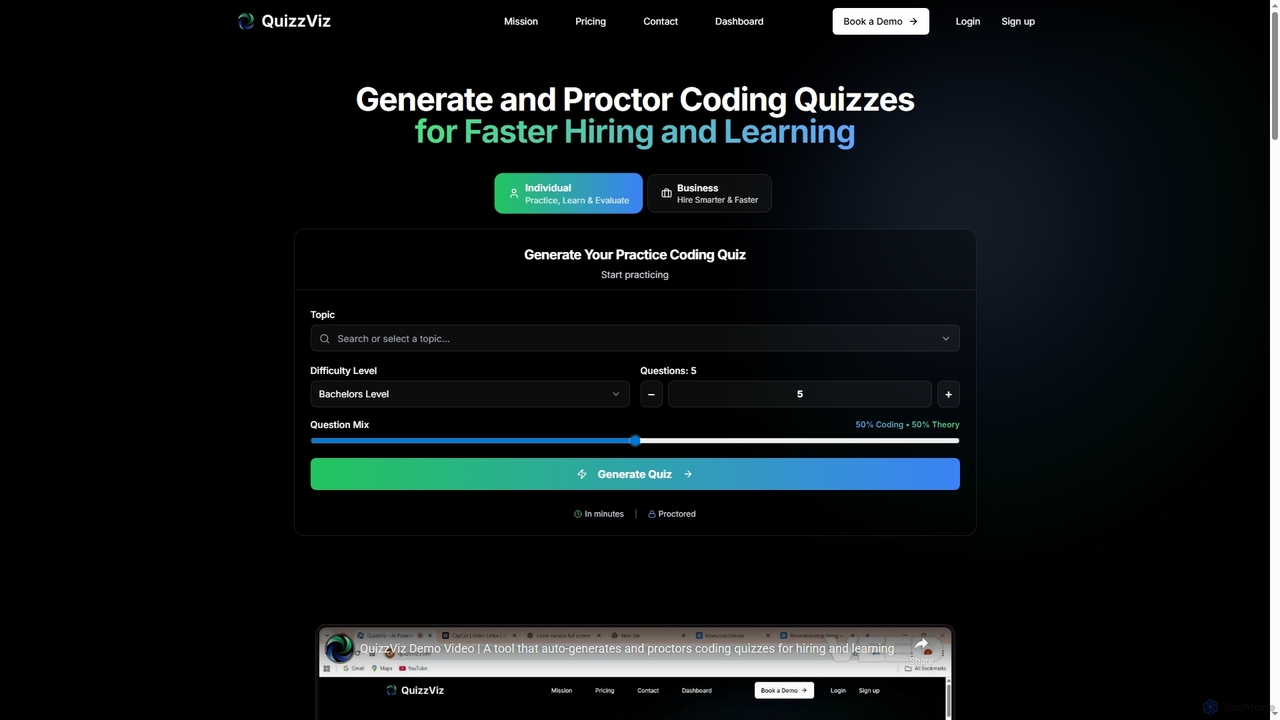
QuizzViz is an AI-powered platform designed to generate and proctor secure, real-world scenario-based coding quizzes. It helps individuals practice and evaluate their skills, and enables businesses to hire smarter and faster by efficiently screening technical talent.

Quiz Generation
Visits 3.7KFavorites 169Likes 171
GitCruiter

GitCruiter

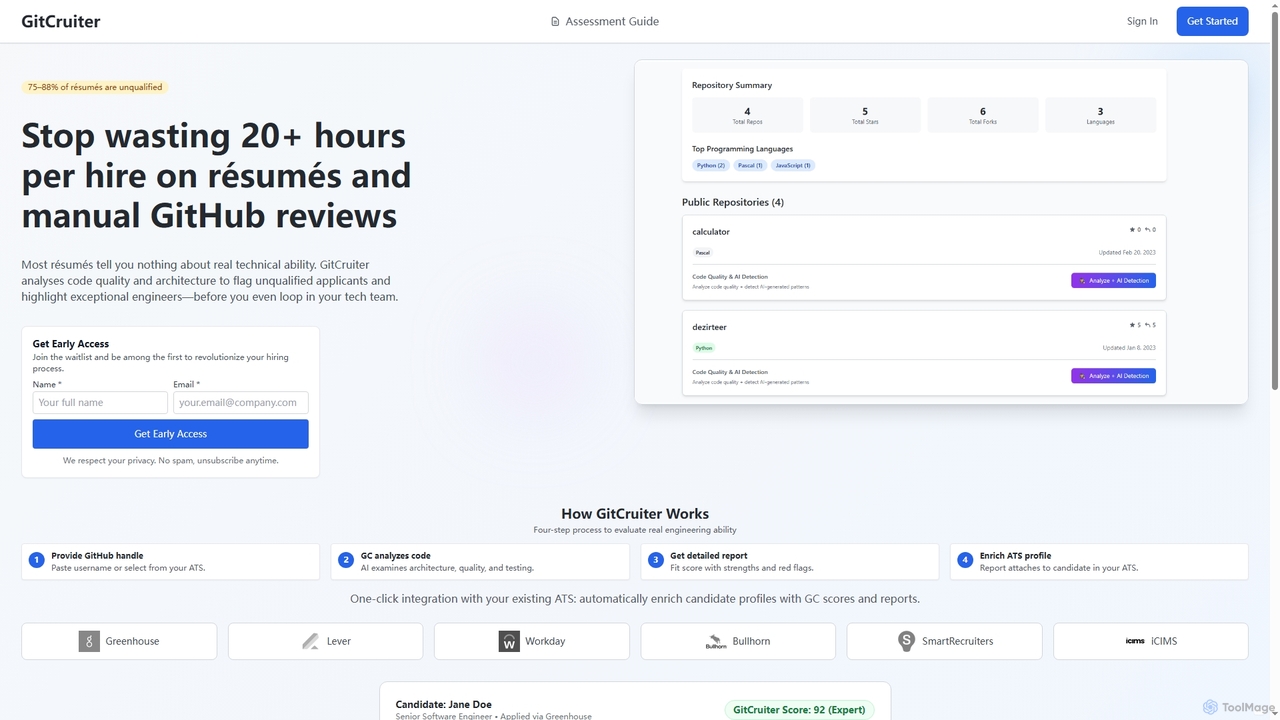
GitCruiter is an AI-powered platform that revolutionizes technical hiring by analyzing candidates' public GitHub repositories. It provides objective scores and detailed reports on code quality, architecture, testing, and problem-solving, helping recruiters and hiring managers identify top engineering talent and reduce time spent on unqualified resumes.

Candidate Screening
Visits 3.8KFavorites 110Likes 99

About Candidate Screening

Candidate Screening tools are a specialized category of AI-powered software designed to automate the initial review and filtering of job applications. These platforms utilize Natural Language Processing (NLP) and machine learning to parse resumes, cover letters, and other application data to identify the most qualified individuals. By analyzing skills, experience, and qualifications against job requirements, they significantly accelerate the top of the hiring funnel for recruiters. This allows HR teams to move beyond simple keyword matching and focus their efforts on engaging with the highest-potential candidates.

Core Features

  • AI-Powered Resume Parsing: Automatically extracts and structures key information like skills, work history, and education from various resume formats.
  • Candidate Scoring & Ranking: Objectively scores and ranks applicants based on customizable criteria and their fit for the specific role.
  • Bias Reduction Tools: Anonymizes demographic information such as name, gender, or age to promote fair evaluation based purely on qualifications.
  • Knockout Questions: Automatically filters out candidates who do not meet essential, non-negotiable job requirements.
  • ATS Integration: Seamlessly connects with existing Applicant Tracking Systems (ATS) to streamline the overall recruitment workflow.

Use Cases

These tools are most impactful in high-volume recruiting environments, such as large enterprises, recruitment agencies, and companies in the tech, retail, or customer service sectors. They are used by recruiters and HR managers to efficiently manage hundreds or thousands of applications for a single opening, ensuring no qualified candidate is overlooked while saving significant administrative time.

How to Choose

When selecting a Candidate Screening tool, consider its integration capabilities with your current ATS. Evaluate the level of customization available for scoring criteria and workflows. Investigate the platform's specific features for bias mitigation and its compliance with data privacy regulations like GDPR. Finally, assess the accuracy of its parsing technology and the clarity of its analytics dashboard.

Featured tool rankings

Candidate Screening use cases

1

Screening for High-Volume Tech Roles

A fast-growing tech company receives over 500 applications for a Senior Software Engineer position. The recruitment team uses an AI screening tool to automatically parse each resume. The tool is configured to score candidates based on proficiency in specific languages (e.g., Go, Rust), experience with cloud platforms (AWS, Azure), and contributions to open-source projects. Within minutes, the system ranks the top 30 applicants, allowing recruiters to bypass manual review of hundreds of unqualified resumes and immediately engage with the most promising talent.

2

Reducing Bias in Leadership Role Hiring

A large corporation aims to improve diversity in its management team. When hiring a new Director of Operations, they use an AI screening tool configured for bias reduction. The software automatically redacts names, university names, and graduation years from all applications. It then scores candidates solely on criteria like years of P&L management experience, certifications in process optimization (e.g., Six Sigma), and demonstrated success in scaling teams. This provides the hiring committee with a shortlist based on merit, helping to mitigate unconscious biases in the initial selection phase.

3

Automating Screening for Retail and Customer Service

A national retail chain needs to hire 200 seasonal employees across 50 stores. The HR department uses an AI screening tool to manage thousands of applications. They set up 'knockout questions' to automatically filter out applicants who are not over 18 or cannot work on weekends. The AI then ranks the remaining candidates based on previous retail experience and mentions of customer service skills. This process reduces the screening time per applicant from several minutes to just seconds, allowing store managers to focus on interviewing a pre-qualified pool of candidates.

4

Enhancing Efficiency for Recruitment Agencies

A staffing agency manages a large, diverse talent pool for multiple clients. Using an AI screening tool, recruiters can screen their entire candidate database against a new job description in minutes. For a client needing a 'Marketing Manager with SaaS experience', the AI identifies candidates who list SaaS companies in their work history and mention skills like 'SEO', 'content marketing', and 'HubSpot'. The tool presents a ranked list, complete with match scores and highlighted keywords, enabling the agency to submit qualified candidates to clients faster than competitors.

5

Identifying Niche Skills for Scientific Roles

A pharmaceutical company is searching for a Research Scientist with a highly specific skill set in CRISPR gene-editing techniques. A standard keyword search might be too broad. Their AI screening tool is trained to understand the context and semantic relationships between scientific terms. It scans resumes and linked publications to identify candidates who not only mention 'CRISPR' but also specific associated methodologies and equipment. This deep analysis uncovers a small pool of highly specialized experts that would be difficult and time-consuming to find through manual sourcing.

6

Streamlining University Graduate Recruitment

A global consulting firm runs an annual graduate recruitment program, attracting tens of thousands of applicants. The HR team uses an AI screening tool to perform the initial pass. The system is configured to check for minimum GPA requirements, relevant internship experience in finance or consulting, and leadership roles in university clubs. It automatically flags candidates from target universities and those with multilingual abilities. This automated first-level screening allows the campus recruitment team to manage the immense volume and focus their time on conducting interviews and assessment centers for the top-ranked graduates.

Candidate Screening FAQ

What are AI Candidate Screening tools?

AI Candidate Screening tools are software applications that automate the initial stage of the recruitment process. They use artificial intelligence, particularly Natural Language Processing (NLP), to read, understand, and analyze job applications. Instead of just matching keywords, these tools can interpret context to evaluate a candidate's skills, experience, and qualifications against a job description, then score and rank them. This helps recruiters quickly identify the most promising candidates from a large applicant pool.

How to choose the right AI Candidate Screening tool?

When selecting a tool, consider these four key factors:

  • ATS Integration: Ensure the tool seamlessly integrates with your existing Applicant Tracking System (ATS) to avoid data silos and manual work.
  • Customization and Control: Look for a platform that allows you to customize screening criteria, scoring weights, and workflows to match your specific hiring needs.
  • Bias Mitigation Features: Ask about the specific methods the tool uses to reduce bias, such as data anonymization or algorithm transparency.
  • Performance and Accuracy: Evaluate the accuracy of its resume parsing and its ability to understand nuanced skills and experiences relevant to your industry.
What's the difference between AI Screening and a traditional Applicant Tracking System (ATS)?

A traditional Applicant Tracking System (ATS) is primarily a database and workflow tool for managing the entire hiring process—from posting jobs to making offers. Its screening capabilities often rely on basic keyword matching. AI Candidate Screening tools are more specialized. They act as an intelligent layer, often integrating with an ATS, to perform a deeper, more contextual analysis of applications. While an ATS manages the process, an AI screener enhances the decision-making at the top of the funnel by understanding skills and qualifications, not just keywords.

Can AI Candidate Screening completely eliminate hiring bias?

AI screening tools can significantly *reduce* unconscious human bias, but they cannot completely eliminate it. By anonymizing demographic data and focusing on objective qualifications, they create a more level playing field in the initial screening stage. However, it's important to be aware that AI models can sometimes inherit biases from the historical data they were trained on. Therefore, these tools are best used as a powerful aid to mitigate bias, combined with well-structured interviews and ongoing audits of the hiring process to ensure fairness.

Who benefits most from using AI Candidate Screening tools?

The primary beneficiaries are recruiters and HR departments in organizations that experience a high volume of applications. This includes large enterprises, fast-growing startups, and companies in sectors like technology, retail, and healthcare. By automating the time-consuming task of initial screening, these tools free up recruiters to focus on more strategic activities, such as engaging with top candidates, building talent pipelines, and working closely with hiring managers. Ultimately, this leads to a faster, more efficient, and often more equitable hiring process.