Infrastructure Best in category 1 results High Performance Computing AI Tool

Popular AI tools in the High Performance Computing field of Infrastructure include Cirrascale Cloud Services, etc., helping you quickly improve efficiency.

Cirrascale Cloud Services

Cirrascale Cloud Services

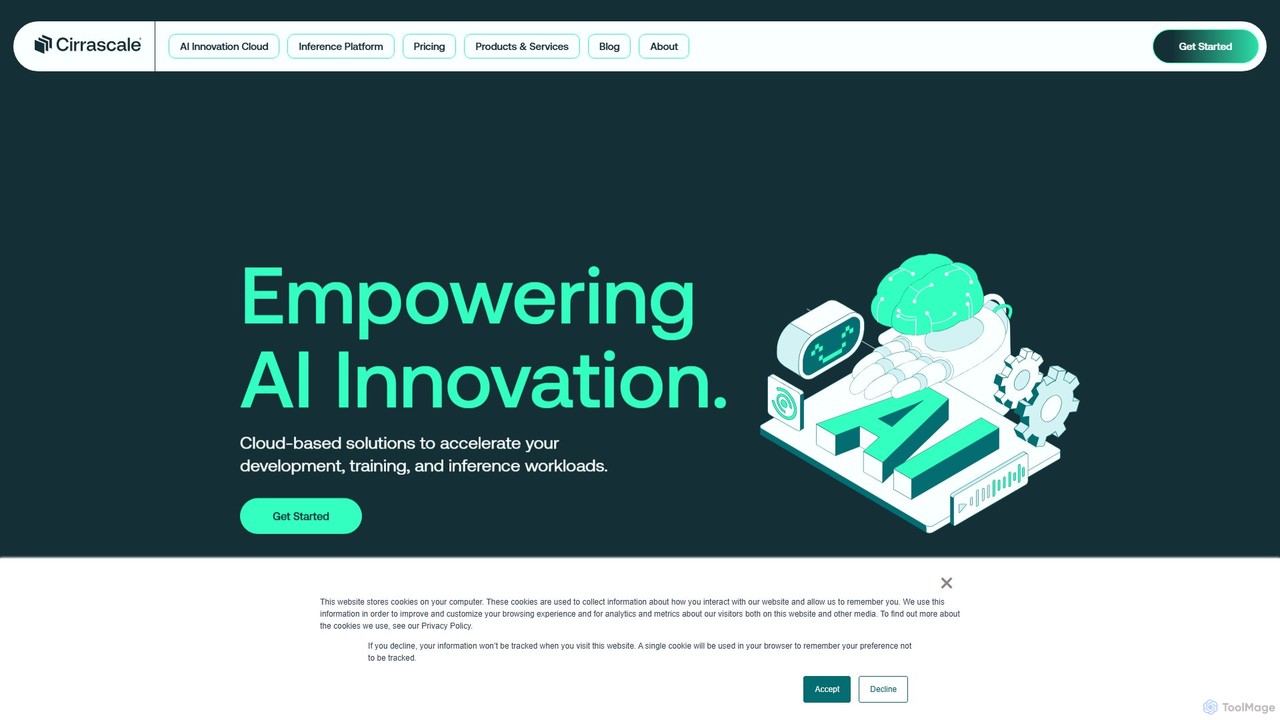
Cirrascale provides high-performance, dedicated GPU cloud services tailored for large-scale AI, deep learning, and High-Performance Computing (HPC). It …

12.0K

About High Performance Computing

High Performance Computing (HPC) refers to the aggregation of computing power to achieve significantly higher performance than typical workstations, crucial for complex AI workloads. These systems leverage parallel processing, specialized hardware like GPUs, and high-speed interconnects to tackle computationally intensive tasks. HPC enables rapid training of large AI models, advanced simulations, and real-time data analytics, accelerating scientific discovery and technological innovation within the broader infrastructure landscape.

Core Features

  • Parallel Processing: Distributes computational tasks across multiple processors or nodes simultaneously to speed up execution.
  • GPU Acceleration: Utilizes Graphics Processing Units for massive parallel computations, essential for AI model training and scientific simulations.
  • High-Speed Interconnects: Employs technologies like InfiniBand or Omni-Path for ultra-low latency and high-bandwidth communication between nodes.
  • Scalable Storage Solutions: Provides high-throughput, low-latency storage systems optimized for large datasets and parallel access.
  • Advanced Workload Management: Orchestrates and schedules complex computational jobs across distributed resources efficiently.

Use Cases

HPC is vital for fields requiring immense computational power, such as scientific research, engineering design, and advanced AI development. It supports tasks like molecular dynamics simulations in drug discovery, complex fluid dynamics analysis in aerospace, and the training of sophisticated deep learning models.

How to Choose

Selecting an HPC solution involves evaluating hardware specifications (CPU/GPU balance), network architecture (interconnect speed), storage capacity and type (parallel file systems), software ecosystem (compilers, libraries), and scalability requirements. Consider the specific computational demands of your AI models or simulations, budget constraints, and the level of technical support offered.

High Performance ComputingUse Cases

1

Accelerating Large Language Model (LLM) Training

AI researchers and data scientists leverage HPC clusters to train massive language models that require billions of parameters and vast datasets. By distributing the computational load across hundreds or thousands of GPUs connected via high-speed networks, training times can be reduced from months to weeks or even days, enabling faster iteration and deployment of advanced AI capabilities.

2

Complex Scientific Simulations in Drug Discovery

Pharmaceutical researchers utilize HPC for molecular dynamics simulations, predicting how drug candidates interact with biological targets. These simulations involve billions of calculations to model atomic movements over time. HPC systems provide the necessary computational power to run these simulations efficiently, significantly accelerating the drug discovery and development process by identifying promising compounds faster.

3

Financial Risk Modeling and Algorithmic Trading

Financial institutions employ HPC to perform complex risk assessments, portfolio optimization, and high-frequency algorithmic trading. These tasks involve processing massive amounts of market data, running Monte Carlo simulations, and executing sophisticated trading strategies in milliseconds. HPC infrastructure ensures the speed and accuracy required to gain a competitive edge and manage financial exposure effectively.

4

Advanced Climate Modeling and Weather Prediction

Meteorological agencies and climate research centers rely on HPC to run highly detailed climate models and make accurate weather predictions. These models simulate atmospheric and oceanic processes, requiring immense computational power to process vast datasets and solve complex differential equations. HPC enables scientists to forecast extreme weather events, study climate change impacts, and improve disaster preparedness with greater precision.

5

Autonomous Vehicle Development and Sensor Data Processing

Engineers developing autonomous vehicles use HPC to process and analyze petabytes of sensor data (Lidar, radar, cameras) collected from test drives. This data is crucial for training perception models, simulating driving scenarios, and validating safety systems. HPC clusters provide the necessary throughput and computational power to rapidly ingest, process, and learn from this massive influx of real-world driving information, accelerating the development cycle.

6

Genomic Sequencing and Bioinformatics Analysis

Biotechnology and medical research institutions utilize HPC for rapid genomic sequencing, variant calling, and complex bioinformatics analyses. Processing vast amounts of DNA/RNA sequencing data to identify genetic markers, understand disease mechanisms, or personalize medicine requires immense computational resources. HPC systems enable researchers to analyze these large biological datasets efficiently, accelerating breakthroughs in genomics and precision health.

High Performance ComputingFrequently Asked Questions