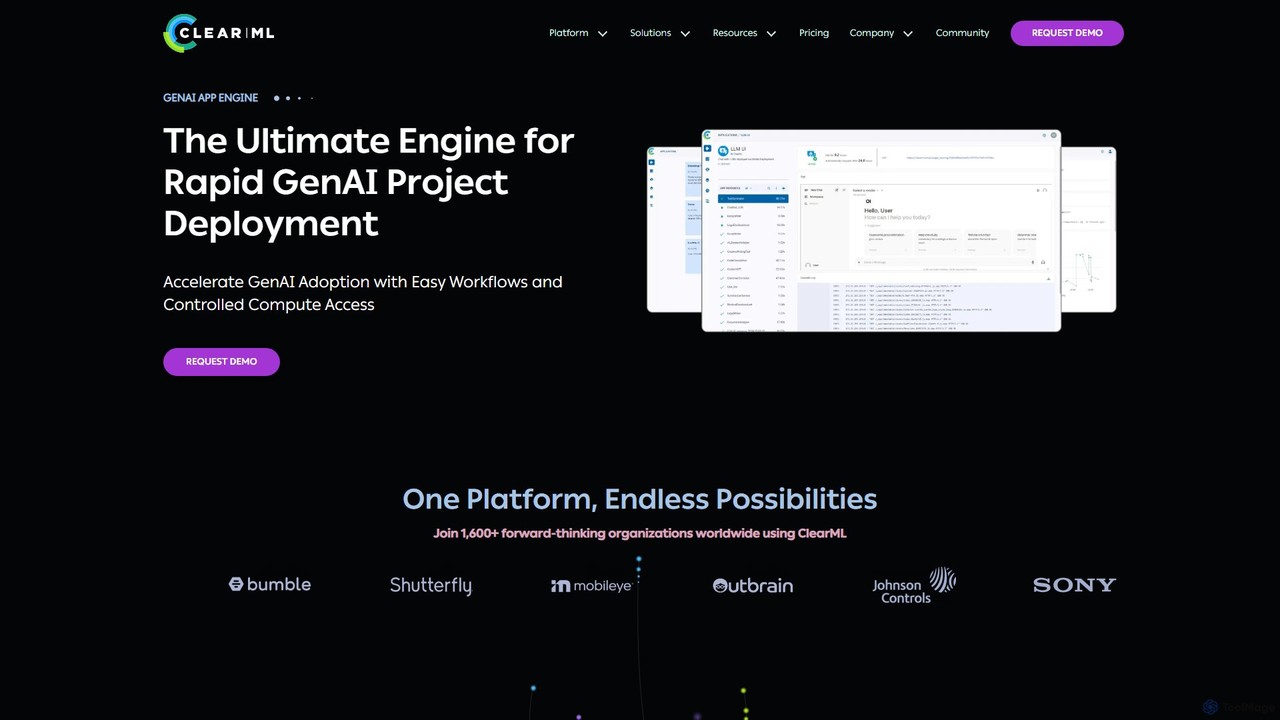
ClearML GenAI App Engine
An enterprise-grade platform for rapidly deploying, managing, and scaling Generative AI applications. It provides a unified infrastructure control …
An enterprise-grade platform for rapidly deploying, managing, and scaling Generative AI applications. It provides a unified infrastructure control plane to streamline LLM deployment, monitor performance, and optimize compute costs, accelerating GenAI adoption securely and efficiently.
About Model Deployment
Model Deployment refers to the process of integrating a trained machine learning or AI model into an existing production environment, making it accessible for real-world applications. This crucial step in the MLOps lifecycle transforms experimental models into functional services, enabling them to process new data and generate predictions or insights at scale. Effective model deployment ensures reliability, scalability, and maintainability of AI-powered systems, bridging the gap between development and practical business value.
Core Features
- API Endpoint Creation: Exposing models as accessible APIs for seamless integration with applications.
- Scalability & Load Balancing: Automatically adjusting resources to handle varying inference requests and distributing traffic efficiently.
- Model Versioning: Managing different iterations of models, allowing for rollbacks and controlled updates.
- Monitoring & Alerting: Tracking model performance, data drift, and resource utilization in real-time, with automated alerts.
- Containerization: Packaging models and their dependencies into isolated, portable units (e.g., Docker) for consistent execution.
Applicable Scenarios
Data scientists and MLOps engineers utilize model deployment tools to bring their trained AI models to life. For instance, an e-commerce company might deploy a recommendation engine to provide real-time product suggestions to users, or a financial institution could deploy a fraud detection model to analyze transactions instantly. These tools are essential for any organization aiming to operationalize AI for business impact.
How to Choose
When selecting a model deployment solution, consider its compatibility with your existing infrastructure and AI frameworks. Evaluate its scalability features to handle anticipated load, the robustness of its monitoring and logging capabilities, and its support for model versioning and A/B testing. Ease of integration, security features, and cost-effectiveness are also critical factors for making an informed decision.
Model DeploymentUse Cases
Deploying Real-time Recommendation Engines
An e-commerce platform's data science team needs to deploy a personalized product recommendation model. Using model deployment tools, they containerize the trained model, expose it via a low-latency API endpoint, and configure auto-scaling to handle peak traffic. This allows the website to provide instant, relevant product suggestions to millions of users, significantly improving conversion rates and customer experience.
Automating Fraud Detection Model Updates
A financial institution requires its fraud detection system to be continuously updated with the latest models to combat evolving threats. MLOps engineers leverage deployment platforms to automate the CI/CD pipeline for models, enabling seamless, zero-downtime updates of new fraud detection models. This ensures the system remains highly effective, protecting customers and assets from financial crime.
Scaling AI Chatbot Services for Customer Support
A large enterprise needs to scale its AI-powered customer service chatbot to handle millions of queries daily across multiple channels. Model deployment solutions allow them to deploy the chatbot's underlying NLP model as a scalable service, automatically provisioning resources based on demand. This ensures consistent, fast responses for customers, reducing wait times and operational costs.
A/B Testing New Model Versions in Production
A marketing analytics team wants to test a new customer churn prediction model against the existing one without disrupting live services. Model deployment platforms facilitate A/B testing by routing a small percentage of live traffic to the new model, collecting performance metrics, and allowing for a controlled rollout or rollback. This enables data-driven decision-making for model improvements.
Deploying Predictive Maintenance Models on Edge Devices
A manufacturing company aims to implement predictive maintenance for its machinery by deploying AI models directly onto edge devices on the factory floor. Specialized model deployment tools for edge computing enable efficient model compression and optimized deployment to resource-constrained hardware. This allows for real-time anomaly detection and proactive maintenance, minimizing downtime and costs.
Managing Multiple AI Model Endpoints for Diverse Applications
A technology company develops various AI services, such as image recognition, natural language processing, and sentiment analysis, for different internal and external applications. Model deployment platforms provide a centralized hub to manage, monitor, and scale these diverse AI model endpoints. This streamlines operations, ensures consistent service delivery, and simplifies governance across the AI portfolio.