BrainHost
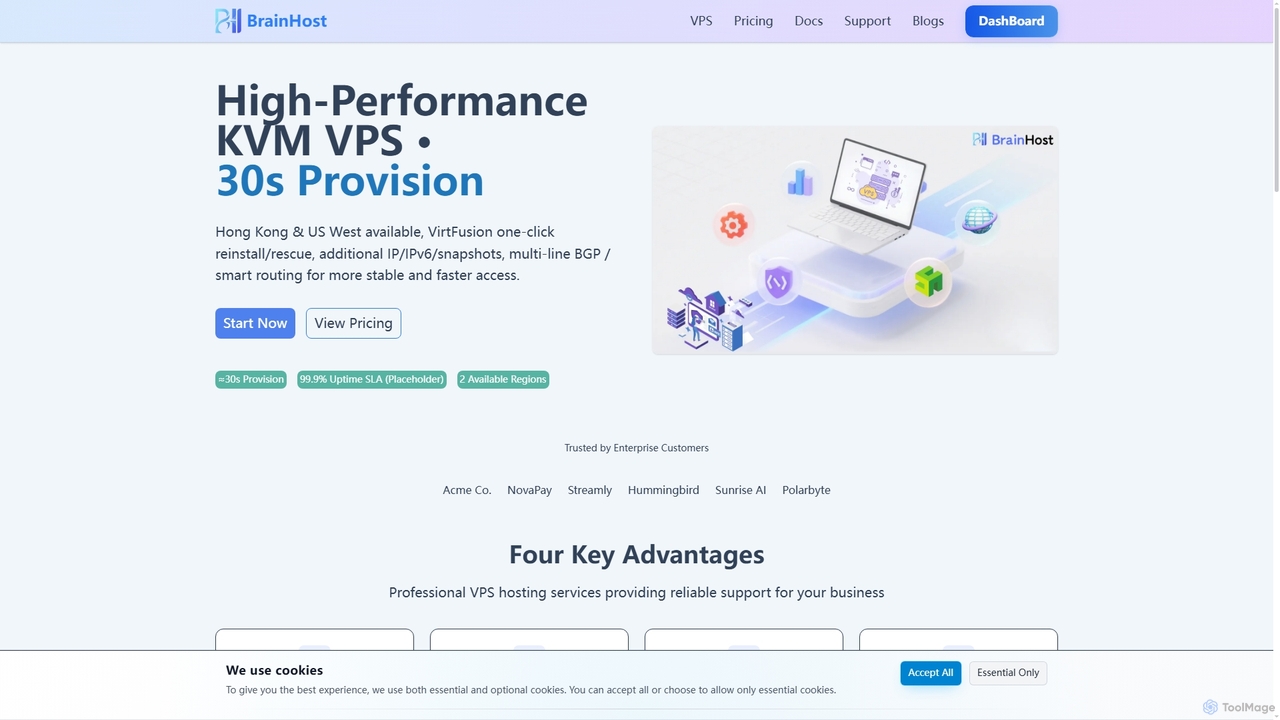
BrainHost offers high-performance KVM VPS hosting with NVMe storage, designed for speed and reliability. Featuring 30-second provisioning, global …
BrainHost offers high-performance KVM VPS hosting with NVMe storage, designed for speed and reliability. Featuring 30-second provisioning, global data centers in Hong Kong and US West, and the intuitive VirtFusion control panel, it provides a robust infrastructure for websites, e-commerce, AI inference, and gaming applications. Flexible scaling and advanced network routing ensure stable and fast access worldwide.
About Server Management
AI Server Management tools are a class of software that leverages machine learning to automate and optimize the monitoring, maintenance, and security of server infrastructure. These tools analyze vast streams of real-time data, such as performance metrics and system logs, to identify patterns invisible to human administrators. By doing so, they enable proactive problem resolution, enhance system reliability, and significantly reduce the manual workload for IT and DevOps teams. This predictive approach shifts server administration from a reactive to a preventative model.
Core Features
- Predictive Analytics: Forecasts potential hardware failures or performance bottlenecks before they impact users.
- Anomaly Detection: Identifies unusual patterns in system behavior that may indicate security threats or operational issues.
- Automated Root Cause Analysis: Rapidly pinpoints the source of errors by correlating events across multiple logs and systems.
- Intelligent Resource Scaling: Automatically adjusts server capacity based on predictive traffic models to optimize cost and performance.
- AI-Powered Security Audits: Continuously scans for vulnerabilities and misconfigurations using intelligent algorithms.
Use Cases
These tools are particularly valuable for managing complex cloud environments in SaaS companies, ensuring high availability for e-commerce platforms, and optimizing the performance of large-scale data processing clusters. They empower Site Reliability Engineers (SREs) and system administrators to maintain robust and efficient infrastructure with less manual intervention.
How to Choose
When selecting a tool, consider its integration capabilities with your existing cloud providers (e.g., AWS, Azure, GCP) and on-premise systems. Evaluate the sophistication of its machine learning models, the clarity of its dashboards for data visualization, and the level of automation it offers for remediation tasks. Also, assess the pricing model to ensure it aligns with your operational scale.

Server ManagementUse Cases
Predictive Hardware Failure Prevention
An e-commerce platform's IT team uses an AI server management tool to continuously monitor the health of their database servers. The AI model, trained on historical hardware data, detects subtle degradations in a solid-state drive's performance. It predicts a 95% probability of failure within the next 72 hours and automatically creates a high-priority ticket with detailed diagnostic data. This allows the team to schedule a replacement during a low-traffic maintenance window, preventing catastrophic failure and potential revenue loss during peak shopping hours.
Automated Root Cause Analysis for Application Downtime
A SaaS application experiences an unexpected outage. Instead of engineers manually sifting through gigabytes of logs from multiple microservices, the AI management tool automatically ingests and correlates logs, metrics, and traces from the time of the incident. Within minutes, it identifies the root cause: a recent code deployment introduced a memory leak in the authentication service. The tool presents a clear report showing the problematic code commit and the resulting spike in memory usage, reducing the mean time to resolution (MTTR) from hours to under 15 minutes.
Intelligent Resource Scaling for Traffic Spikes
A mobile gaming company uses an AI server management tool to manage its global game servers. The tool analyzes historical player activity and learns daily, weekly, and event-driven traffic patterns. Before a scheduled in-game event, the AI predicts a 300% surge in concurrent users. It proactively scales up server instances 30 minutes before the event starts, ensuring a smooth experience for all players. After the event, it intelligently scales down the resources to baseline levels, optimizing cloud costs by avoiding over-provisioning while preventing performance degradation.
AI-Driven Security Threat Identification
A financial services company's security operations center (SOC) uses an AI server management tool to monitor for threats. The tool establishes a baseline of normal network traffic for each server. It then detects an anomaly: a database server, which typically only communicates with application servers, initiates an unusual outbound connection to an unknown IP address. The AI flags this as a potential data exfiltration attempt, automatically isolates the server from the network to contain the threat, and alerts the SOC team with a full report of the anomalous activity for immediate investigation.
Cloud Cost Optimization via Idle Resource Detection
A large enterprise with a sprawling multi-cloud infrastructure uses an AI management tool for cost governance. The AI continuously analyzes resource utilization across thousands of virtual machines and storage volumes. It identifies a cluster of development servers that have been idle for over 30 days and storage snapshots that are no longer associated with any active instances. The tool generates a report with specific recommendations to decommission these resources, projecting an annual saving of over $50,000. This automates a task that would require significant manual effort to perform accurately.
Automated Performance Tuning for Databases
A Site Reliability Engineer (SRE) is tasked with optimizing a high-traffic PostgreSQL database. Instead of manual query analysis, they deploy an AI server management tool. The tool monitors query performance, index usage, and system configurations. Based on its analysis, it recommends creating a new specific index to speed up a frequently slow query, and suggests adjusting memory allocation parameters for better cache hit rates. The SRE implements the changes, resulting in a 40% reduction in average query latency and a significant improvement in application responsiveness.