ToolMage
Sign in

Best 1 Idea Validation AI tools for Market Research

Popular Idea Validation AI tools in Market Research include Hustle Hunter, helping you work more efficiently.

Hustle Hunter
Freemium

Hustle Hunter

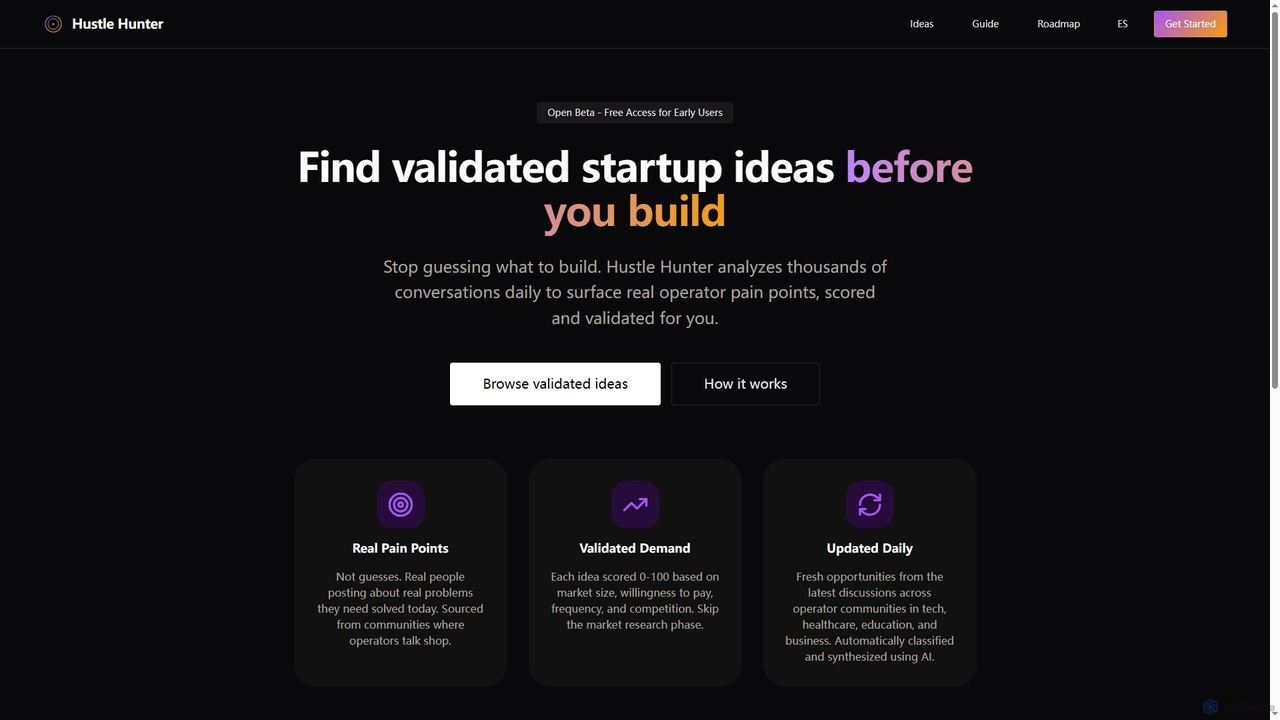
Hustle Hunter is an AI-powered platform designed for solo founders to discover validated startup ideas. It analyzes thousands of online conversations daily to identify real operator pain points, scoring them based on market size, willingness to pay, frequency, and competition, helping entrepreneurs build solutions with confirmed demand.

Startup Ideas
Visits 5.5KFavorites 130Likes 129

About Idea Validation

Idea Validation tools are AI-powered platforms designed to assess the viability and potential success of new concepts, products, or features before significant investment. These tools leverage data analysis, user feedback, and market insights to provide actionable intelligence. They help innovators, entrepreneurs, and product teams quickly understand market demand, identify target audiences, and refine their offerings, significantly reducing development risks within the broader scope of market research.

Core Features

  • Market Demand Analysis: Automatically analyze trends, search volumes, and competitor data to gauge interest.
  • User Feedback Collection: Facilitate surveys, polls, and interviews to gather qualitative and quantitative insights.
  • Concept Testing: Present early-stage ideas or prototypes to target users for structured feedback.
  • Competitor Benchmarking: Identify existing solutions, their strengths, weaknesses, and market positioning.
  • Audience Segmentation: Define and understand potential customer segments based on demographics, behaviors, and needs.

Use Cases

Startups use these tools to confirm a product-market fit before launching, while product managers employ them to test new feature concepts with existing users. Marketing teams can validate messaging and campaign ideas, ensuring resonance with their target demographic. They are essential for anyone seeking to make data-driven decisions about new initiatives.

How to Choose

When selecting an Idea Validation tool, consider its data sources (e.g., social media, search engines, survey panels), the depth of its analytical capabilities, and its integration options with existing workflows. Evaluate the types of validation methods supported (e.g., A/B testing, sentiment analysis, predictive modeling) and ensure it aligns with your budget and technical expertise.

Idea Validation use cases

1

Validate New Product Concepts for Startups

An aspiring entrepreneur with a novel app idea uses an Idea Validation tool to gauge market interest. They input their concept, define target demographics, and the tool generates surveys and analyzes social media sentiment. This helps them understand potential user pain points, desired features, and competitive landscape, allowing them to refine their MVP before committing significant development resources.

2

Test New Feature Ideas for Product Managers

A product manager planning a new feature for an existing SaaS platform uses an Idea Validation tool to gather early feedback. They create mockups or descriptions of the feature and deploy targeted surveys or A/B tests to a segment of their user base. The tool's analysis helps them understand user adoption potential, identify usability issues, and prioritize development efforts based on data, saving weeks of development time on unvalidated features.

3

Optimize Marketing Campaign Messaging

A marketing specialist needs to launch a new ad campaign but is unsure which messaging resonates best with the target audience. They use an Idea Validation tool to test different headlines, calls-to-action, and visual concepts with a small, representative group. The tool provides data on engagement rates, sentiment, and conversion intent for each variation, enabling the specialist to select the most effective messaging for the full campaign, improving ROI by an estimated 15-20%.

4

Identify Target Audience Pain Points

A business owner considering expanding into a new market segment uses an Idea Validation tool to understand the specific challenges and unmet needs of that demographic. By deploying targeted surveys and analyzing online discussions, the tool helps pinpoint critical pain points. This insight allows the business to tailor its offerings and marketing strategies precisely, ensuring a higher likelihood of market acceptance and reducing the risk of misaligned product development.

5

Gather Early Feedback on Minimum Viable Products (MVPs)

A software development team has built an MVP and needs to quickly gather user feedback to guide the next iteration. They integrate an Idea Validation tool into their MVP, allowing users to provide in-app feedback, rate features, and suggest improvements. The tool aggregates and analyzes this data, providing the team with prioritized insights on bugs, desired enhancements, and overall user satisfaction, accelerating the product development cycle by 30%.

6

Assess Market Trends for Business Expansion

A retail chain is considering launching a new line of eco-friendly products. They utilize an Idea Validation tool to analyze current market trends, consumer interest in sustainability, and the competitive landscape of green products. The tool provides data on search trends, social media discussions, and competitor offerings, helping the chain make an informed decision about product categories, pricing strategies, and potential market share, reducing the risk of investing in a declining or saturated niche.

Idea Validation FAQ

What are Idea Validation tools?

Idea Validation tools are AI-powered platforms that help assess the potential success and viability of new concepts, products, or features. They typically feature capabilities for market demand analysis, user feedback collection, and competitor benchmarking. These tools are crucial for reducing risks and making data-driven decisions before significant investment, ensuring that innovations meet real market needs.

How do Idea Validation tools differ from general Market Research tools?

While Idea Validation is a subset of Market Research, its tools are specifically focused on the early-stage assessment of concepts. General market research tools often cover broader aspects like market sizing, trend forecasting, and demographic analysis. Idea Validation tools, however, specialize in testing specific hypotheses, gathering targeted user feedback on prototypes, and quickly iterating on ideas to confirm product-market fit, rather than just understanding the overall market landscape.

What are the key features to look for in an Idea Validation tool?

When choosing an Idea Validation tool, prioritize features like robust market demand analysis (e.g., trend spotting, competitor analysis), diverse user feedback mechanisms (e.g., surveys, sentiment analysis, A/B testing), and concept testing capabilities. Look for tools that offer predictive analytics, audience segmentation, and clear data visualization. Integration with other business tools and scalability for future needs are also important considerations for comprehensive validation.

Who benefits most from using Idea Validation tools?

Idea Validation tools are most beneficial for entrepreneurs, startup founders, and product managers who are in the early stages of developing new products or features. Marketing teams also gain significant value by validating campaign messages and concepts. Essentially, anyone looking to reduce the risk of launching an unproven idea, optimize resource allocation, and ensure their offerings resonate with the target market will find these tools invaluable for making informed, data-driven decisions.

What are the common challenges Idea Validation tools help overcome?

Idea Validation tools primarily help overcome the challenge of uncertainty and risk associated with new ventures. They mitigate the risk of building products nobody wants by providing early market feedback. These tools also address the difficulty of identifying true customer pain points, avoiding costly development mistakes, and optimizing resource allocation. By offering data-driven insights, they prevent reliance on intuition alone, leading to more successful product launches and strategic decisions.