Medical Best in category 1 results Clinical Notes AI Tool

Popular AI tools in the Clinical Notes field of Medical include Claio, etc., helping you quickly improve efficiency.

Claio

Claio

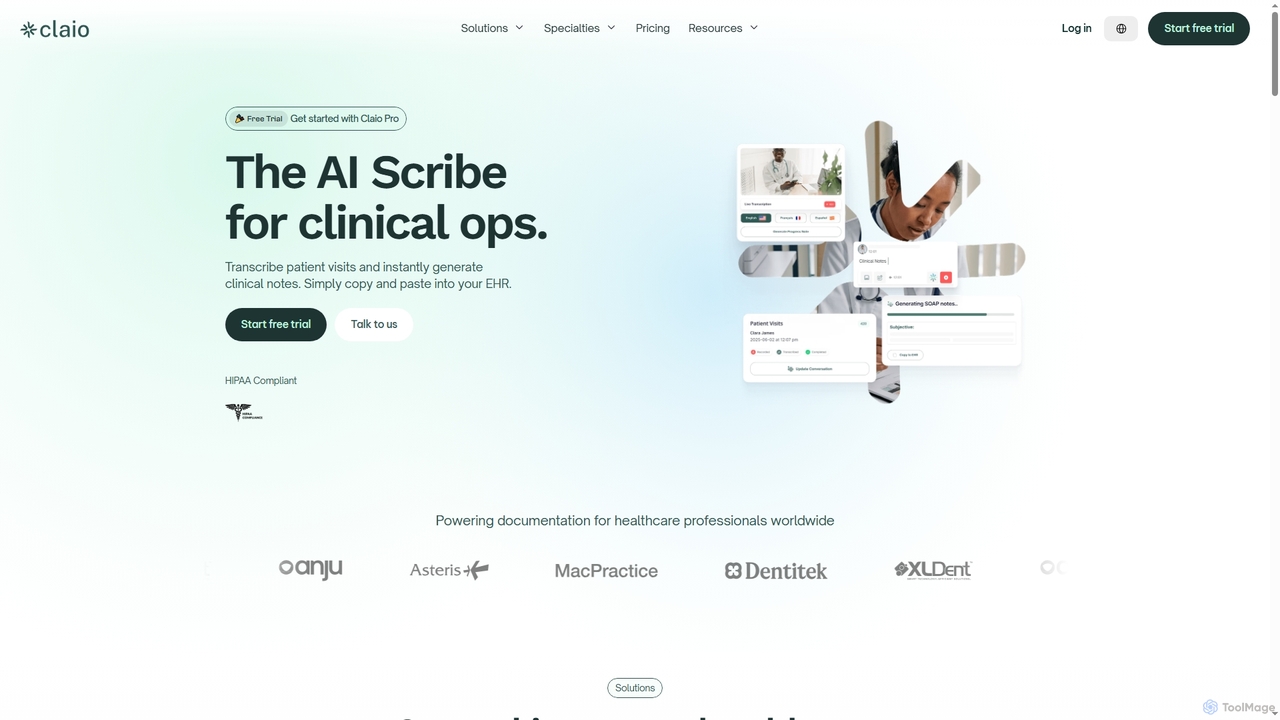
Claio is an AI-powered scribe designed for healthcare professionals to streamline clinical documentation. It transcribes patient visits in …

16.0K

About Clinical Notes

AI Clinical Notes tools are specialized software that use artificial intelligence to automate and enhance the creation of medical documentation. Leveraging Natural Language Processing (NLP) and speech recognition, these tools capture patient-clinician conversations and transform them into structured, accurate clinical records. Their primary value lies in significantly reducing the administrative burden on healthcare professionals, allowing them to focus more on patient care. These systems can automatically generate summaries, extract key medical data, and format notes into standard templates like SOAP.

Core Features

  • Ambient Scribing: Captures and transcribes patient-clinician dialogue in real-time during consultations.
  • Automated Summarization: Condenses lengthy conversations into concise summaries and structured note formats (e.g., SOAP, DAP).
  • Medical Data Extraction: Identifies and extracts key entities such as diagnoses, medications, symptoms, and lab values from unstructured text.
  • EHR/EMR Integration: Seamlessly syncs generated notes and structured data with existing Electronic Health Record systems.
  • Medical Code Suggestion: Analyzes clinical documentation to suggest relevant billing codes like ICD-10 and CPT.

Applicable Scenarios

These tools are widely used in healthcare settings where documentation is time-consuming. This includes primary care clinics, specialty practices (e.g., cardiology, orthopedics, mental health), and hospital departments. Physicians, nurse practitioners, physician assistants, and therapists use them to streamline their charting workflow, improve note quality, and reduce burnout associated with administrative tasks.

Selection Criteria

When choosing an AI Clinical Notes tool, consider its integration capabilities with your current EHR/EMR system. Evaluate the accuracy of its transcription and summarization, especially for your specific medical specialty. Ensure the tool is fully compliant with data privacy regulations like HIPAA. Finally, assess the user interface and the level of customization available for templates and workflows to ensure it fits your practice's needs.

Clinical NotesUse Cases

1

Automating SOAP Note Generation in Primary Care

A general practitioner with a high patient volume uses an ambient scribing tool during consultations. The AI listens to the patient encounter, automatically transcribes the conversation, and structures the information into a standard SOAP (Subjective, Objective, Assessment, Plan) note. The practitioner then only needs to spend 2-3 minutes reviewing and editing the AI-generated draft instead of 10-15 minutes writing it from scratch. This significantly reduces documentation time, allowing for more direct patient interaction and less after-hours administrative work.

2

Streamlining Mental Health Session Documentation

A therapist uses an AI notes tool to document therapy sessions. The tool transcribes the session, allowing the therapist to remain fully engaged with the client. Afterward, the AI generates a summary highlighting key themes, patient progress, and interventions discussed. It can structure this into a DAP (Data, Assessment, Plan) note, which is essential for insurance billing and tracking treatment progress. This process ensures detailed and accurate records are kept while freeing up the therapist's time to focus on client care rather than extensive note-taking.

3

Extracting Key Data for Specialist Consultations

A cardiologist preparing for a new patient consultation receives a lengthy referral file with unstructured notes. Instead of manually reading through pages of text, the specialist's team processes the documents with an AI tool. The AI extracts and organizes a chronological summary of key information, such as past diagnoses, medication history, relevant lab results, and cardiac procedures. This provides the cardiologist with a concise, actionable overview in minutes, enabling a more efficient and informed initial consultation.

4

Generating Accurate Billing Codes from Clinical Narratives

A medical coding department in a hospital uses an AI tool to improve coding accuracy and efficiency. After a clinician finalizes a note, the AI analyzes the full narrative, including the assessment and plan. It then suggests potential ICD-10 (diagnosis) and CPT (procedure) codes based on the documented information. This serves as a powerful verification tool for human coders, helping them identify the most specific codes, reduce claim denials, and ensure compliance, ultimately accelerating the revenue cycle.

5

Assisting Medical Scribes with Real-time Charting

In a busy emergency department, a medical scribe supports a physician. They use an AI clinical notes tool that provides a live transcription of the physician-patient conversation. The AI also pre-populates sections of the chart based on the dialogue. The scribe's role evolves from pure transcriptionist to that of a quality assurance specialist, verifying the AI's output, adding necessary context or nuance, and managing the final entry into the EHR. This human-AI collaboration allows one scribe to support a physician more effectively, ensuring high-quality, real-time documentation.

6

Creating Comprehensive Discharge Summaries

A hospitalist is tasked with creating a discharge summary for a patient with a complex, multi-day hospital stay. Using an AI clinical notes tool, the physician can automatically compile information from various sources within the EHR, including admission notes, daily progress reports, and consultant findings. The AI generates a coherent draft summary, outlining the hospital course, key findings, and discharge instructions. The hospitalist then reviews, refines, and finalizes the document, saving hours of manual data aggregation and writing, ensuring a timely and accurate summary for the patient's transition of care.

Clinical NotesFrequently Asked Questions