
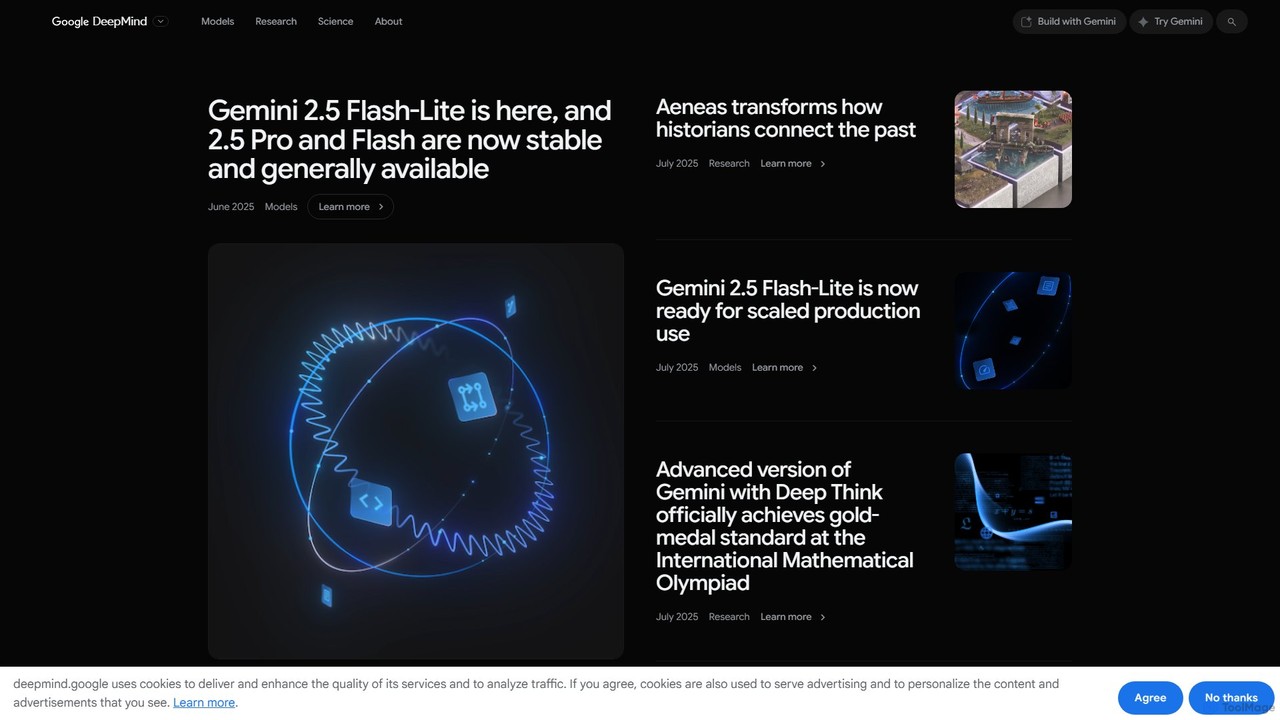
Google DeepMind
Google DeepMind is a world-leading AI research lab and product unit, developing advanced AI models like Gemini, Imagen, …
Google DeepMind is a world-leading AI research lab and product unit, developing advanced AI models like Gemini, Imagen, and Veo. It focuses on building responsible AGI to benefit humanity, offering tools for scientific discovery, creative generation, and developer applications through platforms like Google AI Studio and Vertex AI.
About Image Generation
Image Generation tools are a class of AI applications that create novel visual content from textual descriptions or other inputs. These tools typically leverage advanced models like diffusion or GANs to translate concepts into detailed, high-quality images. They empower users to visualize ideas, produce creative assets, and accelerate design workflows without requiring traditional artistic skills. This technology is particularly valuable for creating unique marketing materials, concept art, and product prototypes.
Core Features
- Text-to-Image Generation: Creates images directly from written descriptions or prompts.
- Image-to-Image Transformation: Modifies an existing image based on textual instructions or another image's style.
- Style Control & Customization: Allows users to specify artistic styles, camera angles, lighting, and other visual parameters.
- Inpainting & Outpainting: Fills in missing parts of an image or extends its boundaries with contextually appropriate content.
- High-Resolution Upscaling: Increases the resolution and detail of generated images for professional use.
Use Cases
Image Generation tools are widely used by digital marketers for creating unique ad creatives and social media content. Game developers and concept artists use them to rapidly prototype characters and environments. Additionally, product designers and architects leverage these tools to generate realistic mockups and visualizations, significantly speeding up the initial design phase.
How to Choose
When selecting an Image Generation tool, consider the quality and realism of the output. Evaluate the diversity of supported artistic styles and the level of control over generation parameters. Also, assess the tool's speed, pricing model (e.g., subscription vs. per-image credits), and any usage rights or licensing restrictions on the generated images. For developers, the availability of an API is a critical factor.
Image GenerationUse Cases
Creating Ad Creatives for Marketing Campaigns
A digital marketer needs to generate a variety of unique visuals for a new social media campaign. Instead of relying on stock photos or waiting for a graphic designer, they use an AI Image Generator. By inputting descriptive prompts like 'a photorealistic image of a person enjoying coffee in a futuristic cafe, vibrant colors,' they can produce dozens of high-quality, on-brand images in minutes. This allows for rapid A/B testing of different visual concepts, leading to more effective campaigns and saving significant time and budget.
Rapid Prototyping for Game and Film Concept Art
A concept artist is tasked with designing a new fantasy character. Using an AI Image Generator, they can input a detailed description: 'elven warrior with glowing silver armor, holding a crystal sword, in an ancient forest'. The tool generates multiple visual interpretations in various styles (e.g., realistic, anime, painterly). The artist can then select the most promising designs and use the Image-to-Image feature to refine them further, drastically reducing the time spent on initial ideation and allowing for more creative exploration compared to drawing every concept from scratch.
Visualizing Architectural and Interior Designs
An architect wants to show a client several design options for a building's facade. Instead of spending days on manual rendering, they upload a basic sketch to an AI Image Generator. Using prompts like 'modern glass and steel facade, daytime, with green landscaping' and 'brutalist concrete facade, overcast sky,' they generate photorealistic renderings in minutes. This allows clients to visualize the final product more effectively and make decisions faster, streamlining the entire design and approval process.
Generating Product Mockups for E-commerce
An e-commerce store owner is launching a new line of custom-printed mugs. To create compelling product listings, they need images of the mugs in various lifestyle settings. Using an AI Image Generator's inpainting or product placement features, they can upload a single image of their mug design and generate scenes like 'mug on a wooden desk next to a laptop' or 'mug held by a person on a cozy balcony'. This process eliminates the need for expensive photoshoots and provides an endless supply of marketing visuals for different target audiences.
Creating Custom Illustrations for Content
A blogger or author needs unique illustrations for their articles or books but lacks the budget for a professional illustrator. They can use an AI Image Generator to create visuals that match their content's tone and subject matter. For a children's book, they might use a prompt like 'a friendly cartoon dragon reading a book in a cozy cave, watercolor style'. For a tech blog, 'an abstract visualization of neural networks, blue and purple neon lines'. This empowers creators to produce visually rich content independently, enhancing reader engagement without significant costs.
Generating Backgrounds and Textures for Design
A graphic designer is working on a website redesign and needs a unique, high-resolution background texture. Instead of searching through stock libraries for something generic, they use an AI Image Generator. With a prompt like 'seamless abstract pattern with organic shapes and a pastel color palette, 4K resolution,' they can generate a perfectly tailored and tileable background. This technique is also used to create textures for 3D models, patterns for textiles, or abstract backgrounds for presentations, providing a limitless source of custom design elements.