No Code & Low Code Best in category 1 results Code Generation AI Tool

Popular AI tools in the Code Generation field of No Code & Low Code include AI Love Code, etc., helping you quickly improve efficiency.

AI Love Code

AI Love Code

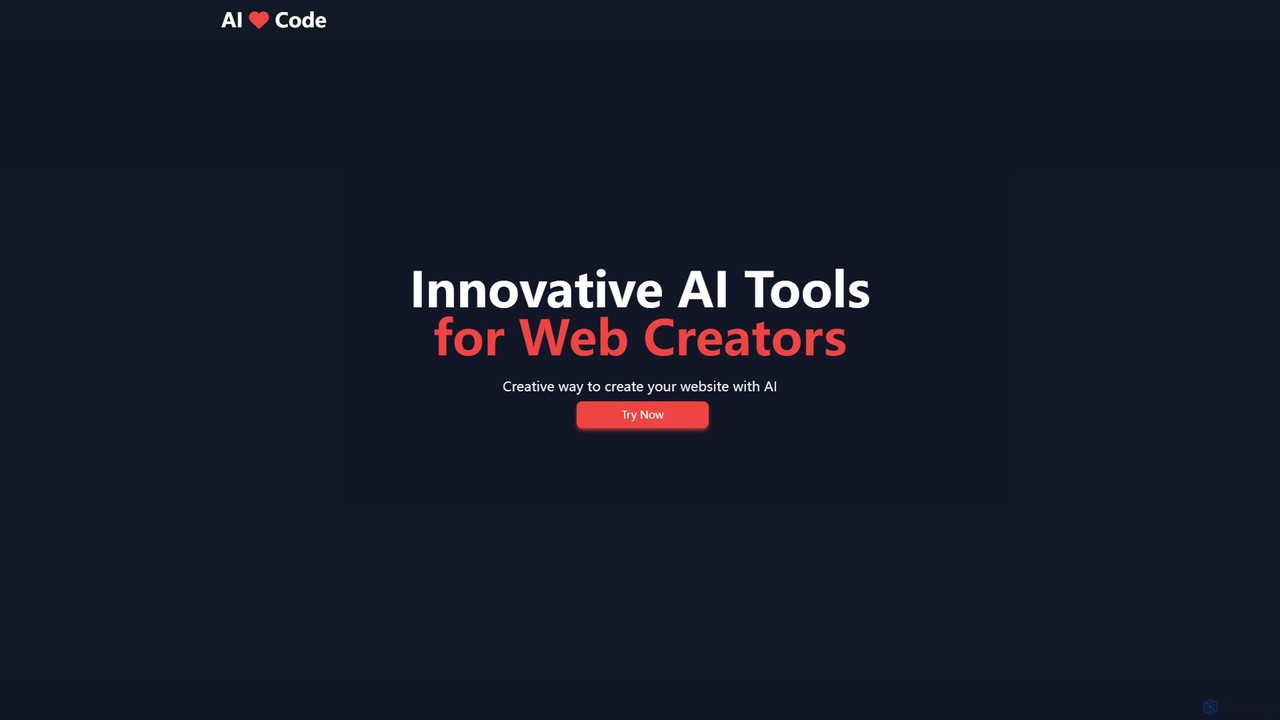
AI Love Code is an innovative AI-powered tool that generates responsive websites with full source code in minutes. …

3.3K

About Code Generation

AI Code Generation tools are a class of software that uses artificial intelligence to automatically write, complete, and debug code. Leveraging large language models (LLMs) trained on vast codebases, these tools translate natural language prompts or partial snippets into functional code across various programming languages. They significantly accelerate the development lifecycle, reduce repetitive coding tasks, and enable rapid prototyping. As a specialized subset of Low-Code platforms, they focus specifically on producing editable source code, bridging the gap between high-level ideas and executable software for developers.

Core Features

  • Natural Language to Code: Converts plain text descriptions, comments, or requirements into executable code snippets or functions.
  • Intelligent Code Completion: Provides context-aware, multi-line code suggestions in real-time as you type, going beyond simple autocompletion.
  • Code Refactoring & Optimization: Analyzes existing code and suggests improvements for readability, performance, or adherence to best practices.
  • Automated Test Generation: Creates unit tests, integration tests, or boilerplate test code based on the function's logic and signature.
  • Code Translation: Converts code from one programming language to another, facilitating modernization or cross-platform development.

Use Cases

These tools are widely used by software developers, data scientists, students, and technical project managers. Common applications include accelerating the development of new features, automating the creation of boilerplate code for APIs or data models, assisting in learning a new programming language by providing instant examples, and generating complex algorithms or SQL queries from simple descriptions.

How to Choose

When selecting an AI Code Generation tool, consider the supported programming languages and frameworks. Evaluate its integration capabilities with your preferred IDE (e.g., VS Code, JetBrains). Assess the quality and accuracy of the generated code and its security policies regarding your source code. Finally, compare pricing models, whether it's based on subscription, usage, or offered as part of a larger platform.

Code GenerationUse Cases

1

Rapid Prototyping of New Features

A software developer at a startup is tasked with building a proof-of-concept for a new API endpoint. Instead of writing the entire controller, service, and data model from scratch, they write a detailed comment describing the required functionality, such as 'Create a POST endpoint /users that accepts a name and email, validates the email format, and saves it to the database'. The AI code generation tool instantly generates the necessary code in their chosen framework (e.g., Express.js or Django), including error handling and status codes. This reduces initial development time from hours to minutes, allowing for faster iteration and feedback cycles.

2

Automating Unit Test Generation

A quality assurance engineer needs to increase test coverage for a legacy codebase. For a complex function that calculates shipping costs based on weight, dimensions, and destination, they use an AI code generation tool. By providing the function's signature and a few examples in the comments (e.g., 'Test with a valid US address', 'Test with an oversized package'), the tool generates a comprehensive suite of unit tests. It creates tests for edge cases, invalid inputs, and expected outcomes, saving significant manual effort and improving the overall reliability of the software.

3

Learning a New Programming Language

A developer experienced in Python wants to learn Rust for a new project. To understand Rust's specific syntax and ownership concepts, they use an AI code generation tool as a learning companion. They write a prompt like, 'Show me how to read a file and count the word frequencies in Rust, similar to this Python code,' and paste their Python snippet. The tool generates the equivalent, idiomatic Rust code, often with comments explaining key differences like error handling with Result and memory management. This interactive process accelerates their learning curve far more effectively than static documentation alone.

4

Refactoring and Explaining Legacy Code

A maintenance developer is assigned a ticket to optimize a poorly documented, monolithic function in a legacy Java application. They paste the entire function into an AI code generation tool and ask it to 'Explain this code, identify performance bottlenecks, and refactor it into smaller, more manageable methods'. The AI first provides a line-by-line explanation of the code's logic. Then, it highlights inefficient loops or redundant database calls. Finally, it suggests a refactored version that breaks the function down into several private methods, each with a clear purpose, improving both performance and maintainability for future developers.

5

Generating Complex SQL Queries

A data analyst needs to pull a complex report from a relational database with multiple joins, aggregations, and conditional logic. Instead of spending time manually writing and debugging a long SQL query, they describe the requirement in plain English: 'Find the top 5 customers by total sales in the last quarter for the 'Electronics' category, including their name, total purchase amount, and number of orders'. The AI tool translates this into an optimized SQL query, correctly joining the `customers`, `orders`, `order_items`, and `products` tables, applying the necessary filters and grouping. This empowers analysts to retrieve data faster without needing deep SQL expertise.

6

Creating Scripts for Data Science Tasks

A data scientist is exploring a new dataset for a machine learning project. They need to perform several data cleaning and preprocessing steps. Using an AI code generation tool within their Jupyter Notebook, they write comments like 'Load the CSV file 'sales_data.csv' into a pandas DataFrame', 'Drop rows with missing values in the 'price' column', and 'Convert the 'order_date' column to datetime objects'. The tool generates the correct Python code using the pandas library for each step. This allows the scientist to focus on the analytical logic and model building rather than recalling the specific syntax for data manipulation functions.

Code GenerationFrequently Asked Questions