ToolMage
Sign in

Best 2 Agent Builder AI tools for No Code & Low Code

Popular Agent Builder AI tools in No Code & Low Code include Spheron and goaigenie, helping you work more efficiently.

goaigenie
Freemium

goaigenie

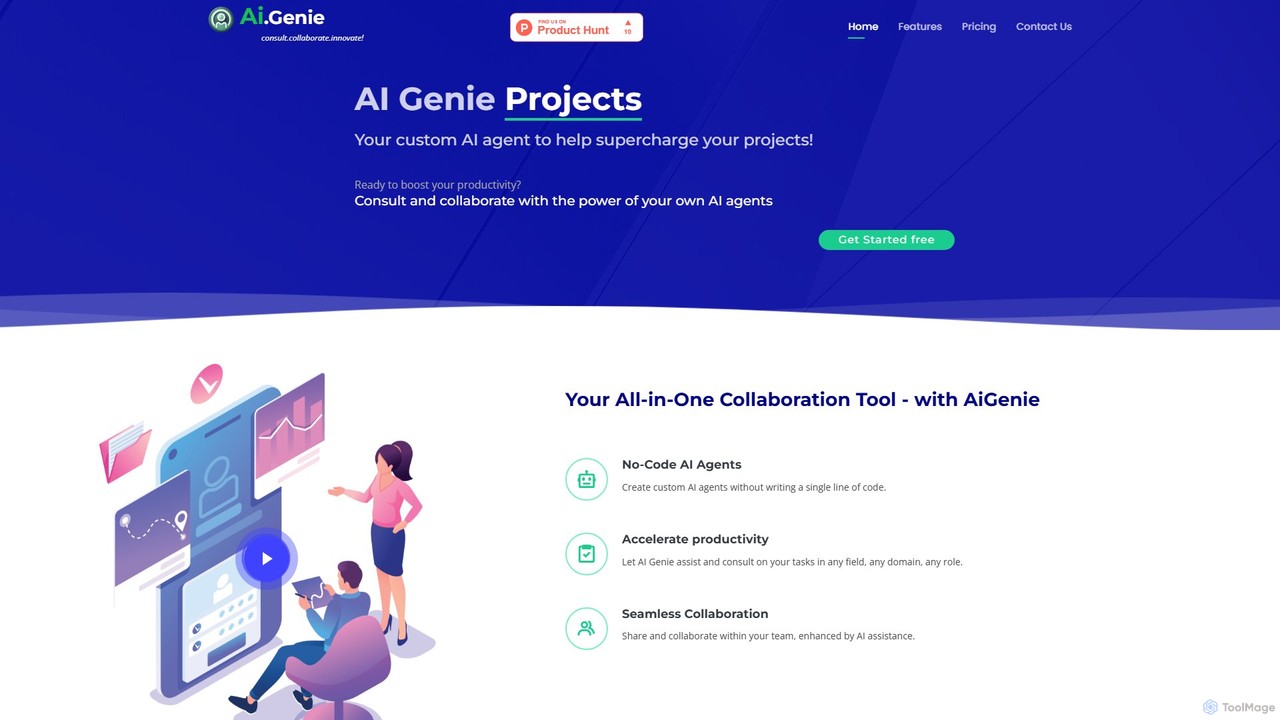
goaigenie is an all-in-one, no-code AI collaboration platform designed to boost productivity. It allows users to create custom AI agents for any task, manage projects, and collaborate seamlessly with teams. Build knowledge bases from files and websites to power your AI, all within a secure, privacy-focused environment.

Agent Builder
Visits 7.3KFavorites 120Likes 111
Spheron
Paid

Spheron

Spheron is a decentralized GPU network (DePIN) that provides scalable and cost-effective compute power for AI/ML workloads. By aggregating idle resources from gaming rigs, data centers, and mining farms, it offers a resilient, censorship-resistant, and up to 80% cheaper alternative to traditional cloud providers.

Model Training
Visits 84.5KFavorites 153Likes 164

About Agent Builder

Agent Builders are AI-powered tools that enable users to design, deploy, and manage autonomous AI agents without extensive coding. These platforms leverage visual interfaces, pre-built components, and sophisticated orchestration capabilities, allowing for the creation of intelligent systems capable of performing complex tasks, making decisions, and interacting with various digital environments. They empower businesses and individuals to automate sophisticated workflows, enhance operational efficiency, and innovate rapidly through intelligent automation, bridging the gap between AI capabilities and practical business applications.

Core Features

  • Visual Workflow Design: Provides intuitive drag-and-drop interfaces for defining agent logic, task sequences, and complex decision flows, making AI agent creation accessible to non-developers.
  • Pre-built Modules & Integrations: Offers a rich library of ready-to-use AI models (e.g., NLP, computer vision), APIs, and connectors for seamless integration with databases, CRMs, communication platforms, and other business applications.
  • Task Automation & Orchestration: Configures agents to execute multi-step actions across different software systems, automating entire business processes from data collection and analysis to communication and reporting.
  • Decision-Making Capabilities: Allows the implementation of sophisticated rules, machine learning models, and conditional logic for agents to make informed choices and adapt their behavior based on real-time data and predefined objectives.
  • Monitoring & Management Dashboards: Includes comprehensive tools to track agent performance, visualize operational metrics, identify bottlenecks, debug issues, and facilitate iterative updates and improvements to deployed agents.

Applicable Scenarios

Agent Builders are invaluable for organizations seeking to automate multi-step processes, create intelligent assistants, or build adaptive systems. They are widely used by business analysts to design automated customer service agents that handle inquiries and escalate complex cases, by operations teams to orchestrate complex data processing and reporting workflows, and by product managers to rapidly prototype and deploy new AI-driven features, significantly reducing reliance on extensive development resources and accelerating innovation cycles.

How to Choose

When selecting an Agent Builder, it's crucial to consider the complexity of tasks your agents need to perform and the level of customization required for specific business logic. Evaluate its integration capabilities with your existing enterprise systems and third-party applications to ensure seamless data flow. Assess the availability and quality of pre-built AI models and modules, along with the ease of monitoring, debugging, and updating deployed agents. Furthermore, consider the platform's scalability to handle increasing workloads and the pricing model to align with your budget and long-term automation strategy.

Agent Builder use cases

1

Automating Customer Service Inquiries

Customer support teams can leverage Agent Builders to create intelligent AI agents that automatically handle routine customer inquiries, provide instant answers from knowledge bases, and guide users through troubleshooting steps. These agents can escalate complex issues to human agents with relevant context, significantly reducing response times and improving customer satisfaction while freeing up human agents for more critical tasks.

2

Orchestrating Complex Data Processing Workflows

Data analysts and operations managers can design agents to automate multi-stage data pipelines. This involves agents collecting data from various sources, cleaning and transforming it, running analytical models, and then generating reports or triggering subsequent actions. This ensures data consistency, reduces manual errors, and accelerates insights delivery for business intelligence.

3

Personalized Marketing Campaign Management

Marketing professionals can build agents that personalize customer interactions across different channels. An agent can analyze customer behavior, segment audiences, dynamically generate tailored content (e.g., email subject lines, ad copy), and schedule campaign deployments, optimizing engagement and conversion rates without constant manual oversight.

4

Automating HR Onboarding and Offboarding

HR departments can use Agent Builders to create agents that streamline employee lifecycle processes. An onboarding agent can automatically send welcome emails, assign training modules, provision software access, and collect necessary documents. Similarly, an offboarding agent can manage access revocation and exit surveys, ensuring compliance and efficiency.

5

Prototyping & Deploying AI-driven Product Features

Product managers and innovators can rapidly prototype and deploy new AI functionalities within their applications. For instance, an agent could be built to provide real-time recommendations, summarize user feedback, or automate content moderation, allowing for quick iteration and validation of new features without deep coding knowledge.

6

Intelligent Supply Chain Optimization

Supply chain managers can deploy agents to monitor inventory levels, track shipments, predict demand fluctuations, and automatically trigger reorder processes or adjust logistics plans. These agents can integrate with ERP systems and external data sources, enabling proactive decision-making and minimizing disruptions and costs.

Agent Builder FAQ

What are Agent Builders and how do they differ from traditional automation tools?

Agent Builders are platforms that allow users to create autonomous AI agents capable of performing complex tasks, making decisions, and interacting intelligently with environments, often without coding. Unlike traditional automation tools (like RPA) that primarily mimic human actions based on predefined scripts, AI agents built with these tools can understand context, adapt to new information, and learn over time, enabling more sophisticated and flexible automation.

Who can benefit most from using Agent Builders?

Agent Builders are highly beneficial for business users, product managers, data analysts, and operations teams who need to automate complex, multi-step processes or create intelligent systems but lack extensive programming skills. They empower non-developers to leverage AI for tasks like customer service, marketing personalization, data orchestration, and HR process automation, accelerating innovation and efficiency across various departments.

What are the key considerations when choosing an Agent Builder platform?

When selecting an Agent Builder, consider its ease of use and visual interface for non-technical users, the breadth of pre-built AI models and integrations with your existing tech stack, and its scalability to handle future demands. Evaluate the platform's capabilities for monitoring, debugging, and managing deployed agents, as well as its security features and pricing model to ensure it aligns with your budget and governance requirements.

Can Agent Builders integrate with existing enterprise systems?

Yes, most Agent Builders are designed with robust integration capabilities. They typically offer a wide range of connectors, APIs, and SDKs that allow AI agents to seamlessly interact with existing enterprise systems such as CRM (e.g., Salesforce), ERP (e.g., SAP), databases, communication platforms (e.g., Slack, Microsoft Teams), and various cloud services. This enables agents to access and process data, trigger actions, and orchestrate workflows across your entire digital ecosystem.

What is the difference between an "Agent Builder" and a "No-Code/Low-Code Platform" in general?

While Agent Builders often fall under the umbrella of No-Code/Low-Code platforms, their primary focus is specifically on creating and managing autonomous AI agents. General No-Code/Low-Code platforms provide tools for building a wide range of applications, websites, or workflows. Agent Builders specialize in enabling intelligent automation, decision-making, and dynamic interaction capabilities unique to AI agents, making them a more focused subset within the broader No-Code/Low-Code landscape.