ToolMage
Sign in

Best 1 Strategy AI tools for Operations

Popular Strategy AI tools in Operations include The Noise Report, helping you work more efficiently.

The Noise Report

The Noise Report

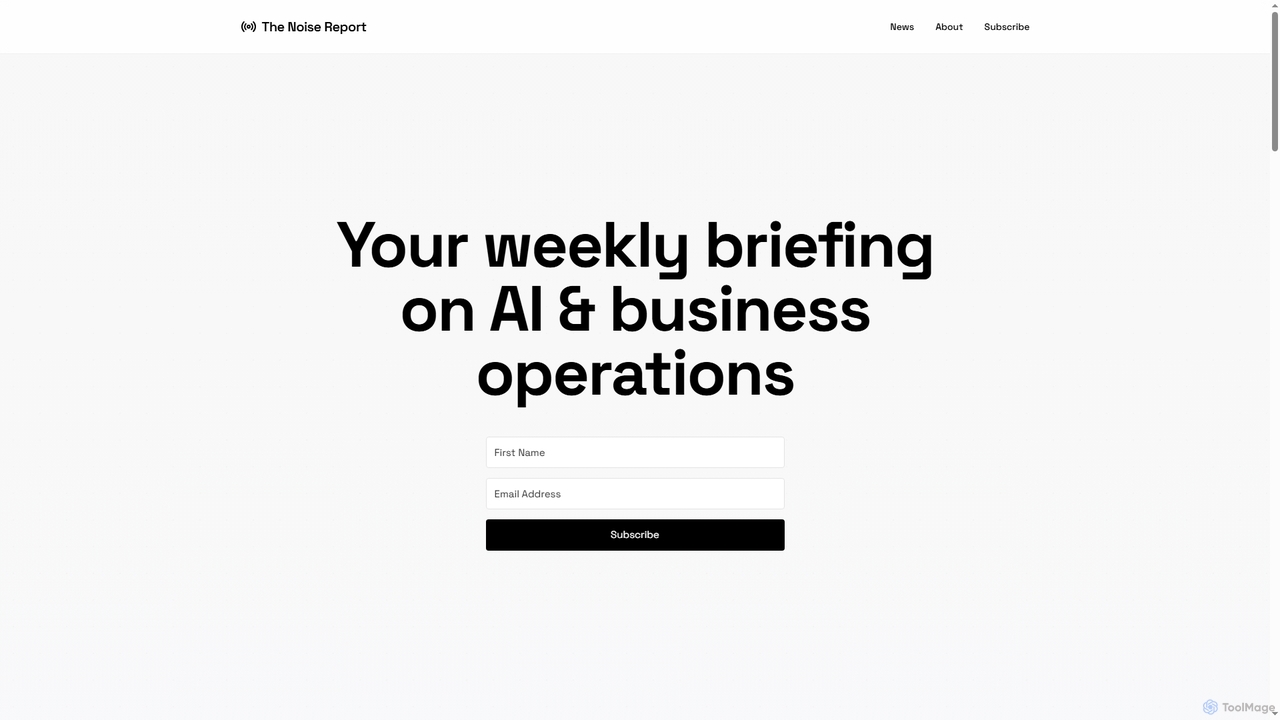
The Noise Report is a weekly email briefing that distills complex updates in AI, automation, and business operations into clear, actionable insights. It helps business operators cut through the hype and focus on what truly drives leverage for their online businesses, delivered directly to their inbox.

Newsletter
Visits 5.5KFavorites 133Likes 124

About Strategy

AI Strategy tools are a class of software that uses artificial intelligence to analyze complex business data, identify market trends, and support high-level decision-making. These tools leverage machine learning, predictive analytics, and natural language processing to sift through vast datasets from internal and external sources. Their primary value lies in transforming raw data into actionable strategic insights, enabling organizations to anticipate market shifts, assess competitive landscapes, and formulate robust long-term plans. Within the broader Operations category, these tools focus specifically on setting the 'why' and 'what' before operational tools execute the 'how'.

Core Features

  • Competitive Intelligence: Automatically tracks and analyzes competitors' activities, product launches, pricing changes, and market sentiment.
  • Market Trend Analysis: Identifies emerging patterns and future trends from consumer behavior data, industry reports, and news sources.
  • Scenario Planning & Forecasting: Simulates the potential outcomes of different strategic choices under various market conditions to assess risk and opportunity.
  • Automated SWOT Analysis: Generates data-driven Strengths, Weaknesses, Opportunities, and Threats analyses by processing internal performance data and external market information.
  • Resource Allocation Modeling: Recommends optimal allocation of budgets, personnel, and other resources to achieve strategic objectives.

Use Cases

AI Strategy tools are primarily used by C-level executives, strategic planners, market analysts, and business development teams. They are valuable across industries like technology, finance, retail, and consulting for tasks such as planning market entry, developing new product roadmaps, and preparing for mergers and acquisitions.

How to Choose

When selecting an AI Strategy tool, consider its data integration capabilities with your existing systems (CRM, ERP). Evaluate the depth and customizability of its analytical models. Assess the user interface for clarity and ease of use by non-technical decision-makers. Finally, scrutinize the platform's data security and compliance protocols to protect sensitive strategic information.

Strategy use cases

1

Formulating a Market Entry Strategy

A consumer electronics company plans to expand into Southeast Asia. A strategy team uses an AI tool to analyze regional consumer preferences, regulatory landscapes, supply chain logistics, and local competition. The tool processes millions of data points, identifying Vietnam as the optimal entry point due to its growing middle class and favorable import policies. It also suggests a product pricing strategy 10% lower than the main competitor to gain initial market share, providing a data-backed roadmap for the expansion.

2

Monitoring Competitive Threats in Real-Time

A SaaS company uses an AI strategy tool to continuously monitor its top three competitors. The system is configured to track their pricing page changes, new feature announcements from blog posts, and shifts in customer sentiment on social media. When a competitor launches a beta for a new feature, the tool sends an immediate alert to the product team. It also provides an analysis showing a potential 5% customer churn risk if a similar feature is not developed within six months, enabling a proactive response rather than a reactive one.

3

Optimizing Product Portfolio Investment

A large manufacturing firm with over 50 products uses an AI strategy platform to optimize its portfolio. The AI analyzes sales data, production costs, market growth rates, and customer feedback for each product. The platform generates a recommendation to divest two low-margin, low-growth products, increase R&D investment by 20% in three high-potential products, and maintain the current strategy for the rest. This data-driven approach helps executives reallocate a multi-million dollar budget towards areas with the highest potential return on investment.

4

Identifying Potential M&A Targets

A private equity firm is looking for acquisition targets in the renewable energy sector. Instead of manual research, they use an AI strategy tool that scans financial databases, patent filings, and industry news. The firm sets criteria such as revenue growth above 15%, proprietary battery technology, and operations in Europe. The AI tool filters through thousands of companies and shortlists five that perfectly match the criteria, including one emerging startup that was not on their radar. This process reduces the initial screening time from weeks to a few hours.

5

Developing a Dynamic Pricing Strategy

An e-commerce retailer wants to implement a dynamic pricing model for its top 100 products. Their strategy team uses an AI tool that analyzes real-time data, including competitor prices, inventory levels, demand signals from website traffic, and seasonal trends. The AI recommends price adjustments throughout the day to maximize revenue. For example, it suggests a slight price increase during peak shopping hours and a discount on items with high inventory. This automated strategy helps the retailer stay competitive and increase profit margins without constant manual oversight.

6

Assessing and Mitigating Corporate Risks

A multinational corporation's risk management team uses an AI strategy tool to identify potential geopolitical and supply chain risks. The tool continuously scans global news, financial reports, and shipping data. It flags a rising political instability in a country where a key supplier is located and simulates the potential impact on production, projecting a 30% delay in component delivery. Based on this insight, the strategy team proactively begins vetting alternative suppliers in a more stable region, mitigating a potential crisis before it occurs.

Strategy FAQ

What are AI Strategy tools?

AI Strategy tools are advanced software platforms that use artificial intelligence to help organizations with high-level planning and decision-making. They analyze vast amounts of data from various sources to uncover insights, predict future trends, and simulate the outcomes of different strategic actions. Unlike tools for daily operations, their focus is on long-term goals, competitive positioning, and navigating market complexities to provide a data-driven foundation for business strategy.

How to choose the right AI Strategy tool?

Choosing the right AI Strategy tool involves evaluating several key factors. First, assess its data integration capabilities to ensure it can connect with your critical data sources (e.g., CRM, market data feeds). Second, examine the sophistication of its analytical models—does it offer predictive and prescriptive analytics, or just descriptive reports? Third, consider the user interface; it should be intuitive for business leaders, not just data scientists. Finally, verify its security and compliance standards to ensure your sensitive strategic data is protected.

What's the difference between AI Strategy and Business Intelligence (BI) tools?

The key difference lies in their focus and analytical approach. Business Intelligence (BI) tools are primarily backward-looking; they collect and present historical data to show 'what happened' and 'what is happening now'. AI Strategy tools are forward-looking. They use BI data and other sources to run predictive and prescriptive analytics, answering questions like 'what will happen next?' and 'what is the best course of action?'. In short, BI reports on the past, while AI Strategy tools help shape the future.

What key functions do AI Strategy tools offer?

AI Strategy tools typically offer a suite of functions for high-level analysis. Key features include:

  • Competitive Intelligence: Monitoring competitors' actions and market positioning.
  • Market Trend Forecasting: Identifying emerging opportunities and threats based on data patterns.
  • Scenario Simulation: Modeling the potential impact of strategic decisions (e.g., a price change or market entry).
  • Resource Optimization: Recommending how to best allocate budgets and personnel to achieve goals.
  • Automated Reporting: Generating data-driven SWOT analyses and strategic summaries for executive review.

Who benefits most from using AI Strategy tools?

The primary beneficiaries are individuals and teams responsible for a company's long-term direction. This includes C-level executives (CEOs, CSOs), strategic planning departments, market intelligence analysts, business development managers, and product strategists. These roles require making high-stakes decisions based on complex information, and AI Strategy tools provide the necessary data synthesis and foresight to improve the quality and confidence of those decisions.