ToolMage
Sign in

Best 1 Strategy AI tools for Product Management

Popular Strategy AI tools in Product Management include Squad, helping you work more efficiently.

Squad
Freemium

Squad

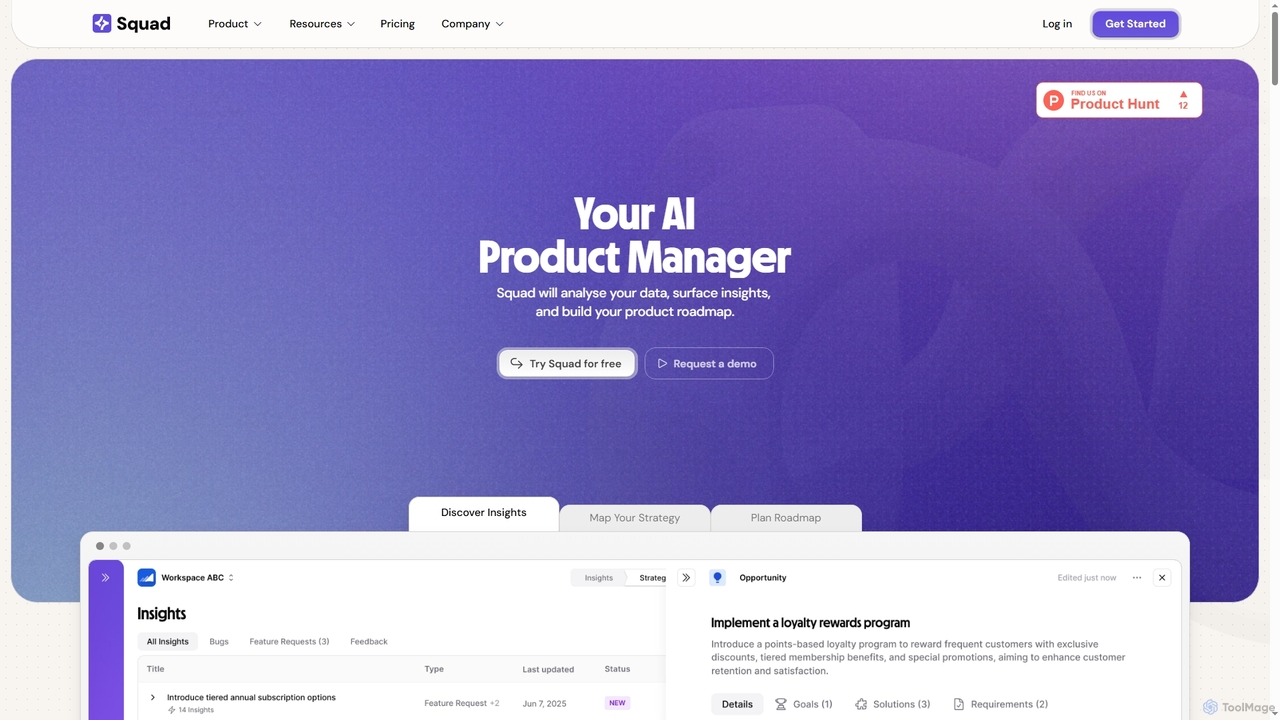
Squad is an AI-powered product management platform designed to streamline product discovery, strategy, and roadmapping. It aggregates customer feedback, aligns it with business goals, and leverages AI agents to surface opportunities, automate documentation, and ensure team alignment for building user-centric products.

Analytics
Visits 9.2KFavorites 114Likes 113

About Strategy

Strategy AI tools are specialized platforms that leverage artificial intelligence to assist product teams in defining, refining, and executing their product strategies. These tools analyze vast amounts of market data, customer feedback, and competitive landscapes to provide actionable insights. They empower product managers and leaders to make data-driven decisions, optimize product roadmaps, and ensure alignment with overarching business objectives, transforming reactive planning into proactive strategic foresight.

Core Features

  • Market Trend Analysis: Utilizes AI to identify emerging market trends, shifts in customer behavior, and technological advancements relevant to product development.
  • Competitive Intelligence: Automatically monitors competitor activities, product launches, and market positioning to inform strategic differentiation.
  • Roadmap Optimization: Recommends adjustments to product roadmaps based on predicted market impact, resource availability, and strategic priorities.
  • Opportunity Identification: Scans data for unmet customer needs, potential new markets, or product feature gaps that represent strategic growth opportunities.
  • Strategic Alignment: Helps visualize and ensure that individual product initiatives and features contribute directly to high-level business goals and the product vision.

Applicable Scenarios

Product leaders and strategists use these tools to develop long-term product visions, ensuring their offerings remain competitive and relevant. They are crucial for startups defining their initial market entry strategy, as well as for established enterprises seeking to innovate and expand their product portfolios. For instance, a product manager might use a Strategy AI tool to evaluate the potential success of a new feature by analyzing similar market introductions and customer sentiment.

How to Choose

When selecting a Strategy AI tool, consider its data integration capabilities with existing systems (CRM, analytics platforms), the depth and breadth of its analytical models (e.g., predictive analytics, sentiment analysis), and its ability to visualize complex strategic insights clearly. Evaluate the level of customization for strategic frameworks and the ease of collaboration among team members. Prioritize tools that offer clear, actionable recommendations rather than just raw data.

Strategy use cases

1

Predicting Market Shifts for New Product Development

A product innovation team uses AI strategy tools to analyze global economic indicators, social media trends, and patent filings. The tool identifies an emerging demand for sustainable smart home devices, allowing the team to pivot their R&D efforts and allocate resources towards developing products that align with future market needs, significantly reducing the risk of launching outdated solutions.

2

Develop Market Entry Strategy

A product manager uses AI strategy tools to analyze new market segments, identify unmet customer needs, and assess competitive landscapes. By leveraging AI-driven insights into market size, growth potential, and regulatory environments, the manager generates data-backed recommendations for launching a new product or service, significantly reducing research time and increasing the likelihood of successful market penetration.

3

Product Roadmap Prioritization

A product lead leverages an AI strategy tool to evaluate potential features and initiatives against strategic goals, customer impact, and resource constraints. The tool's AI capabilities help dynamically prioritize items on the product roadmap, suggesting optimal sequences for development to maximize return on investment and ensure alignment with the overarching product vision, leading to more efficient resource allocation.

4

Optimizing Product Roadmap for Maximum ROI

A product manager for a SaaS platform leverages the tool to evaluate potential features against projected development costs, market demand, and strategic impact. The AI recommends prioritizing features that offer the highest return on investment and align with the company's growth objectives, helping to re-sequence the roadmap and ensure resources are focused on high-value initiatives.

5

OKR & Goal Alignment

A leadership team defines company-wide Objectives and Key Results (OKRs) within the AI strategy tool. The tool then facilitates cascading these OKRs down to individual product teams, allowing for real-time monitoring of progress and automatic identification of potential misalignments. This ensures all product development efforts contribute directly to strategic outcomes, fostering a culture of accountability and goal-oriented execution.

6

Identifying Untapped Customer Segments

A marketing and product strategy team uses AI to analyze customer demographics, purchasing behaviors, and online interactions across various platforms. The tool uncovers a niche segment of environmentally conscious consumers with specific unmet needs, enabling the team to tailor product messaging and develop new product variations specifically for this high-potential audience.

7

Competitive Landscape Analysis

A business intelligence analyst employs AI strategy tools to continuously monitor competitor product launches, pricing changes, and marketing campaigns across various channels. The tool provides strategic alerts and generates comprehensive reports, offering insights into competitor strengths, weaknesses, and potential market shifts. This enables the product team to proactively adjust their strategies, develop defensive measures, and identify offensive opportunities to maintain a competitive edge.

8

Performing Real-time Competitive Landscape Analysis

A competitive intelligence analyst employs the tool to continuously monitor competitor product launches, pricing changes, and marketing campaigns. The AI provides real-time alerts and detailed reports on competitor strategies, allowing the product team to quickly adapt their own positioning, identify competitive advantages, and respond effectively to market dynamics.

9

Portfolio Optimization & Resource Allocation

An executive uses the AI strategy tool to analyze the performance of an entire product portfolio, identifying underperforming products for divestment or re-prioritization, and allocating resources to high-growth areas based on predictive models. The tool provides a holistic view of product health and market potential, enabling data-driven decisions that optimize the overall business strategy and maximize long-term profitability across the portfolio.

10

Aligning Product Initiatives with Business Goals

A product portfolio director utilizes the tool to map individual product features and projects to overarching company objectives, such as increasing market share or improving customer retention. The AI highlights areas where product efforts are misaligned or redundant, enabling the director to reallocate resources and ensure every initiative contributes directly to strategic business outcomes.

11

Strategic Scenario Planning

A product strategist simulates various market shifts, technological advancements, or regulatory changes using the AI tool's capabilities. By modeling different future scenarios and their potential impacts on product lines, the strategist develops contingency plans and adaptive strategies. This proactive approach ensures product resilience, identifies new growth opportunities, and prepares the organization for unforeseen challenges, enhancing long-term strategic foresight.

12

Validating Strategic Hypotheses with Data

Before committing significant resources to a new strategic direction, a product leadership team uses the AI tool to simulate market responses and potential outcomes based on historical data and predictive models. This allows them to test various strategic hypotheses, identify potential pitfalls, and refine their approach with data-backed confidence, minimizing costly strategic missteps.

Strategy FAQ

What are AI Strategy tools in Product Management?

AI Strategy tools are software solutions that leverage artificial intelligence to support the strategic planning and decision-making processes within product management. They help define product vision, analyze markets, prioritize initiatives, and align teams. Key functions include AI-driven market analysis, dynamic roadmap planning, and goal setting (like OKRs), enhancing the precision and data-driven nature of strategic decisions for product success.

What are AI Strategy tools in product management?

AI Strategy tools are specialized software applications that use artificial intelligence to support strategic decision-making in product development. They analyze vast datasets, including market trends, customer feedback, and competitive intelligence, to provide insights and recommendations. Their core purpose is to help product teams define, optimize, and execute product strategies more effectively, moving beyond traditional planning methods.

How do AI Strategy tools differ from general Product Management tools?

While general Product Management tools cover the entire product lifecycle, from discovery to launch and iteration, AI Strategy tools specifically focus on the *initial strategic planning and ongoing strategic adjustment phases*. They provide deeper, AI-driven insights for market analysis, competitive intelligence, and predictive forecasting, which are critical for defining *what* to build and *why*. Broader PM tools often emphasize task management, backlog grooming, and stakeholder communication for execution, whereas strategy tools are about setting the direction.

How do AI Strategy tools differ from general product management software?

While general product management software focuses on task management, roadmapping, and project execution, AI Strategy tools specifically concentrate on the strategic foresight and decision-making aspects. They leverage AI for advanced analytics, predictive modeling, and opportunity identification, offering data-driven recommendations that go beyond simple organization or tracking. They help answer "what should we build next?" and "why?" rather than just "how do we build it?".

What are the key benefits of using AI for product strategy?

The key benefits include enhanced data-driven decision-making, faster identification of market opportunities and risks, optimized resource allocation, and improved alignment of product initiatives with business goals. AI tools can process and synthesize information far more rapidly than humans, providing deeper insights into complex market dynamics, predicting future trends, and enabling more agile and informed strategic adjustments.

What are the key benefits of using AI for product strategy?

Using AI for product strategy offers several key benefits. It enhances data-driven decision-making through automated market analysis, trend identification, and competitive benchmarking, providing a comprehensive view of the landscape. AI improves foresight with predictive analytics for scenario planning and risk assessment, allowing for more proactive adjustments. Additionally, AI tools streamline the prioritization process, ensure better alignment of product initiatives with business goals, and free up product managers to focus on higher-level strategic thinking rather than manual data crunching.

Who typically uses AI Strategy tools?

AI Strategy tools are primarily used by roles responsible for defining and guiding product direction and business growth. This includes product managers, product leads, chief product officers (CPOs), business strategists, and executive leadership. Market researchers and business intelligence analysts also benefit from these tools as they feed critical data into the strategic planning process. Essentially, anyone involved in high-level decision-making for product portfolios and market positioning finds these tools invaluable.

What types of data do AI Strategy tools analyze?

AI Strategy tools analyze a wide range of data sources. This typically includes external market data (e.g., industry reports, economic indicators, social media trends), competitive intelligence (e.g., competitor product launches, pricing, marketing), customer feedback (e.g., surveys, reviews, support tickets), internal product usage data, and financial performance metrics. They integrate and cross-reference these diverse datasets to generate comprehensive strategic insights.

How can AI Strategy tools help with product roadmap planning?

AI Strategy tools significantly enhance product roadmap planning by providing data-backed recommendations for feature prioritization and sequencing. They can analyze the potential impact of different features on key metrics, predict market reception, and identify dependencies or resource constraints. This allows product managers to create more optimized, resilient, and strategically aligned roadmaps that maximize value and minimize risk.

What should I look for when selecting an AI Strategy tool?

When selecting an AI Strategy tool, consider its data integration capabilities with your existing analytics, CRM, and market research systems to ensure a unified data view. Evaluate its support for various strategic frameworks like OKRs, SWOT, or balanced scorecards, and the sophistication of its AI for predictive analytics and scenario modeling. Look for robust collaboration features, intuitive visualization of strategic plans, and scalability to accommodate evolving business needs. User-friendliness and strong customer support are also crucial for effective adoption.