Project Management Best in category 1 results Agile Planning AI Tool

Popular AI tools in the Agile Planning field of Project Management include GoAgile, etc., helping you quickly improve efficiency.

GoAgile

GoAgile

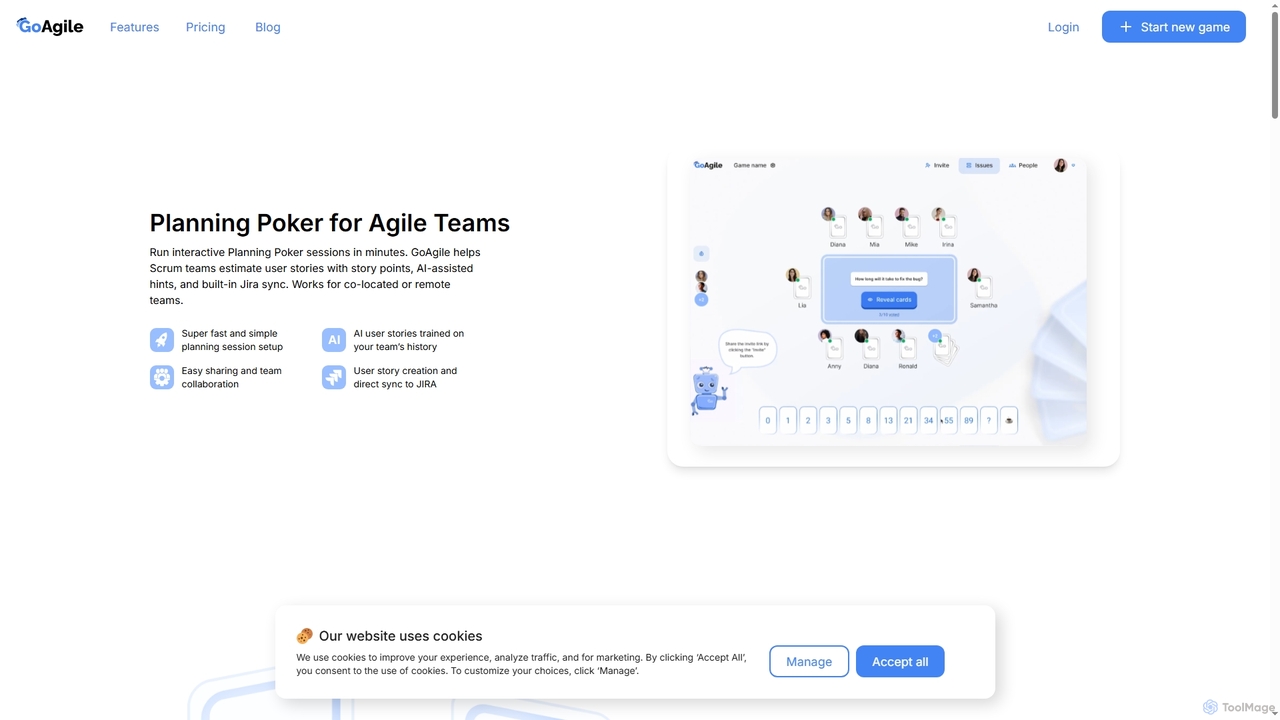
GoAgile is an online Planning Poker tool designed for Agile teams to streamline user story estimation. It features …

4.4K

About Agile Planning

Agile Planning tools are AI-powered platforms designed to optimize and streamline agile project management workflows. These tools leverage artificial intelligence to provide intelligent insights, automate routine tasks, and enhance decision-making across sprint planning, backlog management, and progress tracking. They empower agile teams to improve predictability, adapt quickly to changes, and deliver value more efficiently than traditional methods.

Core Features

  • AI-driven Backlog Prioritization: Automatically ranks user stories and tasks based on business value, dependencies, and team capacity.
  • Predictive Sprint Planning: Forecasts sprint completion rates and identifies potential bottlenecks using historical data and machine learning.
  • Automated Progress Tracking: Monitors task status, team velocity, and burndown charts in real-time, providing instant visibility.
  • Intelligent Resource Allocation: Suggests optimal task assignments based on individual skills, availability, and workload balance.
  • Proactive Risk Identification: Flags potential project risks and suggests corrective actions by analyzing patterns and deviations.

Applicable Scenarios

Agile Planning tools are indispensable for software development teams practicing Scrum or Kanban, enabling them to manage sprints, backlogs, and releases with greater precision. Marketing teams can use them to plan and execute iterative campaigns, while product management teams benefit from refining feature roadmaps and prioritizing development efforts based on data-driven insights.

How to Choose

When selecting an Agile Planning tool, prioritize solutions that offer robust support for your specific agile methodology (Scrum, Kanban, SAFe). Evaluate the depth of AI capabilities, such as predictive analytics and automation features, to ensure they align with your needs. Consider integration with existing development, communication, and project management ecosystems, along with the tool's scalability and customization options to fit your team's unique workflow.

Agile PlanningUse Cases

1

Optimizing Sprint Backlog Prioritization

Product owners and Scrum Masters can leverage AI-powered Agile Planning tools to analyze user stories, dependencies, and team velocity. The tool suggests optimal backlog prioritization, ensuring high-value features are addressed in upcoming sprints. This reduces manual effort in grooming sessions, improves alignment with strategic goals, and accelerates feature delivery by up to 20%.

2

Optimizing Software Sprint Cycles

Software development teams use Agile Planning tools to refine their sprint cycles. A lead developer can input user stories and epics, and the AI assists in breaking them down into manageable tasks, estimating effort, and distributing them across team members for an upcoming sprint. This ensures balanced workloads, identifies potential overcommitments, and helps predict sprint completion with higher accuracy, reducing delays and improving delivery predictability.

3

Optimizing Sprint Backlog for Software Development

A Software Development Lead or Product Owner manages a large product backlog with hundreds of features and bug fixes. Using an Agile Planning AI tool, they can analyze dependencies, estimated effort, and business value, automatically prioritizing the most impactful items for the next sprint. This ensures the team focuses on high-value tasks, reducing manual prioritization time by 50% and improving sprint goal achievement.

4

Optimizing Sprint Backlog for Software Development

A Scrum Master utilizes an AI Agile Planning tool to dynamically prioritize user stories and tasks for upcoming sprints. By inputting business value, estimated effort, and dependencies, the AI automatically ranks items, ensuring the development team focuses on the most impactful work. This process significantly reduces manual prioritization time and enhances sprint efficiency, leading to faster delivery of high-value features.

5

Predicting Project Timelines and Bottlenecks

Project managers can utilize Agile Planning tools with AI to forecast project timelines more accurately. By analyzing historical data on task completion, team capacity, and external dependencies, the AI identifies potential bottlenecks and suggests adjustments to the sprint plan. This proactive approach helps in setting realistic expectations and mitigating risks before they impact delivery, improving on-time completion rates by 15%.

6

Managing Product Feature Backlogs

Product managers leverage Agile Planning tools to dynamically manage and prioritize extensive product feature backlogs. By integrating market research data, customer feedback, and strategic business goals, the AI can suggest optimal sequencing for feature development. This allows product teams to continuously adapt their roadmap, ensuring that high-value features are always at the forefront of development, maximizing ROI and market responsiveness.

7

Predictive Resource Allocation for Marketing Campaigns

A Marketing Project Manager needs to plan multiple campaigns simultaneously, allocating designers, copywriters, and strategists. The AI tool analyzes team member availability, skill sets, and historical task completion rates to suggest optimal resource assignments for upcoming campaign sprints. This prevents team overload, balances workloads, and ensures critical campaign deliverables are met on time, improving resource utilization by 20%.

8

Predictive Resource Allocation in Marketing Campaigns

A marketing project manager employs the tool to intelligently allocate team members to various campaign tasks. The AI analyzes individual skill sets, historical performance, and current workloads to suggest optimal assignments, preventing bottlenecks and ensuring balanced distribution of effort. This proactive approach helps in timely campaign launches and maximizes team productivity.

9

Facilitating Cross-Functional Team Collaboration

For cross-functional teams, Agile Planning tools provide centralized platforms for shared backlogs, real-time progress tracking, and communication. AI features can highlight inter-team dependencies or potential communication gaps, prompting timely discussions. This fosters better alignment, reduces misunderstandings, and ensures all team members are synchronized on project goals, enhancing overall team productivity by 10%.

10

Coordinating Cross-Functional Marketing Campaigns

Marketing teams utilize Agile Planning tools to orchestrate complex, multi-channel campaigns. A marketing director can define campaign objectives and key deliverables, and the tool helps break these down into tasks for content creators, designers, and advertisers. The AI monitors progress across different channels, identifies dependencies, and alerts the team to potential bottlenecks, ensuring timely launch and consistent messaging across all platforms.

11

Dynamic Roadmap Adjustment for Product Managers

A Product Manager's roadmap needs constant updates based on market feedback, competitor analysis, and internal resource changes. Inputting new data points into the Agile Planning AI allows it to simulate different scenarios and suggest adjustments to feature timelines and release schedules. This enables rapid adaptation to market shifts, maintaining a realistic and responsive product roadmap, reducing planning cycle time by 30%.

12

Real-time Risk Identification in Product Launches

A product owner monitors a new feature launch using the tool's AI-driven risk analysis capabilities. The system continuously analyzes task progress, dependencies, and team velocity to identify potential delays or roadblocks before they escalate. This allows the product owner to implement corrective measures proactively, keeping the product launch on schedule and mitigating costly setbacks.

13

Adapting to Changing Market Demands

Product managers in dynamic markets can use Agile Planning tools to quickly re-prioritize features based on new market data or customer feedback. AI algorithms can analyze external trends and internal capacity to suggest optimal adjustments to the product roadmap and sprint plans. This enables organizations to remain agile and responsive, reducing time-to-market for critical updates by up to 25%.

14

Facilitating Remote Team Collaboration

Distributed agile teams rely on these tools to maintain seamless collaboration and transparency. Team members from different time zones can update their task progress, log impediments, and participate in virtual stand-ups within the platform. The AI aggregates individual contributions into a unified project view, making it easy for scrum masters to track overall velocity, identify areas needing support, and keep everyone aligned on project goals, regardless of location.

15

Automated Daily Stand-up Summaries for Distributed Teams

A Scrum Master or Team Lead of a globally distributed agile team often struggles with consistent daily stand-ups due to time zone differences and varying participation. Team members can update their progress in the AI planning tool, which then generates a concise, AI-summarized daily stand-up report, highlighting progress, blockers, and upcoming tasks. This ensures all team members are informed, even asynchronously, fostering transparency and reducing the need for lengthy synchronous meetings.

16

Automating Daily Stand-up Reporting

Development teams leverage the tool to automatically generate concise daily progress reports based on individual task updates and completed work. This eliminates the need for manual report compilation, freeing up valuable time during daily stand-ups. The automated reports provide a clear, real-time overview of team progress and highlight any immediate blockers for discussion.

17

Streamlining Release Planning and Deployment

DevOps teams and release managers benefit from Agile Planning tools by gaining a clear overview of upcoming releases. The tools help in coordinating deployment schedules, managing dependencies across multiple teams, and identifying potential conflicts. AI can predict the likelihood of successful deployments based on past performance, ensuring smoother releases and reducing post-deployment issues by 18%.

18

Adapting to Changing Project Requirements

Project managers in dynamic environments use Agile Planning tools to quickly pivot when requirements shift. If a critical stakeholder requests a major change mid-sprint, the AI can rapidly re-evaluate the impact on existing tasks, dependencies, and timelines. It then suggests alternative sprint plans or backlog adjustments, allowing the team to respond effectively to new demands without derailing the entire project, maintaining agility and client satisfaction.

19

Identifying Bottlenecks in Cross-functional Sprints

A Project Coordinator or Team Lead of a cross-functional team (e.g., design, development, QA) working on a complex feature often experiences delays without clear reasons. The Agile Planning AI analyzes task dependencies, individual progress, and historical data to pinpoint specific tasks or team members causing bottlenecks in real-time. This allows for proactive intervention, reallocation of resources, or adjustment of expectations, preventing sprint failures and improving delivery predictability.

20

Enhancing Release Planning for Large Enterprises

An enterprise architect uses the tool to plan complex software releases across multiple agile teams and departments. The AI visualizes cross-team dependencies and potential integration conflicts, suggesting optimized sequencing for release trains. This ensures smoother coordination, reduces integration issues, and accelerates the deployment of new features across the organization.

21

Enhancing Resource Allocation and Load Balancing

Team leads and resource managers can use Agile Planning tools to optimize resource allocation across different sprints and projects. AI algorithms analyze individual team member skills, availability, and current workload to suggest balanced task assignments. This prevents burnout, maximizes team efficiency, and ensures critical tasks are assigned to the most suitable personnel, leading to a 12% improvement in resource utilization.

22

Efficient Onboarding of New Team Members

When new members join an agile team, these tools streamline their onboarding process. A new developer can quickly access the current sprint backlog, understand task priorities, and see the overall project roadmap. The tool can even suggest initial tasks based on their skill set and current team needs, helping them integrate faster, contribute meaningfully from day one, and understand the team's agile workflow without extensive manual guidance.

23

Estimating Project Completion Dates with AI Accuracy

Stakeholders or Senior Management often need accurate project completion estimates, but traditional methods are frequently inaccurate due to changing requirements. The AI planning tool continuously learns from past sprint velocities, task complexities, and team performance to provide dynamic, data-driven predictions for project completion dates. This offers more reliable timelines, enhances stakeholder trust, and allows for better strategic planning based on realistic delivery expectations.

24

Facilitating Remote Team Collaboration and Transparency

Distributed agile teams rely on the tool's centralized dashboard and automated update features to maintain high transparency. Team members can easily track individual contributions, project status, and upcoming tasks from anywhere. This fosters better communication, ensures everyone is aligned on goals, and improves overall collaboration in a remote work environment.

Agile PlanningFrequently Asked Questions