Geekbot
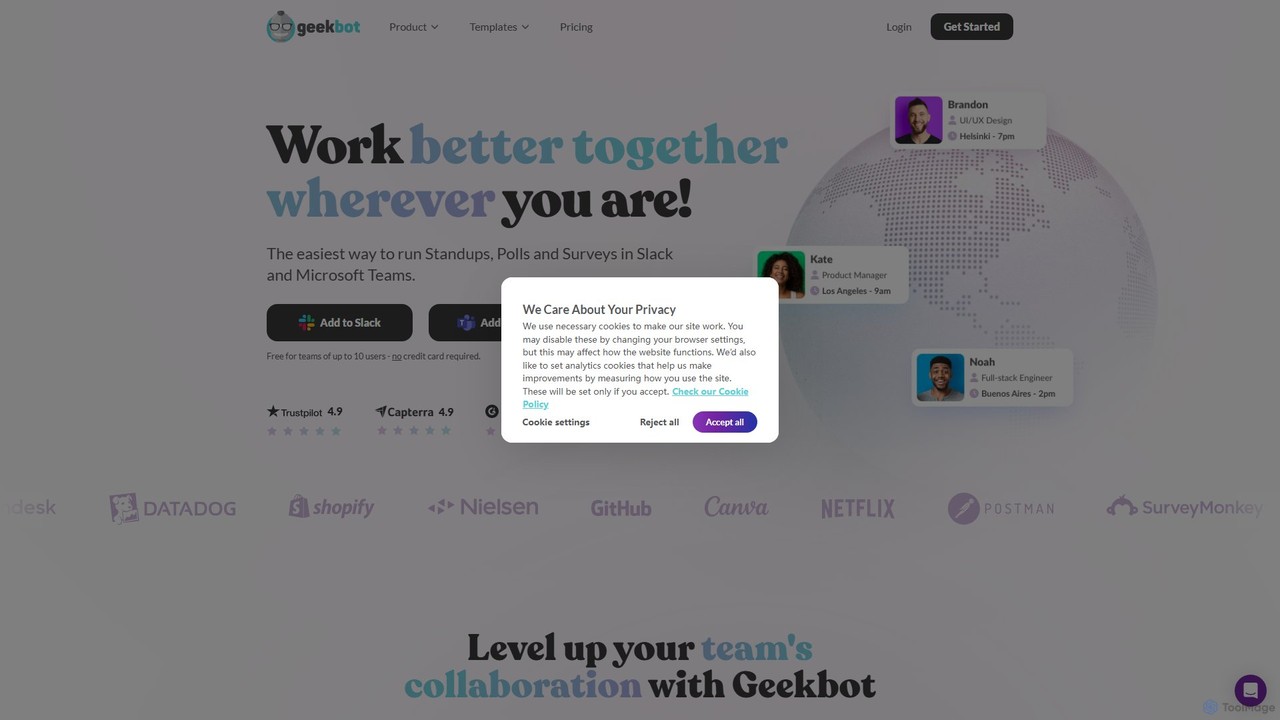
Geekbot is an AI-powered assistant for running asynchronous stand-up meetings, surveys, and polls directly within Slack and Microsoft …
Geekbot is an AI-powered assistant for running asynchronous stand-up meetings, surveys, and polls directly within Slack and Microsoft Teams. It helps remote and hybrid teams stay synchronized, track progress, and foster a culture of transparent communication without the need for constant meetings.
About Agile Tools
Agile Tools are a specialized category of project management software designed to support iterative development and continuous delivery using methodologies like Scrum and Kanban. These tools leverage AI to automate workflows, provide predictive insights, and enhance team collaboration in dynamic environments. By analyzing historical data and real-time progress, they help teams improve sprint planning, identify potential risks, and optimize resource allocation. This data-driven approach allows for greater adaptability and efficiency compared to traditional project management methods.
Core Features
- Intelligent Sprint Planning: AI suggests story points, predicts team velocity, and helps balance workloads for upcoming sprints.
- Predictive Analytics: Forecasts project completion dates, identifies potential bottlenecks, and analyzes risks based on historical performance.
- Automated Workflows: Automatically updates task statuses, assigns sub-tasks from user stories, and generates progress reports.
- Enhanced Collaboration: Summarizes communication threads, suggests relevant documentation, and identifies dependencies between tasks and teams.
- Data-Driven Retrospectives: Provides objective insights into sprint performance, highlighting recurring issues and areas for improvement.
Use Cases
AI-powered Agile Tools are primarily used by software development teams, product management departments, and marketing agencies. They are ideal for projects with evolving requirements, such as developing a new mobile application, managing a multi-channel digital marketing campaign, or executing a product design sprint where rapid iteration is key.
How to Choose
When selecting an Agile Tool, consider its support for your specific methodology (Scrum, Kanban, SAFe). Evaluate the depth of its AI features—whether they offer simple automation or advanced predictive analytics. Assess its integration capabilities with your existing toolchain, such as code repositories (Git) and CI/CD pipelines. Finally, consider the tool's scalability to support your team's size and future growth.

Agile ToolsUse Cases
AI-Assisted Sprint Planning for Software Teams
A Scrum Master for a mobile app development team uses an AI Agile Tool to prepare for the next two-week sprint. Instead of manually estimating story points for each backlog item, the tool analyzes historical data from similar tasks and suggests estimates, reducing subjective bias. The AI also simulates the sprint based on team member availability and predicted velocity, highlighting a potential overload on a specific developer. This allows the Scrum Master to proactively rebalance the workload, leading to a more realistic and achievable sprint plan, cutting planning time by over 30%.
Automating Kanban Board for Marketing Campaigns
A marketing team uses a Kanban-style Agile Tool to manage content creation for a product launch. The AI integrates with their email and document approval systems. When a blog post draft is sent for review via email, the AI automatically moves the corresponding card on the Kanban board from 'In Progress' to 'In Review'. Once the final approval email is detected, the card is moved to 'Done'. This automation eliminates manual updates, ensures the board always reflects the true status of tasks, and allows the marketing manager to see bottlenecks in the review process at a glance.
Predictive Risk Analysis for a Product Launch
A Product Owner is overseeing a complex project with multiple feature dependencies. They use an AI Agile Tool's predictive analytics feature. The tool analyzes the current progress, team velocity, and the dependency graph between user stories. It flags a critical path of tasks that has a 75% probability of delaying the launch date. The report also suggests which lower-priority, independent tasks could be postponed to free up resources for the critical path. This foresight allows the Product Owner to facilitate a discussion with stakeholders to adjust scope or reallocate resources weeks in advance, preventing a last-minute crisis.
Generating User Stories from High-Level Requirements
A Business Analyst is tasked with breaking down a high-level feature requirement, such as 'Improve user profile page,' into actionable user stories for the development team. They input this requirement into an AI Agile Tool. The AI, trained on thousands of software development projects, generates a set of well-structured user stories, like 'As a user, I want to upload a profile picture so I can personalize my account,' complete with standard acceptance criteria. This process transforms a vague requirement into a clear, structured backlog in minutes, saving the analyst hours of manual writing and ensuring consistency in story format.
Optimizing Team Retrospectives with AI Insights
An Agile Coach wants to make sprint retrospectives more data-driven. Their AI Agile Tool analyzes data from the completed sprint, including task completion times, communication patterns in linked chat tools, and the number of tasks that were pushed to the next sprint. It generates a report highlighting that 'tasks related to API integration were consistently underestimated' and that 'communication dropped significantly on Fridays'. The coach presents these objective findings to the team, sparking a more focused and productive discussion on specific process improvements rather than relying solely on subjective feelings and memories.
Dynamic Resource Allocation Across Multiple Teams
A Program Manager at a large tech company oversees five agile teams working on a single product. An unexpected critical bug is found, requiring immediate attention from a specialist. The manager uses an AI Agile Tool that has visibility into all team backlogs and skillsets. The AI identifies a developer on a different team with the required skills who is currently working on a low-priority task. It recommends a temporary reassignment and shows the calculated impact on the other team's sprint. This enables the manager to make a quick, data-informed decision to resolve the critical issue while minimizing disruption across the program.