Architechtures
Architechtures is a generative AI-powered building design platform that enables architects and real estate developers to create optimal …
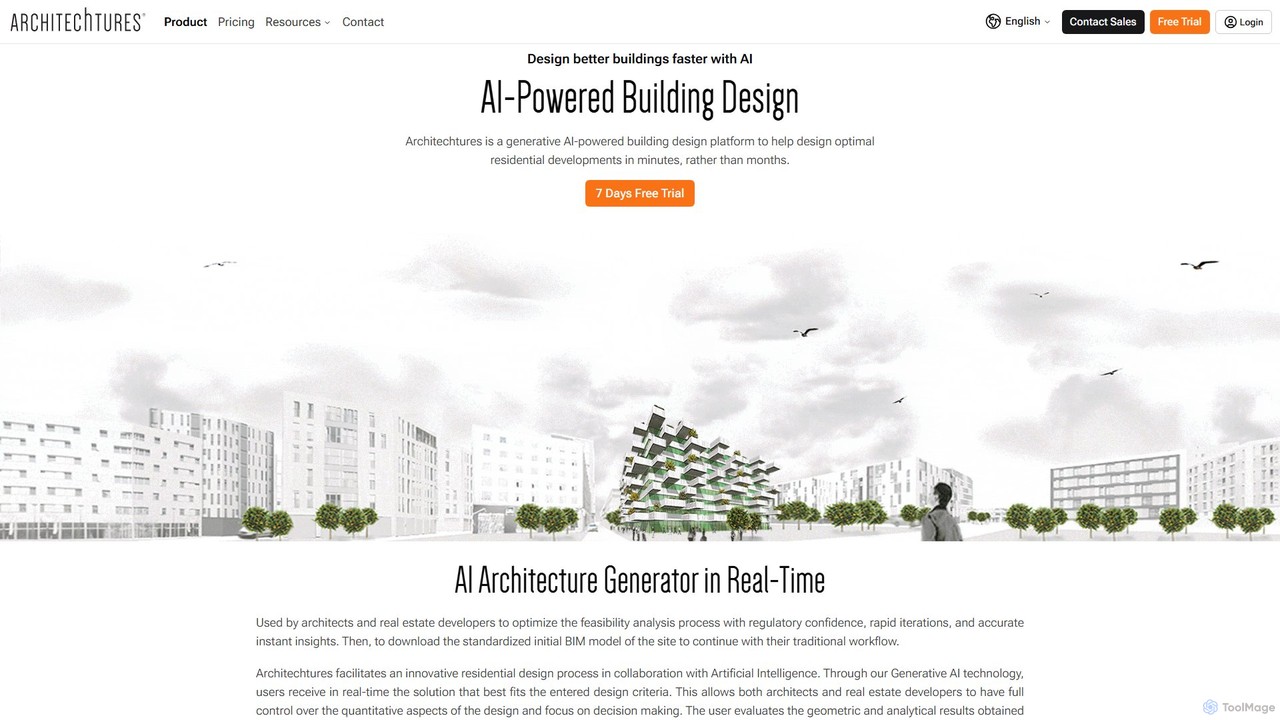
Architechtures is a generative AI-powered building design platform that enables architects and real estate developers to create optimal residential building designs in minutes. It automates the early-stage design process, providing real-time BIM models, data analytics, and cost estimations to accelerate decision-making and improve project feasibility.
About Development
AI Real Estate Development tools are specialized platforms that leverage artificial intelligence to analyze, plan, and manage property development projects. These tools process vast datasets, including market trends, zoning regulations, and geographic information, to provide data-driven insights for decision-making. They help developers, investors, and architects optimize site selection, design, and financial forecasting, significantly reducing risks and improving project ROI. This technology transforms traditional development workflows by introducing predictive analytics and automated optimization.
Core Features
- Site Feasibility Analysis: Uses AI to evaluate potential development sites based on demographic data, market value, zoning laws, and environmental factors.
- Generative Design: Automatically creates optimized building layouts, floor plans, and site configurations that meet predefined constraints like budget, regulations, and sustainability goals.
- Financial Modeling & Forecasting: Employs machine learning to predict project costs, rental income, property values, and return on investment with greater accuracy.
- Construction Management & Monitoring: Utilizes computer vision and data analysis to track construction progress, identify potential delays, and ensure quality control.
- Regulatory Compliance Automation: Scans architectural plans and project documents to automatically check for compliance with local building codes and zoning ordinances.
Use Cases
These tools are primarily used by real estate developers, investment firms, architectural companies, and construction managers. For example, a developer can use an AI tool to identify the most profitable location for a new mixed-use complex, while an architect can use generative design to quickly iterate through hundreds of efficient building layouts. They are essential for large-scale urban planning and commercial property development.
How to Choose
When selecting an AI Real Estate Development tool, consider the accuracy and scope of its data sources (e.g., GIS, market data). Evaluate its integration capabilities with existing software like BIM and CAD. Assess the sophistication of its financial modeling and generative design features. Finally, consider the user interface's complexity and whether it aligns with your team's technical expertise.

DevelopmentUse Cases
Identifying High-Potential Development Sites
A real estate development firm aims to find undervalued land parcels for a new residential project in a competitive urban market. Using an AI development tool, their analysts input criteria such as zoning for multi-family housing, proximity to public transit, school district ratings, and projected population growth. The AI platform analyzes thousands of parcels, layering GIS data with market trends and demographic shifts. Within hours, it generates a shortlist of the top 5 most promising sites, complete with preliminary financial feasibility reports, saving weeks of manual research and providing a significant competitive advantage.
Optimizing Apartment Building Layouts with Generative Design
An architectural firm is tasked with designing a cost-effective and highly livable apartment building on a challenging urban lot. Instead of manually drafting a few options, they use an AI generative design tool. They define key parameters: number of units, unit mix (1-bed, 2-bed), natural light exposure requirements, structural constraints, and budget limits. The AI then generates hundreds of valid floor plan and massing options, each optimized for different variables like construction cost, spatial efficiency, or resident comfort. Architects can then explore these AI-generated solutions to find an innovative design that would be difficult to discover through traditional methods.
Predicting Construction Delays and Cost Overruns
A large construction company managing a high-rise project uses an AI-powered project management tool to mitigate risks. The platform integrates with their existing scheduling software, financial systems, and on-site sensors. It continuously analyzes data streams, including weather forecasts, supply chain logistics, labor availability, and daily progress reports. The AI model identifies patterns that indicate a high probability of future delays or cost overruns, such as a specific subcontractor consistently falling behind schedule. It then alerts the project manager with specific, actionable recommendations, allowing them to proactively address issues before they impact the project's timeline and budget.
Automating Zoning Compliance Reviews
A municipal planning department is overwhelmed with building permit applications, leading to long review cycles. They implement an AI tool designed for regulatory compliance. Architects and developers can now upload their digital building plans (like BIM or CAD files) directly to the system. The AI automatically scans the plans against the city's entire zoning code, checking for violations in height, setbacks, floor area ratio, and parking requirements. It generates an instant compliance report, highlighting specific areas of non-compliance. This reduces the manual review time for city planners by over 70% and allows developers to get faster feedback, accelerating the entire development process.
Conducting Rapid Financial Feasibility Studies
A real estate investment trust (REIT) needs to quickly evaluate dozens of potential acquisition and development opportunities each month. They use an AI financial modeling tool to streamline this process. An analyst inputs basic project data: location, property type, estimated construction costs, and target rental rates. The AI platform instantly pulls relevant market data, comparable sales, and operating expense benchmarks. It then generates a comprehensive pro forma financial model, including cash flow projections, IRR, and sensitivity analysis under various economic scenarios. This allows the investment committee to assess the viability of a project in minutes rather than days, enabling them to act faster on promising deals.
Monitoring Construction Progress with Drones and AI
A project manager for a large industrial park development uses an AI platform integrated with drone technology. Weekly drone flights capture high-resolution imagery of the entire construction site. This imagery is uploaded to the AI tool, which automatically compares the current state of construction against the 4D BIM (Building Information Modeling) schedule. The system identifies discrepancies, such as a foundation being poured behind schedule or materials being stored in the wrong location. It generates a visual progress report, highlighting potential issues on a digital twin of the site, enabling the manager to make timely interventions and keep stakeholders informed with accurate, visual data.