ToolMage
Sign in

Best 1 Photography AI tools for Real Estate

Popular Photography AI tools in Real Estate include Dropply, helping you work more efficiently.

Dropply
Freemium

Dropply

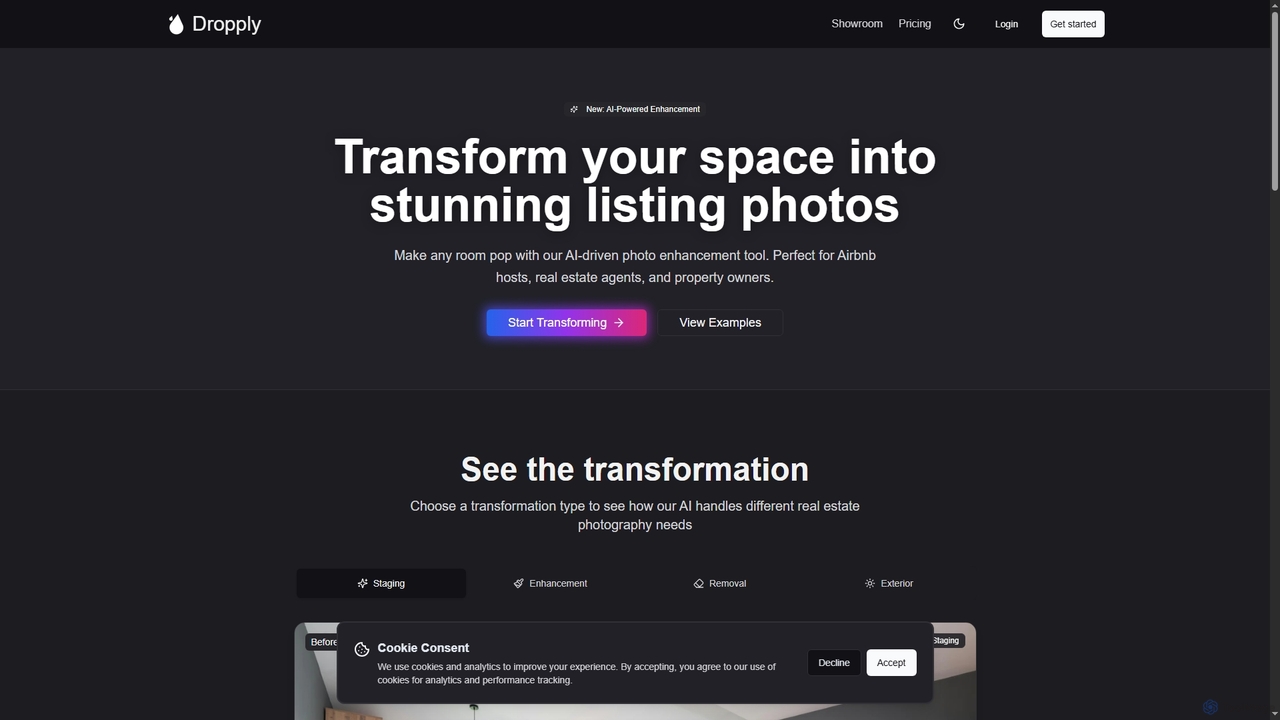
Dropply is an AI-powered tool designed for real estate professionals and property owners. It transforms standard property photos into stunning listing images through features like virtual staging, smart enhancement, object removal, and exterior improvements, all within seconds.

Visual Content
Visits 5.7KFavorites 158Likes 153

About Photography

AI-powered Photography tools for real estate are specialized solutions designed to optimize visual content for property listings and marketing. Leveraging advanced artificial intelligence, these tools automate and enhance various aspects of real estate imagery, from initial capture to final presentation. They significantly improve image quality, reduce manual editing time, and enable the creation of compelling visuals that attract potential buyers and renters.

Core Features

  • Image Enhancement: Automatically correct lighting, color balance, sharpness, and remove imperfections in property photos.
  • Virtual Staging: AI-generates realistic furniture and decor into empty rooms, showcasing a property's potential without physical staging.
  • Object Removal: Intelligently identify and eliminate unwanted objects, clutter, or personal items from real estate images.
  • Sky Replacement: Seamlessly replace dull or overcast skies with vibrant, appealing ones to enhance curb appeal.
  • Floor Plan Generation: Convert property photos or scans into detailed 2D or 3D floor plans.

Applicable Scenarios

Real estate agents, photographers, and marketing professionals utilize these tools to streamline their workflow and elevate property presentations. They are essential for creating high-quality, consistent visual assets across large portfolios, preparing properties for online listings, and developing immersive virtual tours.

How to Choose

When selecting AI Photography tools for real estate, consider the specific features offered, such as virtual staging accuracy or image enhancement capabilities. Evaluate integration with existing CRM or listing platforms, ease of use for non-technical users, and the pricing model based on usage volume. Look for tools that provide consistent, high-quality output and offer robust customer support.

Photography use cases

1

Batch Optimization for Property Listing Photos

Real estate agents or marketing teams often need to prepare high-quality images for numerous property listings quickly. AI photography tools can automatically adjust exposure, color balance, and sharpness in bulk, applying consistent style filters to ensure all images are professional and appealing. This significantly shortens the time required to prepare properties for market, ensuring visual consistency across all listings.

2

Virtual Staging for Empty Homes

Real estate agents use AI virtual staging tools to furnish vacant properties digitally. By uploading photos of empty rooms, the AI generates realistic furniture, decor, and lighting, helping potential buyers visualize the space's full potential and make emotional connections without the cost and effort of physical staging. This significantly reduces listing time and broadens buyer appeal.

3

Virtual Staging for Empty Homes

A real estate agent needs to market an empty property. Instead of costly physical staging, they use AI virtual staging tools to digitally furnish rooms with stylish, realistic furniture and decor. This allows potential buyers to visualize the space's potential, significantly increasing interest and reducing time on market.

4

Automated Image Enhancement for Listings

A property photographer captures hundreds of photos daily. AI photography tools automatically correct lighting, exposure, color, and sharpness across all images, ensuring a professional and consistent look. This saves hours of manual post-processing, allowing faster listing updates and higher quality visuals.

5

Virtual Staging for Empty Properties

For vacant or unfurnished properties, AI virtual staging tools can intelligently recognize room structures and add style-matched virtual furniture, decorations, and lighting. This allows potential buyers to easily visualize themselves living in the space, significantly enhancing the property's appeal and accelerating the sales process by making empty rooms feel warm and inviting.

6

Automated Image Enhancement for Listings

Property managers and agents leverage AI photography tools to automatically correct lighting, color balance, and sharpness across hundreds of property photos. This ensures consistent, high-quality visuals for all online listings, saving hours of manual editing per property and presenting every listing in its best light to attract more views and inquiries.

7

Sky and Landscape Optimization

Real estate photographers utilize AI to instantly replace dull or overcast skies with vibrant, appealing ones in exterior property shots. The AI seamlessly integrates new skies, enhancing curb appeal and making properties look more inviting, especially crucial for luxury listings or homes with significant outdoor space, without needing to reshoot.

8

Removing Distracting Elements from Photos

Real estate photographers or agents may encounter clutter, vehicles, or imperfect weather during shoots. AI photography tools can intelligently identify and remove unnecessary objects like trash cans, power lines, or even people from photos, or replace dull skies. This ensures property photos are clean, professional, and free from distractions, presenting the property in its best possible light.

9

Removing Unwanted Objects from Property Photos

An agent takes photos of a property, but there's a stray trash can or an owner's personal item in the frame. AI object removal tools intelligently detect and seamlessly erase these distractions, presenting a cleaner, more appealing image of the property without needing a reshoot or complex manual editing.

10

Object Removal for Clutter-Free Spaces

Home sellers or agents employ AI object removal features to eliminate unwanted items like personal belongings, trash cans, or temporary signs from property photos. This creates clean, uncluttered images that allow potential buyers to focus solely on the property's features, making spaces appear more spacious and appealing.

11

Enhancing Drone Photography for Aerial Views

A real estate developer uses drones to capture aerial views of large land parcels or luxury properties. AI photography tools process these drone images, enhancing clarity, correcting distortions, and optimizing colors to highlight property boundaries, amenities, and surrounding landscapes, making the aerial views more impactful.

12

Generating Immersive Virtual Tours

Real estate developers or luxury property sales teams aim to offer experiences beyond traditional images. AI tools can intelligently stitch multiple property photos together to generate 360-degree panoramic views or virtual tours. This allows clients to explore properties immersively online, significantly improving viewing efficiency and conversion rates by providing a comprehensive, interactive experience.

13

Generating 3D Virtual Tours from 2D Photos

Developers and marketing teams use AI to construct immersive 3D virtual tours from a series of standard 2D property photos or floor plans. This provides prospective buyers with an interactive, walk-through experience of the property from anywhere, significantly increasing engagement and reducing the need for preliminary physical viewings.

14

Automating Property Photo Background Replacement

For marketing needs that require highlighting the property's main structure or maintaining a consistent brand style, AI photography tools can automatically identify the property building, intelligently cut it out, and replace the background. For instance, a city background can be replaced with a natural landscape, or a uniform brand color can be applied, enhancing the visual impact of promotional materials and creating a cohesive aesthetic.

15

Generating Interactive 3D Tours from 2D Photos

A marketing specialist wants to create an immersive online experience for potential buyers. They use AI tools that can stitch together 2D property photos and generate interactive 3D virtual tours or floor plans. This provides a comprehensive view of the property layout and flow, engaging viewers more effectively than static images.

16

Quickly Generating Floor Plans from Photos

Real estate agents or designers often need to quickly convert property photos into clear floor plans. AI tools can analyze interior photos, automatically identify walls, doors, windows, and room layouts, and then generate accurate 2D or even 3D floor plans. This helps clients visually understand the space structure, improving communication efficiency and providing a valuable asset for property listings.

17

Batch Processing for Large Property Portfolios

A large real estate agency manages thousands of listings. AI photography tools enable batch processing of images for consistent branding and quality. They can apply predefined styles, watermarks, and enhancements to entire sets of photos, ensuring uniformity and efficiency across their extensive portfolio.

18

Creating AI-Generated Property Marketing Videos

Real estate marketers use AI photography tools to transform a collection of enhanced property images into dynamic marketing videos. The AI can add transitions, background music, and text overlays, generating professional-grade video content for social media and website promotion quickly and cost-effectively, showcasing properties in an engaging narrative format.

Photography FAQ

What are AI Photography tools for Real Estate?

AI Photography tools for Real Estate are specialized software solutions that use artificial intelligence to automate and enhance the visual content creation process for properties. They leverage algorithms for tasks like image correction, virtual staging, object removal, and 3D tour generation, aiming to produce high-quality, appealing property visuals more efficiently. These tools help real estate professionals create stunning listings, attract buyers, and streamline their marketing efforts.

What are AI photography tools for real estate?

AI photography tools for real estate are specialized software applications that leverage artificial intelligence to automate and enhance the creation, editing, and presentation of property images. They are designed to improve the visual quality of listings, streamline workflows for real estate professionals, and create more engaging content for potential buyers. These tools often include features like image enhancement, virtual staging, and object removal.

What are AI Photography tools for Real Estate?

AI Photography tools for Real Estate are software or platforms that leverage artificial intelligence to optimize and automate the processing of property images and videos. They perform tasks such as image enhancement, virtual staging, background replacement, and object removal, specifically designed to improve the quality and efficiency of visual content for the real estate industry. Their goal is to better showcase properties and attract potential buyers.

How do AI Photography tools specifically benefit real estate agents?

AI Photography tools offer significant benefits to real estate agents by saving time and improving listing quality. Agents can quickly enhance photos, virtually stage empty rooms, and remove clutter without professional editing skills or expensive physical staging. This leads to more attractive listings, faster sales cycles, increased buyer interest, and a more professional brand image, allowing agents to focus more on client interactions.

How to choose the right AI Photography tool for Real Estate?

When selecting an AI photography tool for real estate, prioritize core functionalities such as high-quality virtual staging, precise object removal, intelligent image enhancement, and sky replacement. Evaluate its ease of use, level of automation, and processing speed to suit the fast-paced real estate environment. Also, consider its integration capabilities with existing workflows (e.g., CRM or listing platforms), pricing models, and customer support to ensure it meets your specific needs.

How do AI photography tools differ from traditional photo editing for real estate?

Traditional photo editing relies heavily on manual adjustments by a human editor, requiring significant time and skill. AI photography tools, conversely, automate many of these tasks using algorithms to analyze and modify images. While traditional editing offers granular control, AI tools provide speed, consistency, and scalability, often achieving professional results in a fraction of the time, especially for repetitive tasks like sky replacement or basic enhancements.

What is virtual staging, and how does AI make it better?

Virtual staging is the process of digitally adding furniture and decor to photos of empty rooms. AI makes virtual staging better by generating highly realistic and contextually appropriate furnishings that match the room's style and lighting. Unlike traditional virtual staging, AI can often offer more diverse design options, faster rendering times, and a more natural integration of virtual elements, making the staged images almost indistinguishable from physically staged ones.

What core features do Real Estate AI Photography tools typically have?

Real Estate AI photography tools typically include several core features. These are: Image Enhancement for automatic adjustments to brightness, contrast, and color; Virtual Staging to add virtual furniture to empty rooms; Object Removal for intelligently erasing clutter or unwanted elements; Sky Replacement to improve outdoor photos; 3D Virtual Tour Generation by stitching multiple photos; and Floor Plan Generation from interior photos for clear layout visualization. These features collectively streamline visual content creation for properties.

What key features should I look for in real estate AI photography software?

When choosing real estate AI photography software, prioritize features like robust image enhancement (lighting, color, sharpness), accurate virtual staging capabilities, and efficient object removal. Also consider tools that offer sky replacement, floor plan generation from photos, and batch processing for large volumes. Integration with your existing CRM or listing platforms, ease of use, and a clear pricing structure are also crucial considerations.

Can AI photography tools really make empty rooms look furnished?

Yes, AI photography tools can realistically furnish empty rooms through a process called virtual staging. These tools use AI algorithms to analyze the dimensions and lighting of an empty room and then digitally insert 3D models of furniture, decor, and accessories. The result is a highly convincing image that helps potential buyers visualize how the space could look, often indistinguishable from physically staged photos, but at a much lower cost and faster turnaround.

Can AI Photography tools replace professional real estate photographers?

While AI Photography tools significantly enhance efficiency and quality for many tasks, they are generally seen as complementary to, rather than a full replacement for, professional real estate photographers. AI excels at automation and specific enhancements, but a professional photographer brings creative vision, expertise in composition, lighting, and understanding unique property angles, which AI currently cannot fully replicate. They often work together, with AI tools refining the professional's output.

What benefits do AI Photography tools bring to Real Estate sales?

AI Photography tools significantly boost real estate sales efficiency and effectiveness. By automating image processing, they drastically save post-production time and costs for photographers and agents. High-quality, professionally enhanced images and virtual tours more effectively capture potential buyers' attention, increasing click-through rates and viewing intentions. Virtual staging, in particular, helps buyers better visualize living scenarios, shortening decision-making time and accelerating the property sales cycle.

How do Real Estate AI Photography tools differ from general image editing software?

The main difference between Real Estate AI Photography tools and general image editing software (like Photoshop) lies in their specialization and automation level. General software offers broad editing functions requiring professional skills and extensive manual operations. Real Estate AI tools, however, are optimized for specific industry needs, with features like virtual staging, sky replacement, and object removal being highly automated and designed for property scenarios. They leverage AI algorithms to quickly complete complex tasks, lowering the technical barrier and making them more suitable for real estate professionals to produce professional visual content efficiently.

Who benefits most from using AI photography tools in real estate?

Real estate agents, brokers, property managers, and professional real estate photographers benefit significantly from AI photography tools. Agents and brokers can quickly create appealing listings without extensive editing knowledge. Photographers can automate repetitive tasks, focusing on capture. Marketing teams can generate consistent, high-quality visuals at scale. Ultimately, anyone involved in presenting properties visually can achieve better results more efficiently.

What's the difference between general AI image editing and AI Photography for Real Estate?

General AI image editing tools offer broad functionalities for various types of images, such as basic enhancements, style transfers, or content generation. AI Photography for Real Estate, however, is highly specialized. It focuses on features directly relevant to property visuals, like virtual staging, sky replacement, object removal specific to home clutter, and 3D tour creation from architectural layouts. Its algorithms are often trained on real estate datasets, making its outputs more accurate and relevant for property marketing.