ToolMage
Sign in

Best 1 Blog Writing AI tools for Seo

Popular Blog Writing AI tools in Seo include Simpler.ai, helping you work more efficiently.

Simpler.ai
Freemium

Simpler.ai

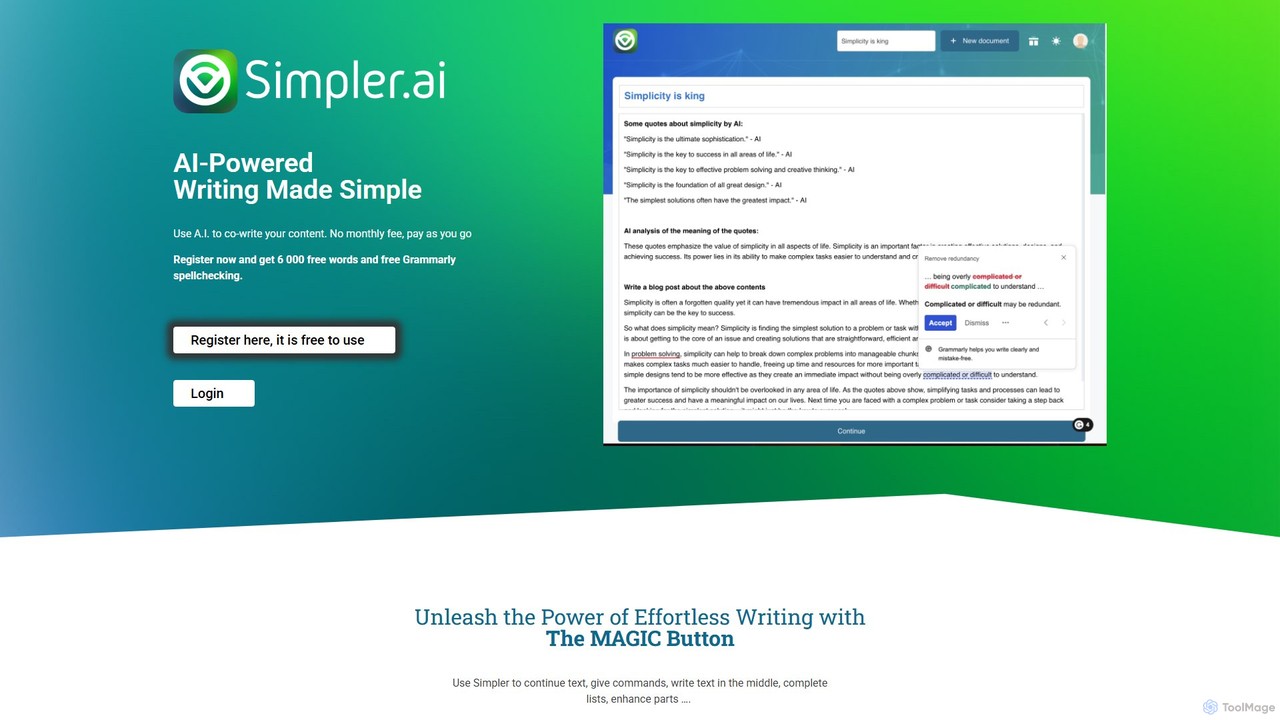
Simpler.ai is an AI-powered writing assistant with a distraction-free editor and a unique "MAGIC button" for seamless content co-creation. It offers integrated Grammarly spellchecking and a flexible pay-as-you-go pricing model, eliminating monthly subscriptions. Ideal for writers, marketers, and creators looking to overcome writer's block, generate ideas, and produce high-quality content efficiently.

Content Creation
Visits 7KFavorites 161Likes 137

About Blog Writing

AI Blog Writing tools are specialized applications designed to automate and assist in creating long-form, SEO-friendly articles. Leveraging advanced language models, these tools can generate complete blog posts from a simple prompt, including outlines, introductions, body paragraphs, and conclusions. They are engineered to accelerate the content creation process, helping marketers and writers maintain a consistent publishing schedule while optimizing content for search engines. Many platforms also integrate features for keyword research, readability analysis, and plagiarism checking to ensure the final output is high-quality, original, and effective.

Core Features

  • Full Article Generation: Creates complete, structured blog posts from a keyword or topic description.
  • SEO Content Optimization: Integrates target keywords naturally and provides suggestions to improve on-page SEO.
  • Outline & Brief Creation: Generates logical outlines with headings (H2, H3) to structure the article before writing.
  • Tone and Style Customization: Adapts the writing voice to match specific brand guidelines, from professional to conversational.
  • Plagiarism Checking: Scans the generated text against online sources to verify its originality.

Use Cases

These tools are widely used by content marketers, SEO specialists, freelance writers, and small business owners. For instance, a marketing team can use them to scale content production for multiple topic clusters, while a solo blogger can overcome writer's block and generate fresh ideas. They are particularly effective for creating foundational drafts that can then be enriched with human expertise and unique insights.

How to Choose

When selecting an AI Blog Writing tool, evaluate the quality and coherence of the generated text. Consider the depth of its SEO features, such as keyword density analysis and internal linking suggestions. Also, assess its integration capabilities with platforms like WordPress, its support for multiple languages, and whether its pricing model (based on word count or features) aligns with your content needs.

Blog Writing use cases

1

Automate SEO-Optimized Article Production

A content marketing manager needs to produce over ten high-quality, SEO-focused blog posts per month to support a new product launch. They use an AI Blog Writing tool to generate first drafts based on target keywords and detailed outlines. The tool automatically structures the articles with H2/H3 tags and integrates keywords naturally. This process reduces drafting time by over 70%, allowing the team to focus on editing, fact-checking, and adding unique insights, ultimately doubling their content output without increasing headcount.

2

Overcome Writer's Block for Niche Blogs

A solo blogger specializing in a niche topic, such as vintage watch collecting, often struggles with consistently generating fresh ideas. To overcome writer's block, they input a few core concepts into an AI blog writer. The tool generates multiple title ideas, a detailed outline, and an engaging introduction. This provides a solid foundation to build upon with personal expertise and stories, eliminating the 'blank page' problem and ensuring a steady flow of content to keep their audience engaged.

3

Scale Content Creation for a Digital Agency

A digital marketing agency manages content for multiple clients across different industries, each with a unique brand voice. To scale operations, the agency uses AI blog writing tools to create baseline drafts for each client. They customize the tone, style, and keyword focus for each project within the tool. This allows junior writers to handle a larger volume of work under the supervision of senior editors, increasing the agency's capacity to serve more clients without a proportional increase in headcount and improving overall profitability.

4

Generate Topic Clusters for Content Strategy

An SEO strategist aims to establish topical authority in a competitive market by creating a comprehensive pillar page and multiple supporting cluster articles. They use an AI tool's ideation features to brainstorm a list of related subtopics around a central theme. Then, the tool generates outlines and initial drafts for each cluster article, ensuring they are interlinked and cover the topic exhaustively. This process accelerates the creation of a complete topic cluster from weeks to just a few days, significantly strengthening the website's SEO performance.

5

Repurpose Webinars and Videos into Blog Posts

A corporate marketer has a library of valuable video content, such as webinars and interviews, but lacks the resources to manually transcribe and rewrite them into articles. They provide an AI blog writing tool with a transcript or a summary of the video. The tool then restructures the information into a well-organized, readable blog post format, complete with an introduction, key takeaways, and a conclusion. This efficiently maximizes the value of existing content assets by converting them into a new format, reaching a wider audience through search engines.

6

Create Multilingual Blog Content for Global Reach

An international e-commerce business wants to expand its blog's reach to non-English speaking markets but cannot afford professional translators for every article. The team first generates a high-quality article in English using an AI tool. Then, they use the same tool's multilingual capabilities to translate and adapt the blog post into several target languages, such as Spanish and German. While a final review by a native speaker is recommended, this process provides a cost-effective way to launch and maintain multilingual blogs, driving international traffic and engaging a global audience.

Blog Writing FAQ

What are AI Blog Writing tools?

AI Blog Writing tools are software applications that use artificial intelligence, specifically large language models, to generate long-form written content for blogs. They can produce everything from topic ideas and outlines to full-length articles. These tools are designed to assist content creators by automating the initial drafting process, optimizing content for SEO, and helping to overcome writer's block, thereby increasing content production efficiency.

How to choose the best AI tool for blog writing?

To choose the best tool, consider these factors:

  • Output Quality: Evaluate the coherence, accuracy, and readability of the generated content. The text should sound natural and require minimal editing.
  • SEO Features: Look for tools that offer keyword integration, content optimization suggestions, and SERP analysis to help your articles rank higher.
  • Customization: The ability to control tone, style, and perspective is crucial for matching your brand's voice.
  • Integrations: Check for integrations with platforms like WordPress, Google Docs, or plagiarism checkers to streamline your workflow.
  • Pricing: Compare plans based on your content volume. Some offer unlimited words, while others charge per word or article.
What's the difference between AI Blog Writers and general AI writers?

The main difference lies in their specialization. General AI writers (like those for social media or email) are optimized for short-form, versatile content. AI Blog Writers, however, are specifically designed for long-form content. They include features crucial for blogging, such as:

  • Generating structured articles with introductions, multiple sections, and conclusions.
  • Creating detailed outlines and content briefs.
  • Integrating SEO elements like keywords and meta descriptions.
  • Maintaining a consistent narrative flow over thousands of words.

In short, while a general writer can write a paragraph, a blog writer is built to construct a complete, coherent, and optimized article.

Can AI-generated blog content rank on Google?

Yes, AI-generated content can rank on Google. Google's guidelines state that they reward high-quality content, regardless of how it is produced. The focus is on whether the content is helpful, reliable, and demonstrates expertise, experience, authoritativeness, and trustworthiness (E-E-A-T). Using AI to generate a first draft is acceptable, but it's crucial for a human expert to review, edit, fact-check, and add unique insights to ensure the final article provides real value to the reader. Simply publishing raw AI output without human oversight is unlikely to perform well.

What are the key features of an effective AI Blog Writing tool?

An effective AI Blog Writing tool typically includes a combination of features designed for long-form content creation. Key features include:

  • Long-Form Generation: The ability to create articles exceeding 1,500 words with a coherent structure.
  • Outline Builder: Automatically generates a logical structure with H2 and H3 headings based on a topic.
  • SEO Integration: Tools for keyword research, density analysis, and on-page optimization suggestions.
  • Tone & Style Control: Options to adjust the writing to be formal, casual, witty, or any other brand-specific voice.
  • Fact-Checking & Source Citing: Advanced tools may offer features to verify information and cite sources, enhancing credibility.
  • Plagiarism Checker: An integrated tool to ensure the generated content is original.