
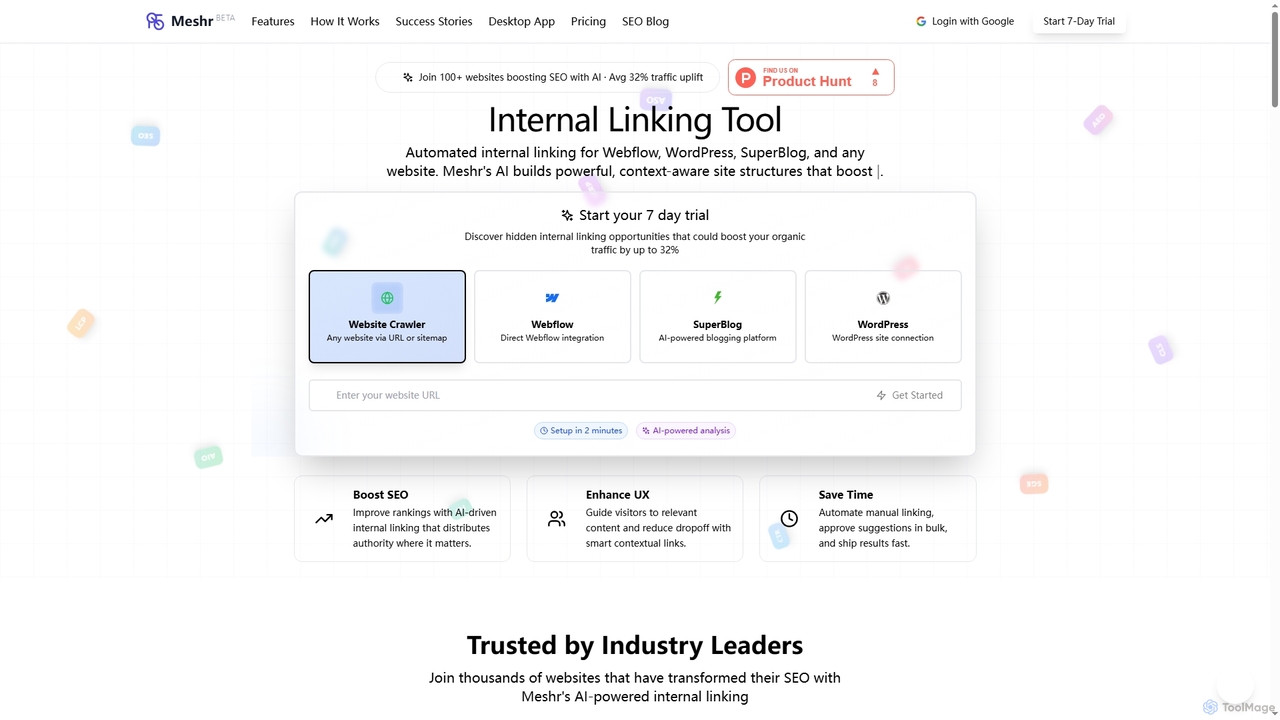
Seo Best in category 1 results Internal Linking AI Tool

Popular AI tools in the Internal Linking field of Seo include Meshr, etc., helping you quickly improve efficiency.

Meshr

Meshr

Meshr is an AI-powered internal linking tool designed to automate and optimize SEO for websites on platforms like …

2.6K

About Internal Linking

AI Internal Linking tools are a specialized category of SEO software that automates the creation and management of links between pages on the same website. Leveraging Natural Language Processing (NLP), these tools analyze your content to identify relevant linking opportunities and suggest contextually appropriate anchor text. They help improve site navigation for users, establish a clear information hierarchy for search engines, and distribute link equity effectively across your site. This significantly reduces the manual effort required to build a robust internal link structure, a critical factor for on-page SEO success.

Core Features

  • Automated Link Suggestions: The AI scans all content to find and recommend relevant internal linking opportunities.
  • Contextual Anchor Text Generation: Suggests SEO-friendly and contextually relevant anchor text for each link.
  • Orphan Page Identification: Discovers pages that have no incoming internal links, helping to integrate them into the site structure.
  • Internal Link Auditing: Monitors and reports on broken internal links, redirect chains, and overall link health.
  • Bulk Link Management: Provides options to implement or reject link suggestions across multiple pages at once.

Use Cases

These tools are particularly valuable for large content-driven websites such as news portals, extensive blogs, and major e-commerce platforms. SEO agencies also use them to efficiently manage the on-page SEO for multiple client websites, ensuring consistent and effective internal linking strategies without extensive manual labor.

How to Choose

When selecting an AI Internal Linking tool, consider its integration capabilities with your Content Management System (CMS) like WordPress or Shopify. Evaluate the level of automation—whether it's fully automatic or provides suggestions for manual approval. Also, assess the quality of its NLP analysis for relevance and the tool's ability to scale with your website's size and complexity.

Internal LinkingUse Cases

1

Strengthen Topical Authority for Niche Sites

An SEO manager for a specialized finance blog wants to establish topical authority on 'retirement planning.' They use an AI Internal Linking tool to scan all articles related to this topic. The tool identifies the main 'pillar page' and automatically suggests contextual links from dozens of related 'cluster' posts (e.g., articles on 401ks, IRAs) back to the pillar page. This creates a tightly-knit content hub, signaling deep expertise to search engines and improving rankings for competitive keywords.

2

Automating Link Building for a Large Content Blog

A content manager for a blog with over 2,000 articles finds it time-consuming to manually identify linking opportunities for each new post. Using an AI Internal Linking tool, the platform scans the new draft, analyzes its content via NLP, and suggests 5-10 highly relevant existing articles to link to. It also identifies older articles that could link to the new post, creating a reciprocal structure. This process reduces the time spent on internal linking by over 80%, improves the site's topical authority, and helps surface older, valuable content to both readers and search engines.

3

Automating Link Building for a Large Content Blog

For an SEO manager overseeing a blog with thousands of articles, manually creating a relevant internal link network is a daunting task. An AI Internal Linking tool automates this process by continuously scanning all content. When a new article is published, the tool identifies older, relevant posts and suggests contextually appropriate links and anchor text. This not only saves dozens of hours monthly but also revitalizes older content by driving new traffic to it, improving the site's overall topical authority and reducing orphan pages.

4

Automate Linking for Large E-commerce Catalogs

An e-commerce manager for a store with over 10,000 product pages struggles with internal linking. Using an AI tool, they set up rules to automatically link product descriptions to relevant buying guides and category pages. For instance, a 'hiking boots' page automatically gets a link to the 'waterproof socks' category and the 'How to Choose Hiking Boots' guide. This enhances user navigation and distributes link equity across the catalog, saving hundreds of manual hours.

5

Fixing Orphan Pages on an E-commerce Site

An e-commerce SEO manager discovers their site has numerous 'orphan pages'—product pages with no internal links pointing to them, making them invisible to search engines. An AI Internal Linking tool performs a full site crawl and generates a report of all orphan pages. For each one, it suggests contextually relevant parent category pages, blog posts about the product type, or related product pages to link from. By implementing these suggestions, the manager ensures all products are discoverable, improving indexation rates and distributing link equity more effectively across the site.

6

Establishing Topical Authority for Niche Websites

A niche site owner aiming to become an authority on a specific topic can use an AI tool to build a 'pillar and cluster' content model. The tool identifies the main 'pillar' page (e.g., 'The Ultimate Guide to Coffee') and automatically suggests links from all related 'cluster' articles (e.g., 'How to Use a French Press,' 'Best Espresso Beans'). This creates a tightly-knit topic cluster, signaling to search engines that the website has comprehensive expertise on the subject, which can significantly boost rankings for competitive head terms.

7

Rescue Orphaned Content After a Website Migration

After a major website redesign and migration, a technical SEO specialist discovers hundreds of 'orphaned' pages that lost their internal links. Instead of manually searching for linking opportunities, they run an AI Internal Linking tool. The tool quickly identifies all orphaned pages and provides a prioritized list of relevant pages from which to link, complete with suggested anchor text. This allows the team to quickly reintegrate valuable content into the site structure and recover lost traffic.

8

Building Topical Authority with Content Clusters

An SEO strategist aims to establish their company's website as an authority on 'cybersecurity'. This requires a pillar page and multiple supporting cluster articles. The AI tool helps visualize this structure by identifying the main pillar page and suggesting which supporting articles should link to it. It also recommends how the cluster articles should interlink with each other to form a cohesive topic group. This strategic linking signals to search engines that the site has comprehensive coverage of the topic, strengthening its perceived expertise and improving rankings for competitive keywords.

9

Optimizing E-commerce Site Structure

An e-commerce manager needs to guide users from informational blog posts to transactional product pages. An AI Internal Linking tool can scan blog articles for mentions of product categories like 'running shoes' or 'summer dresses' and automatically suggest links to the corresponding category or product pages. This not only improves user journey and conversion rates but also passes valuable link equity from high-traffic content pages to commercially important product pages, boosting their visibility in search results.

10

Boost New Content Visibility Immediately

A content marketing team publishes several new articles each week. To ensure new content gets indexed and ranked quickly, they use an AI tool as part of their publishing workflow. The tool analyzes the new article's content and instantly finds 5-10 high-authority, older articles on the site to link *from*. This process, known as 'internal link building,' funnels existing authority to the new posts, helping them gain traction in search results much faster.

11

Conducting a Site-Wide Internal Link Audit

A technical SEO analyst is preparing for a website migration and needs to prevent any loss of SEO value. They use an AI Internal Linking tool to crawl the entire site and generate a comprehensive audit. The report flags all broken links (404s), links pointing to unnecessary redirects, and identifies pages with a critically low number of incoming links. This provides a clear, actionable checklist to fix critical link errors before the migration, ensuring a smooth transition, preserving link equity, and improving the overall crawlability of the new site.

12

Conducting an Internal Link Audit at Scale

A technical SEO analyst for a large enterprise website needs to identify and fix widespread linking issues. Instead of manually crawling thousands of pages, they use an AI tool to perform a comprehensive audit. The tool quickly generates a report detailing all broken internal links (404s), links pointing to unnecessary redirect chains, and a complete list of orphan pages. This provides an actionable roadmap for technical fixes that improve crawl efficiency and user experience, a task that would otherwise take weeks to complete manually.

13

Optimize User Journeys from Blog to Product

A SaaS company's marketing team wants to improve conversions by guiding readers from their informational blog posts to their product pages. They use an AI Internal Linking tool to identify mentions of product features or user pain points within blog articles. The tool then suggests adding contextual links directly to the relevant product feature page or a free trial sign-up. This creates a seamless path for users, increasing lead generation from content marketing efforts.

14

Optimizing Anchor Text for Better Rankings

An SEO content writer notices that many internal links on their site use generic anchor text like 'click here' or 'read more', providing little contextual value to search engines. The AI tool scans all internal links and identifies these under-optimized anchor texts. For each instance, it suggests several keyword-rich, descriptive alternatives based on the content of the target page. The writer can then review and approve these changes in bulk, significantly improving the relevance signals sent to search engines and enhancing the ranking potential of key pages.

15

Managing Multilingual SEO Link Structures

An international SEO manager for a global brand must ensure that internal links stay within the correct language directory (e.g., /en/, /es/, /de/). Manually checking this across thousands of pages is prone to error. An AI tool can be configured to respect language boundaries, automatically suggesting links only between pages of the same language. This prevents cross-language linking issues that can confuse both users and search engine crawlers, ensuring a clean and effective international SEO architecture.

16

Diversify Anchor Text to Avoid Over-Optimization

An SEO consultant notices a client's website has an unnatural anchor text profile, with most internal links using the exact same keyword. This poses a risk of search engine penalties. The consultant uses an AI tool to audit all internal links. The tool's NLP capabilities suggest semantic variations and long-tail anchor texts that are more natural and descriptive. This helps diversify the anchor text profile, making the link structure appear more organic and improving overall SEO health.

17

Onboarding New Content Team Members

The head of content at a fast-growing company struggles with training new writers on the site's complex internal linking strategy. New hires are often unfamiliar with the hundreds of existing articles. By integrating an AI Internal Linking tool into their CMS, new writers receive real-time, context-aware suggestions as they draft articles. This acts as an automated guide, ensuring all new content is properly interlinked from day one. It standardizes the linking process, reduces the training burden, and helps new team members become productive more quickly.

18

Accelerating SEO Agency Workflows

An SEO agency managing dozens of client websites needs an efficient way to implement on-page strategies. Using an AI Internal Linking tool, agency professionals can quickly generate a baseline internal linking structure for new clients or identify improvement areas for existing ones. The tool's reporting features allow them to demonstrate clear progress to clients by showing reductions in orphan pages and improvements in link distribution. This scales their service delivery, allowing them to manage more clients effectively without a proportional increase in manual labor.

Internal LinkingFrequently Asked Questions