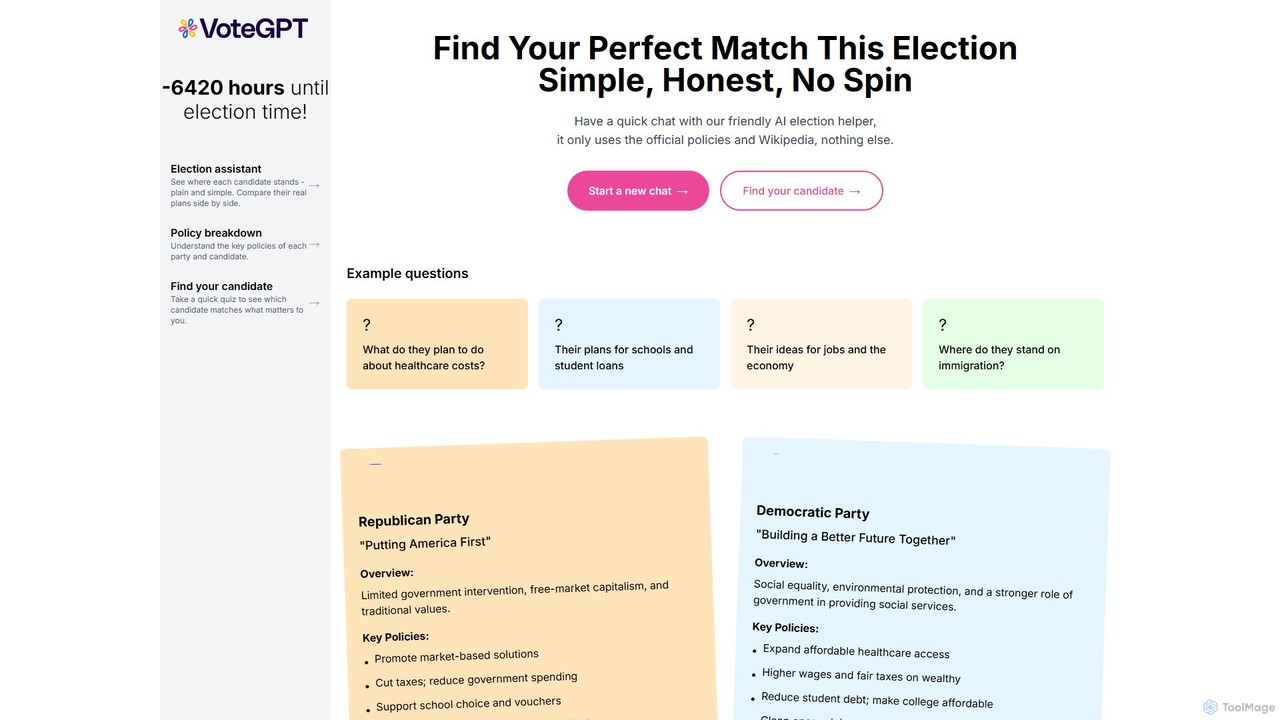
AI Politics tools are specialized applications designed to analyze political data, monitor public discourse, and forecast trends using artificial intelligence. These tools leverage natural language processing (NLP), sentiment analysis, and predictive modeling to process vast amounts of information from social media, news, and official documents. They provide actionable insights for political campaigns, researchers, journalists, and government agencies, enabling data-driven decision-making. Their unique strength lies in identifying subtle shifts in public opinion and detecting coordinated information campaigns in real-time.
Core Features
- Voter Sentiment Analysis: Gauges public opinion and emotional response towards candidates, parties, or policies.
- Misinformation Detection: Identifies and tracks the spread of false or misleading political narratives online.
- Trend & Narrative Tracking: Monitors emerging political topics and how they are framed across different media.
- Legislative Analysis: Processes and summarizes bills, laws, and policy documents to identify key points and potential impacts.
- Predictive Modeling: Uses historical and real-time data to forecast election outcomes or shifts in voter behavior.
Use Cases
These tools are primarily used by political campaign managers to refine messaging, policy analysts to understand legislative implications, and journalists to uncover trends and fact-check claims. Government bodies also use them to gauge public response to new policies, while academic researchers study political communication dynamics.
How to Choose
When selecting an AI Politics tool, consider the accuracy and scope of its data sources (e.g., social media platforms, news outlets). Evaluate the transparency of its analytical models and its ability to provide real-time analysis. Also, assess its compliance with data privacy regulations like GDPR and the ease of integrating its insights into your existing workflow.